

Why do teams composed of brilliant individuals so often retreat into the safety of mediocre results when the stakes are highest? It is a quiet tragedy in the modern workplace. The more we demand breakthrough thinking, the more the collective mind seems to narrow under the weight of unspoken cultural scripts. You likely recognize the frustration of watching a high-talent group produce "safe" work, not because they lack skill, but because the systemic cost of failure feels too high to bear. This psychological contraction is not a failure of talent. It is a survival mechanism that requires a deeper, more reflective intervention than typical brainstorming sessions can provide.
We agree that true transformation happens when we address the invisible dynamics beneath the surface. This article explores how team coaching for innovation and creativity, rooted in a systemic Transactional Analysis approach, can dissolve the unconscious blocks that stifle original thought. You'll discover a repeatable framework for building a culture where creative intelligence flourishes even under pressure. We will move through the psychological barriers of team scripts toward a state of systemic wholeness that allows for sustainable, repeatable innovation.
Key Takeaways
- Understand team coaching for innovation and creativity as a systemic intervention that addresses the deep psychological structures of a group rather than just teaching surface-level skills.
- Learn to identify how the "Critical Parent" ego state silences emerging ideas and how to cultivate the "Natural Child" to access genuine, uninhibited creative intelligence.
- Discover how to map and rewrite the "Team Script," the unconscious collective life plan that often prioritizes safety and survival over true innovation.
- Apply a multi-level contracting framework to establish the administrative and psychological boundaries required for teams to take risks under high-pressure conditions.
- Explore the path toward systemic mastery by integrating agile Transactional Analysis into your coaching practice through EMCC-accredited senior practitioner training.
The Psychological Architecture of Team Innovation
Why Traditional Innovation Workshops Fail
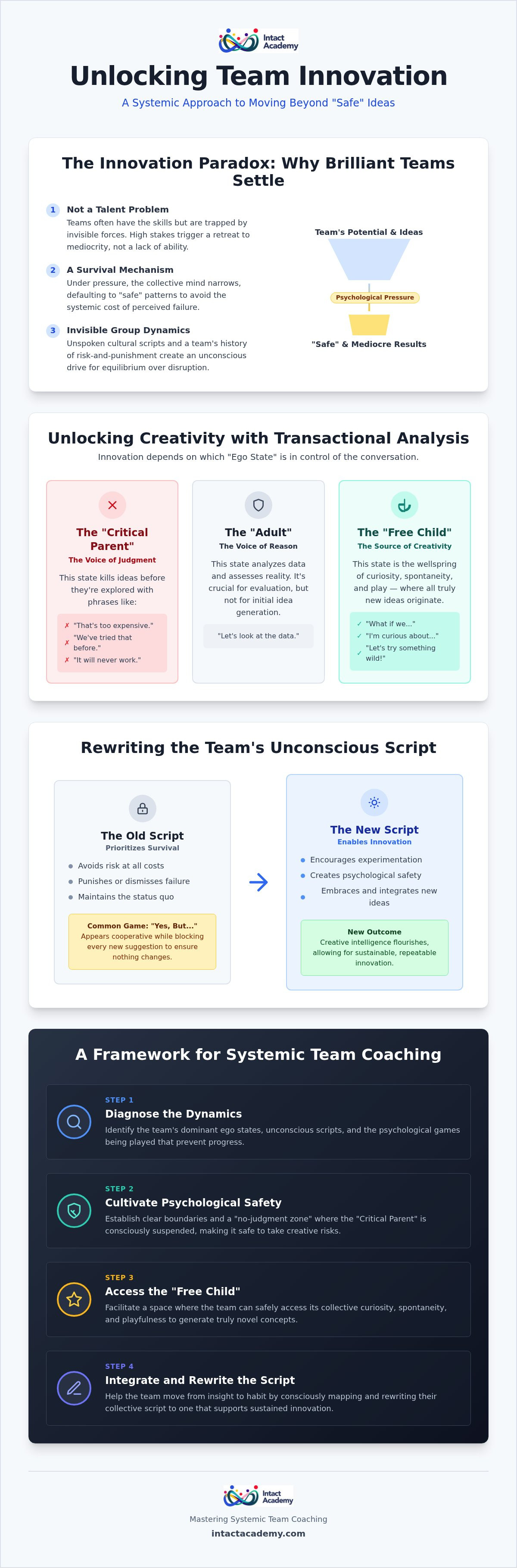
Most workshops focus on the "aha!" moment, yet they neglect the day-to-day reality of behavioral change. This is the "Insight vs. Habit" problem. Real change requires consistent repetition to override old neural and cultural pathways. Under high pressure, the human brain naturally narrows its cognitive field. It defaults to "safe" patterns to ensure survival. This response is often reinforced by an unconscious contract between team members to never truly challenge the status quo, regardless of what the official mission statement says. While many organizations rely on traditional team-building strategies to boost morale, these interventions often fail to address the underlying psychological scripts that punish risk-taking.
The Systemic Field of Creativity
A team functions as a living organism with its own memory and defense mechanisms. It protects its existing script with fierce, often invisible, loyalty. If a team's history includes a period where risk led to punishment, that "ghost" will haunt current ideation sessions. We must acknowledge that a team’s capacity for risk is a direct reflection of its systemic safety and historical context. Systemic team coaching is the facilitation of a team's collective evolution toward a state of wholeness and creative freedom. By addressing the field in which the team operates, we allow the group to move beyond survival and into a space of genuine, sustainable contribution.
Using Transactional Analysis to Unlock the Creative Ego
Transactional Analysis (TA) provides a structural map of the human psyche, categorizing our thoughts and behaviors into three distinct "Ego States": Parent, Adult, and Child. In the context of team coaching for innovation and creativity, these states determine whether an idea is nurtured or strangled at birth. The "Critical Parent" is the internal and collective voice of judgment. It’s the part of the team that says "that’s too expensive" or "we’ve tried that before" before an idea has even been fully articulated. This state kills emerging ideas in their infancy by prioritizing safety and tradition over exploration. When we practice team coaching for innovation and creativity, we aren't just facilitating a meeting; we are managing the energetic flow between these ego states.
Teams often play "Psychological Games" to avoid the vulnerability inherent in innovation. For instance, the game of "Yes, But" allows a team to appear cooperative while effectively blocking every suggestion, ensuring they remain in a comfortable, if stagnant, equilibrium. Recognizing these patterns is the first step toward reclaiming the group's creative potential.
The 'Free Child' and the Source of New Ideas
To access raw creativity, the coach must facilitate a space where the "Free Child" ego state can safely emerge. This state is the reservoir of our curiosity, spontaneity, and uninhibited play. It is the only part of the psyche capable of generating truly novel concepts. Bypassing the "Internalized Critic" during the divergent phase of innovation requires specific techniques, such as creating a "no-judgment zone" where the team consciously suspends the Parent state. For those new to these concepts, our guide on what is transactional analysis offers the foundational context needed to understand these psychological shifts. Leaders who successfully inspire creativity and innovation often do so by modeling this Free Child energy themselves, signaling to the system that it is safe to play.
Adult-to-Adult Innovation: From Idea to Execution
While the Free Child generates the spark, the "Adult" ego state is essential for the convergent phase of innovation. The Adult functions like a data-processing computer, testing and refining creative concepts against reality without the baggage of judgment. Without the Adult, innovation remains a fantasy; without the Child, it becomes a chore. A common trap is "Adapted Child" compliance, where team members agree to innovate simply because they are told to, turning the process into a sterile, box-ticking exercise. The coach's role is to maintain an "I'm OK, You're OK" dynamic. This ensures that high-stakes feedback is experienced as a collaborative refinement rather than a personal attack. Mastering these dynamics is at the heart of our team coaching approach, where we move from surface performance to systemic mastery.
Mapping and Rewriting the Systemic Team Script
The team script serves as an unconscious life plan, a collective narrative that dictates how a group perceives its potential and its boundaries. It's a set of "unspoken rules" inherited from founders, past leaders, or significant organizational traumas. When we engage in team coaching for innovation and creativity, we are essentially acting as systemic archaeologists, uncovering the layers of belief that prevent a team from stepping into its full power. This work is inextricably linked to the broader challenge of leading organizational change, as a system cannot move toward a new future while its script remains anchored in the past. Common innovation scripts include "Don't be successful" or "Don't be different," both of which prioritize group cohesion over the disruptive nature of new ideas.
Identifying the 'Don't' Injunctions in Your Team
The most pervasive barrier to creativity is the "Don't Make a Mistake" injunction. It's often born from a single, high-profile failure in the company’s history, leaving a residue of caution that paralyzes experimental cultures. This injunction creates a systemic "freeze" response whenever a team is asked to innovate. To address this, we use a Script Audit. In this exercise, the team identifies the hidden mandates they follow to stay safe. If the unspoken rule is "never challenge the leader’s first idea" or "only present finished products," the team's creative capacity is already capped. By naming these injunctions, we begin to dissolve their power over the collective behavior.
Creating New Permissions for Creativity
To rewrite the script, the coach must step into the role of a "Permission Giver" within the systemic field. This isn't about giving orders; it's about providing the psychological safety and the structural "okayness" for the team to explore uncharted territory. We work to move the team from a Certainty-Based script, where the primary goal is being right, to a Discovery-Based script, where the primary goal is learning. While many coaching strategies for innovation focus on brainstorming tools, the most impactful interventions prioritize the systemic permission to fail. This permission must be reinforced through structured interventions that celebrate intelligent failures as essential data points for evolution. When the script changes from "survival" to "flourishing," the team naturally accesses a state of completeness and genuineness that makes innovation inevitable.
Actionable Interventions for Creative Team Coaching
Effective team coaching for innovation and creativity requires a robust container to hold the inherent tension of the new. Without clear boundaries, a team’s creative energy often dissipates into confusion or retreats into safety. We use a Multi-Level Contracting model to provide this structure. This approach moves beyond simple goal-setting to address the layers of commitment required for true transformation. By making the invisible visible, we ensure the team isn't just performing innovation, but actually living it.
- The Administrative Contract: This level establishes the logistics, goals, and boundaries. It answers the "what" and "when," providing the external stability the team needs to take internal risks.
- The Professional Contract: Here, we define the innovation process itself. We agree on how we will ideate, how we will handle divergent opinions, and how we will move from a concept to a tangible prototype.
- The Psychological Contract: This is the most critical and often neglected layer. It addresses the hidden fears of failure and the unspoken desires for status. It asks: "What do we need from each other to feel safe enough to be vulnerable?"
Safe conflict is a necessary driver for creative friction. Innovation doesn't emerge from polite agreement; it comes from the synthesis of opposing ideas. The coach’s role is to facilitate "clean" conflict where the team can challenge ideas without attacking individuals. This requires a high level of systemic maturity from the coach to hold the space while the team works through the heat of disagreement.
Contracting for Innovation: A Core Competency
Clear contracting serves as the ultimate antidote to the "Psychological Games" that teams play to avoid change. When a team has explicitly agreed to the "Administrative" and "Psychological" terms of their work, there is less room for passive-aggressive blocking or "Yes, But" dynamics. Contracting for vulnerability is particularly challenging in high-performance environments. It requires the coach to model authenticity and to explicitly name the risks involved in the creative process. For those seeking to master these deep interventions, exploring our professional development for coaches pillar is essential for reaching senior practitioner levels of mastery. To begin your own journey into these systemic methodologies, you can explore our full range of team coaching programs.
Facilitating the 'Creative Field'
To move beyond standard brainstorming, we employ systemic techniques for "presencing" new possibilities. This involves helping the team tune into the emerging future rather than just reacting to past data. We often look at the system through multiple lenses to supervise the innovation process, ensuring that the coach doesn't become entangled in the team's own resistance. The coach's own Internal Supervisor acts as a silent anchor, ensuring they remain present and non-reactive when the team enters the chaotic, "messy middle" of the creative process. This internal stability allows the coach to hold the "Creative Field" open even when the team feels the urge to close it prematurely for the sake of comfort.
Mastering Systemic Team Coaching with Intact Academy
Mastering the art of team coaching for innovation and creativity requires more than just learning a set of tools; it demands a fundamental shift in how you perceive human systems. While transactional coaching focuses on surface-level performance, transformational systemic mastery addresses the deep scripts that define a team's potential. The TA EMCC Senior Team Coach Academy offers a rigorous path for those ready to move beyond the conventional. Led by Sari van Poelje, this program integrates her decades of international expertise in systemic change with an agile Transactional Analysis approach. It is a space designed for senior practitioners who understand that to change the output of a team, one must first understand the field in which it operates.
The Path to EMCC Senior Team Coach Accreditation
The curriculum is a deliberate journey from the foundational principles of TA to the complexities of systemic dynamics. It provides a stable container for deep learning through intensive supervision and peer collaboration. This isn't a passive course; it is an evolution of your professional identity. Achieving EMCC Senior Practitioner level accreditation distinguishes you in a crowded global market, signaling a capacity for deep, ethical, and effective intervention. Our upcoming 2026-2027 schedule reflects this global reach, with programs starting in Poznań on September 10, 2026, and continuing through India, Rome, Edinburgh, and Athens in 2027. This certification ensures your practice is recognized by both the EMCC and ICF, providing the credentialing necessary for high-level executive work.
Join a Global Community of Systemic Change Agents
When you join Intact Academy, you enter a network of professionals spanning over 14 countries. This community is united by a commitment to "Wholeness," the belief that returning to a state of genuineness is the ultimate driver of organizational innovation. We don't just train coaches; we foster a global citizenship of change agents dedicated to human flourishing. By choosing this path, you're choosing to honor the maturity of your clients and the depth of the challenges they face. If you're ready to facilitate profound transformation and elevate your practice in team coaching for innovation and creativity, we invite you to Apply for the TA EMCC Senior Team Coach Academy and begin your journey toward systemic mastery.
Reclaiming the Systemic Freedom to Innovate
True innovation isn't a skill we add to a team; it's a freedom we reclaim by removing the psychological barriers that keep groups in a state of survival. By shifting from the judgment of the Critical Parent to the spontaneity of the Free Child, teams can finally access the creative intelligence required for high-stakes problem solving. Using team coaching for innovation and creativity allows us to move beyond temporary bursts of ideation toward a sustainable culture of systemic wholeness.
Mastering these deep-level interventions requires psychological rigor and professional experience. At Intact Academy, our EMCC and ICF accredited programs provide the methodology needed for profound human transformation. Led by international expert Sari van Poelje, our systemic approach has helped global organizations move from transactional safety to transformational growth. We focus on the field in which teams operate, ensuring that change is both deep and durable.
If you're ready to lead teams toward their complete potential, we invite you to Master the art of systemic innovation at the TA EMCC Senior Team Coach Academy. The path to mastery is deliberate and rewarding. We look forward to supporting your evolution as a systemic change agent and watching your practice flourish.
Frequently Asked Questions
How does team coaching differ from creativity workshops?
Team coaching is a long-term developmental process, whereas creativity workshops are typically one-off events. While a workshop might provide a temporary morale boost, team coaching for innovation and creativity addresses the underlying psychological scripts that dictate how a group functions daily. It focuses on the systemic dynamics that either permit or punish original thought, ensuring that new behaviors become permanent habits rather than fleeting insights.
Can Transactional Analysis really be used in a corporate innovation setting?
TA is exceptionally effective in corporate settings because it offers a clear, non-clinical vocabulary for complex behaviors. By identifying Parent, Adult, and Child ego states, teams can objectively observe their own communication patterns. This structural rigor allows leaders to see exactly when judgment is killing curiosity. It transforms abstract cultural issues into manageable, actionable shifts in how people relate to one another during high-stakes work.
What is the ROI of team coaching for innovation and creativity?
The ROI is evidenced by increased speed to market and the mitigation of performance-related losses. Research indicates that businesses can lose an average of $15.5 million annually due to poor team performance. In contrast, sectors like media and entertainment have seen a 20% faster content development cycle by applying creative problem-solving. Effective coaching reduces the "Mental Fitness Gap," turning dormant talent into measurable organizational value.
How long does it take to see a systemic shift in team creativity?
You should expect to see significant systemic shifts within six to twelve months. While initial breakthroughs in communication often happen in the first few sessions, rewriting a long-standing team script requires consistent repetition. Systemic evolution is a methodical process. It moves the group from unconscious survival patterns to a conscious state of "Adult" execution and "Free Child" exploration, which demands time to stabilize under pressure.
What is the role of psychological safety in team innovation?
Psychological safety is the essential container that allows for vulnerability and risk-taking. In TA terms, it creates the "permission" needed for the Natural Child to express raw ideas without fear of the Critical Parent’s judgment. Without this safety, the cognitive field narrows. Team members default to safe, mediocre results to avoid social or professional repercussions, effectively ending the possibility of true innovation.
Is the TA EMCC Senior Team Coach Academy suitable for internal HR leaders?
Yes, the TA EMCC Senior Team Coach Academy is designed for any senior professional responsible for collective performance. Internal HR leaders and organizational development specialists benefit from the program's systemic depth. It equips them to move beyond transactional training into the realm of profound human transformation. This senior-level accreditation provides the authority and methodology required to lead significant organizational change from the inside.
How do I deal with a 'Critical Parent' culture that blocks new ideas?
Addressing a Critical Parent culture starts with making the invisible dynamics visible through a "Script Audit." You must explicitly contract for a space where judgment is suspended in favor of curiosity. By modeling an "I'm OK, You're OK" dynamic, you lower the group's collective anxiety. This allows the team to move from a culture of blame to one of discovery, where mistakes are viewed as essential data.
What are the core competencies for an EMCC-accredited team coach?
EMCC-accredited coaches must master multi-level contracting, systemic awareness, and the facilitation of collective evolution. They need to maintain a stable "Adult" presence while navigating the turbulent emotions of a group. Mastery involves the integration of proprietary frameworks and a commitment to ongoing supervision. These competencies ensure the coach provides a safe, reliable container for the often-difficult work of professional and personal change.


