

What if the friction stalling your cross-functional project isn't a lack of talent, but a silent war of unconscious loyalties? You've likely felt the weight of departmental silos where "us versus them" mentalities quietly sabotage even the most brilliant strategies. Effective team coaching for cross-functional teams addresses these hidden agendas, which are rarely simple personality clashes; they're symptoms of a systemic struggle for belonging and safety. It's exhausting to watch high-level professionals struggle to align when their functional identities and project goals pull them in opposite directions.
This 2026 guide reveals how to resolve deep-seated tribalism and systemic friction using Transactional Analysis and professional coaching frameworks. We'll explore a methodology to align diverse perspectives into a unified force, allowing you to resolve conflict without damaging the human relationships at the core of the work. We'll also preview how the TA EMCC Senior Team Coach Academy provides the rigorous tools needed for this level of profound transformation. By looking inward at the psychological scripts running your teams, you can finally move from fragmented effort to a state of collective wholeness and genuine collaboration.
Key Takeaways
- Identify the underlying "Loyalty Conflict" that creates friction between functional departments and specific project objectives.
- Use team coaching for cross-functional teams to decode the "Tribal Scripts" that drive unconscious behaviors and stall collective progress.
- Shift from surface-level team building to transformational systemic coaching that addresses deep-seated organizational processes.
- Master multi-stakeholder contracting to align diverse perspectives and create a unified force within the wider system.
- Explore the path to elite professional standards through the TA EMCC Senior Team Coach Academy for sustainable change.
The Cross-Functional Paradox: Why High-Potential Teams Often Fail
Organizations often assemble their brightest minds from marketing, engineering, and finance, expecting a symphony of innovation. Instead, they frequently encounter a cacophony of competing interests. Professional team coaching for cross-functional teams acts as a systemic intervention, looking beyond individual performance to the boundary-spanning dynamics that define a Cross-functional team. It's a process of unearthing the invisible threads that bind individuals to their departments while preventing them from fully committing to a shared project.
This struggle often manifests as a "Loyalty Conflict." A team member isn't just a project contributor; they're a representative of their home department. When a project requires a pivot that might disadvantage their functional boss, progress halts. This isn't a lack of professionalism. It's a deeply human response to the need for belonging and safety within one's primary "tribe." When these loyalties remain unaddressed, the cost is staggering: lost innovation, sluggish speed-to-market, and a pervasive executive burnout that stems from constantly refereeing departmental disputes.
Friction in these settings isn't an error to be corrected through better scheduling or tighter KPIs. It's a symptom of deeper systemic patterns. These patterns suggest that the organization's structure is inadvertently rewarding siloed survival over collective flourishing.
The 75% Failure Rate: A Symptom of Tribalism
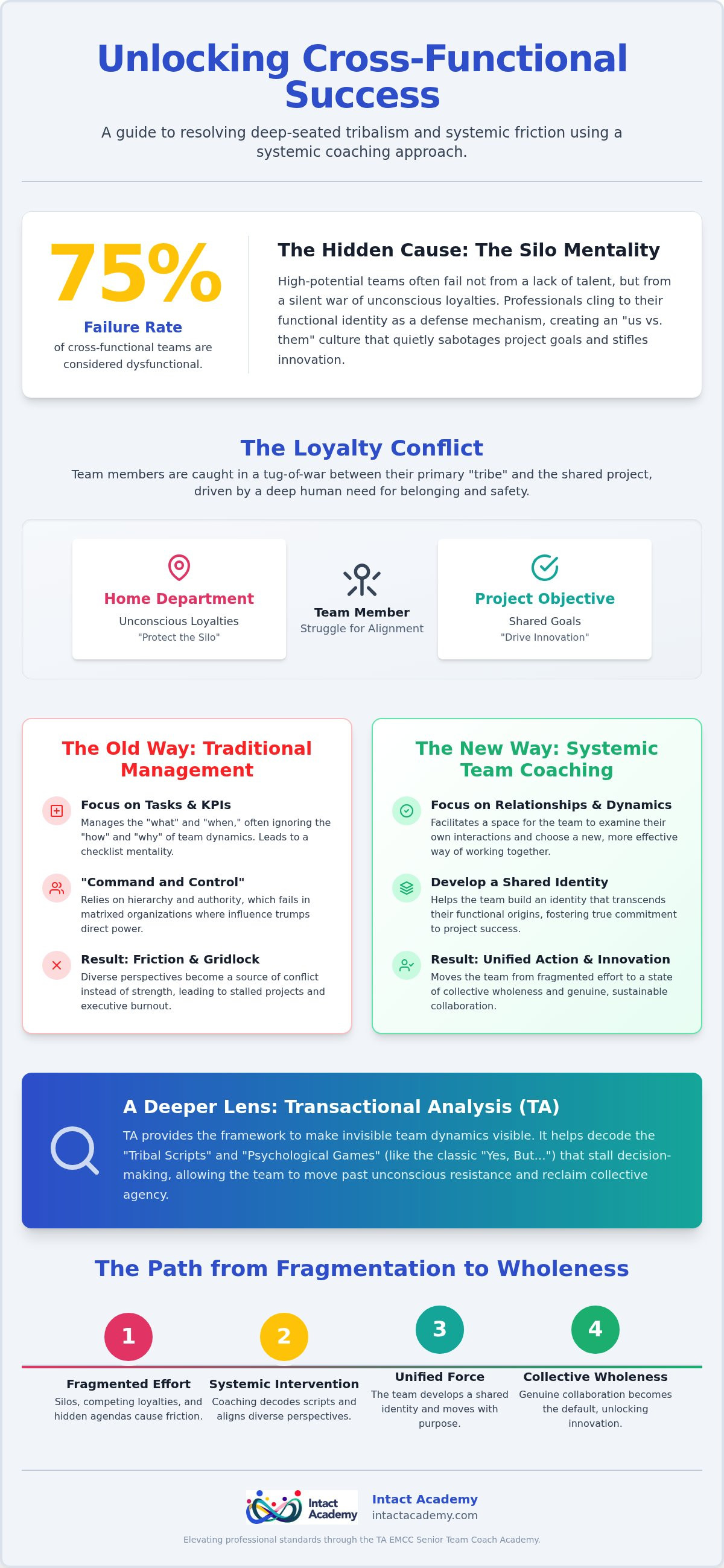
Industry data suggests that approximately 75% of cross-functional teams are dysfunctional. While many leaders assume "diverse perspectives" naturally lead to better outcomes, the reality is often gridlock. Without a framework to integrate these views, diversity becomes a source of friction. The "Silo Mentality" emerges as an unconscious defense mechanism. Professionals cling to their functional identity because it provides a clear script for success. When incentive systems favor departmental metrics over project milestones, collaboration becomes a secondary concern, and the team’s potential is sacrificed to protect the silo.
Moving from Management to Systemic Coaching
Traditional "command and control" management fails in matrixed organizations because you cannot mandate trust or force a collective identity through a memo. Management focuses on the task, while team coaching for cross-functional teams focuses on the relationship between the parts. The coach doesn't manage the project; they facilitate a space where the team can examine their own dynamics and choose a new way of being together. Systemic team coaching is the art of seeing the whole beyond the parts. By helping the team develop a shared identity that transcends their functional origins, a coach enables them to move from fragmented effort to genuine, unified action.
Beyond the Surface: A Systemic Lens on Cross-Functional Dynamics
Clarity of purpose is often cited as the antidote to team dysfunction, yet even the most well-defined charters fail when they collide with unconscious "Tribal Scripts." These are the unwritten rules and narratives that departments develop over years to protect their own interests and identities. When we use Transactional Analysis (TA) as a tool for mapping interactions, we move beyond surface-level behavior to see the psychological architecture of the organization. It's a way to make the invisible visible, transforming a chaotic meeting into a legible map of human needs and systemic pressures.
In a cross-functional meeting, you might observe a "Critical Parent" stance from a finance lead or a "Rebellious Child" reaction from creative talent. These transactions aren't just personality quirks; they're manifestations of the systemic pressure to perform. When team coaching for cross-functional teams is applied through this lens, we begin to see the "Psychological Games" that stall decision-making. The classic "Yes, But" game occurs when a team seemingly agrees to a plan but immediately lists reasons why it won't work, effectively maintaining the status quo while appearing to cooperate. Recognizing these patterns is the first step toward reclaiming collective agency.
Mapping Unconscious Systemic Loyalties
Every member enters a project with a dual identity. They carry "hidden contracts" from their home department, which dictate how they should interact with "outsiders" and what information they should protect. These unconscious systemic loyalties often force individuals to prioritize departmental safety over project innovation. To understand these deep structures, one must ask What Is Transactional Analysis? and how it serves as a map for professional transformation. By surfacing these hidden contracts, the coach allows the team to negotiate new, transparent agreements that serve the whole system rather than just a part of it.
The Role of the Leader as a Systemic Anchor
The leader’s role is to act as a systemic anchor, facilitating Systemic Team Coaching that invites members into an "Adult-to-Adult" relationship. This shift is vital. When a leader operates from a "Parental" stance, they inadvertently encourage dependency or rebellion among department heads. By recognizing how their own "Life Script"-the unconscious life plan formed in early development-influences their leadership style, they can create a more genuine and autonomous environment. For those seeking to master these dynamics, the TA EMCC Senior Team Coach Academy provides the rigorous training necessary to navigate these complex human landscapes. This level of insight ensures that profound psychological concepts remain accessible and actionable for every leader involved.
Traditional Management vs. Systemic Team Coaching
Traditional management often treats a team like a machine; if you align the parts and oil the gears with clear tasks, the system should function. This "Task-Only" approach focuses heavily on the "What" - the deliverables, the timelines, and the KPIs. While these are necessary, they're insufficient for teams spanning multiple boundaries. Professional team coaching for cross-functional teams shifts the focus to the "How," exploring the living dynamics and the way energy flows between departments. Management relies on authority, whereas systemic coaching relies on awareness and the transformation of relationships.
There's a vital distinction between recreational team building and transformational team coaching. Team building might offer a temporary reprieve from tension through shared activities, but it rarely touches the underlying systemic friction. Coaching is a sustained process that invites the team to look at its own reflection and choose a new way of being. As highlighted in a comprehensive guide to cross-functional teaming, navigating these high-stakes environments requires a coach with the depth to handle complex human systems. Surface-level alignment often dissolves the moment a project faces real pressure because it lacks the psychological foundation to withstand conflicting interests.
Why Charters and Goals Are Not Enough
Many leaders believe a team charter is the ultimate solution to cross-functional gridlock. However, a charter is merely an "Explicit Contract." It outlines the goals, but it doesn't address the "Psychological Contract" - the unwritten expectations regarding trust, respect, and safety. Systemic coaching addresses these unspoken barriers, making the invisible visible. For those seeking to lead these interventions, Choosing the Right Team Coaching Course is the first step toward gaining the systemic mastery required to negotiate these deep-seated psychological agreements.
The Power of Systemic Supervision
Coaches working within a matrix are often pulled into the same "tribal" dynamics they're trying to resolve. This is why Systemic Supervision is a non-negotiable requirement for professional excellence. By using frameworks like the "7-Eyed Model," a coach can step back to observe the entire stakeholder web. This process ensures they remain a neutral, objective anchor for the team. Supervision provides a safe container for the coach to process the complex emotional data of the organization, ensuring they don't become another part of the problem they were hired to solve.
- Management: Focuses on individual accountability and task completion.
- Systemic Coaching: Focuses on collective intelligence and relational health.
- Management: Uses documents (charters) to enforce alignment.
- Systemic Coaching: Uses dialogue and psychological insight to foster genuine commitment.
A Framework for Coaching Cross-Functional Mastery
Mastering the dynamics of boundary-spanning groups requires more than a standard meeting agenda; it demands a structured methodology that honors the complexity of the human system. Team coaching for cross-functional teams provides this structure, moving through deliberate stages that transform a collection of departmental representatives into a high-performing unit. This evolution doesn't happen by chance. It's the result of a rigorous process that addresses both the visible tasks and the invisible psychological forces at play.
The framework begins with multi-stakeholder contracting, ensuring the team is aligned with the wider organization's needs. From there, the focus shifts to building psychological safety, which is the prerequisite for any meaningful work. In cross-functional settings, "politeness" is often a mask for mistrust or a fear of overstepping departmental boundaries. We must facilitate a move toward "productive conflict," where differing views are seen as vital data rather than personal threats. This leads to the alignment of "Tribal Scripts," where the team creates a new, shared narrative that replaces old departmental rivalries. Finally, we establish continuous systemic feedback loops, ensuring the team remains agile and evolves as the project's external pressures change.
Contracting for Success in a Matrix
In a matrixed environment, the "Three-Way Contract" is a non-negotiable tool for clarity. This agreement involves the coach, the team, and the functional sponsors who hold authority over the individual members. Without this alignment, team members are often paralyzed by conflicting mandates from different department heads. Effective contracting is the foundation of all systemic change. It establishes the "rules of engagement" and ensures that every stakeholder understands the boundaries of the coaching intervention. If you're ready to master these high-level negotiations, explore the TA EMCC Senior Team Coach Academy to gain the credentials required for this complex work.
Creating a "New Tribe" Identity
Facilitating a shared vision that transcends departmental boundaries requires a shift in how members perceive their belonging. We use Transactional Analysis "Strokes" - specific units of recognition - to reinforce collaborative behaviors. When a team member prioritizes the project’s success over their home department’s immediate interests, that behavior must be acknowledged and validated. This transition from "My Department" to "Our Mission" is a profound psychological evolution. It moves the team away from fragmented loyalties and toward a state of completeness, where the collective identity becomes stronger than the individual silos. By reinforcing these new patterns, team coaching for cross-functional teams helps create a "new tribe" that is capable of achieving what no single department could do alone.
Elevating Your Impact: Professional Certification in Team Coaching
The journey to becoming an EMCC Senior Team Coach is a path of both professional rigor and personal evolution. In the complex landscape of modern business, where surface-level interventions are increasingly common, Transactional Analysis (TA) stands as the gold standard for understanding organizational change. It provides the depth needed to map the interactions that define team coaching for cross-functional teams, moving beyond the "what" of business tasks to the "who" and "how" of human connection. This methodology doesn't just address symptoms. It transforms the systemic scripts that govern how diverse groups interact, creating a stable container for the often-turbulent work of professional change.
The TA EMCC Senior Team Coach Academy
The TA EMCC Senior Team Coach Academy bridges the gap between high-level theoretical frameworks and direct, pragmatic application. The curriculum moves methodically from the foundations of TA to advanced systemic interventions, ensuring participants can navigate the most turbulent matrixed environments with quiet power. A central part of this journey is the mentorship of Sari van Poelje, whose personal insights into systemic change and agile TA provide a bridge between clinical depth and executive reality. This certification differentiates you in the 2026 market. It signals that you possess the courage to address the underlying psychological dynamics that others might ignore, positioning you as a leader at the intersection of human behavior and business.
A Path Toward Wholeness and Mastery
Mastery is a process of returning to a state of completeness and genuineness. It's about moving beyond transactional coaching to facilitate a space where teams can drop their masks and collaborate with integrity. By joining a global community of practitioners, you commit to a standard of systemic excellence that honors the maturity of the organizations you serve. This is the work of global citizenship: helping leaders and teams find their way back to wholeness. To begin your own journey toward this level of impact, you can Explore the TA EMCC Senior Team Coach Academy and discover a framework for mastery that lasts a lifetime.
Mastering the Systemic Future of Collaboration
The path from fragmented silos to a unified, high-performing force is paved with psychological insight and systemic awareness. You've likely observed how tribal scripts and unconscious loyalties often dictate team behavior more than any project charter could. By shifting from a task-only mindset to one of systemic process, you allow your teams to resolve deep-seated friction and reclaim their collective agency. Mastering team coaching for cross-functional teams is not merely a professional skill; it's a commitment to facilitating profound human transformation within the organizations you serve.
This work requires a stable container and a rigorous methodology. The TA EMCC Senior Team Coach Academy offers a world-class environment to achieve this mastery. Led by international expert Sari van Poelje, this program delivers EMCC Senior Practitioner Level Accreditation through a systemic methodology proven in 14+ countries. It's time to move beyond transactional coaching and step into the role of a wise global mentor. Apply for the TA EMCC Senior Team Coach Academy and begin your journey toward wholeness and systemic impact. You possess the capacity for this change; the next step is simply to begin.
Frequently Asked Questions
What is the main difference between team coaching and team building for cross-functional groups?
Team coaching for cross-functional teams is a sustained, systemic intervention focused on relational dynamics and long-term performance, whereas team building is typically a one-off recreational event. While building activities offer temporary rapport, coaching addresses the unconscious scripts and structural friction that prevent deep collaboration. It invites teams to examine their collective identity and transform their way of being together rather than just participating in shared activities.
How does Transactional Analysis help in resolving departmental silos?
Transactional Analysis (TA) resolves silos by mapping the "Tribal Scripts" and ego states that drive departmental isolation. By identifying when members act from a "Critical Parent" or "Adapted Child" stance toward other departments, a coach can facilitate a shift to an "Adult-to-Adult" way of being. This psychological clarity allows teams to negotiate new, transparent agreements that transcend old boundaries and foster a sense of collective wholeness.
Can team coaching work in a virtual or hybrid cross-functional environment?
Professional coaching is highly effective in virtual or hybrid settings when the focus remains on systemic dynamics rather than just the technology used. Remote environments often amplify "hidden agendas" and silos due to reduced informal contact. A coach uses digital platforms to facilitate psychological safety and ensure that the "unspoken" barriers to collaboration are surfaced and addressed, regardless of the team's physical location.
How long does a typical team coaching engagement for a cross-functional team last?
A typical engagement for cross-functional mastery usually spans six to twelve months to allow for deep behavioral shifts. This timeframe provides the space needed for the team to move through the stages of contracting, surfacing systemic friction, and establishing new collaborative habits. It ensures that the transformation is integrated into the team's daily operations rather than being a fleeting change that dissolves under pressure.
What are the requirements for EMCC Senior Team Coach accreditation in 2026?
In 2026, EMCC Senior Team Coach accreditation requires a minimum of 100 hours of team coaching practice across at least five different teams. Candidates must also demonstrate ongoing systemic supervision and a deep mastery of specific psychological frameworks. This level of certification ensures the coach can manage the high-stakes complexity inherent in large, matrixed organizations and facilitate sustainable, profound human transformation.
How do you measure the ROI of coaching for a cross-functional team?
Measuring ROI involves tracking both qualitative shifts in psychological safety and quantitative improvements in project speed-to-market or innovation rates. We look for a reduction in "Psychological Games" and a measurable increase in the team's ability to resolve conflicts without executive escalation. These systemic improvements lead to sustainable performance gains that far outweigh the initial investment in professional team coaching for cross-functional teams.
What happens if a department head is resistant to the team coaching process?
Resistance from a department head is often a signal of a "Loyalty Conflict" that requires careful multi-stakeholder contracting. Rather than forcing compliance, the coach explores the underlying fears or hidden contracts that make the leader feel unsafe. By addressing these concerns directly, the coaching process often transforms the resistant leader into a key sponsor who values the connection between individual growth and organizational success.
Is TA-based coaching suitable for highly technical or scientific teams?
TA-based coaching is exceptionally well-suited for technical or scientific teams because of its logical, structured approach to human behavior. Technical professionals often appreciate the precision of TA ego states and transactional mapping. It provides a clear, objective language for discussing complex interpersonal dynamics, allowing highly analytical minds to engage with the "human system" with the same rigor they apply to their technical work.


