

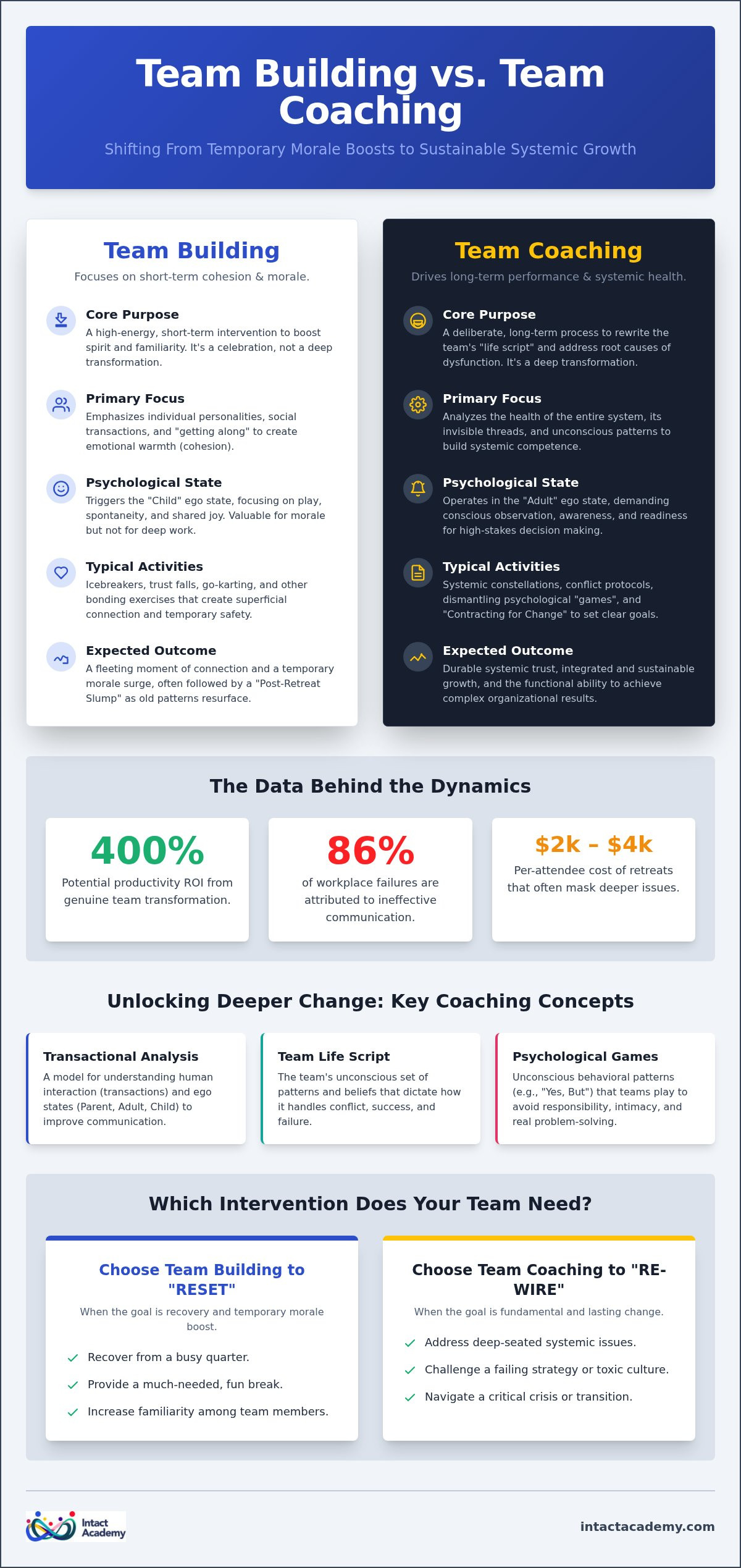
Why does the shared laughter from last week's mountain retreat feel like a distant echo when the same boardroom tensions resurface on Monday morning? It's a quiet frustration for many leaders who recognize the potential for a 400% ROI in productivity, yet find themselves trapped in a cycle of temporary fixes. The confusion often stems from a fundamental misunderstanding of team building vs team coaching activities. While one creates a fleeting moment of connection, the other builds a stable, systemic container for collective evolution. You've likely noticed that persistent team dysfunctions often survive even the most expensive bonding exercises. The underlying human script remains untouched.
In this guide, we'll explore the psychological depth required to move beyond surface-level facilitation into the realm of profound transformation. You'll learn how to apply Transactional Analysis to uncover the hidden dynamics that govern how your team interacts and grows. By looking past the $2,000 to $4,000 per attendee cost of traditional retreats, you can begin to choose interventions that foster genuine wholeness and sustainable organizational growth. We'll examine the specific activities that drive systemic change and discuss how the 2026 professionalization of the coaching industry offers a path toward maturity and excellence.
Key Takeaways
- Recognize the fundamental shift from high-energy morale boosters to long-term systemic interventions that address the root causes of collective performance.
- Discover how to move beyond "Child" ego state social transactions and use Transactional Analysis to dismantle the psychological games that hinder team progress.
- Evaluate the effectiveness of team building vs team coaching activities by contrasting superficial bonding exercises with transformative conflict protocols and systemic constellations.
- Apply the Team Maturity Matrix to determine the precise moment your organization requires deep coaching rather than a standard retreat, especially during periods of crisis or transition.
- Understand the role of the coach as a "systemic instrument," where personal psychological work becomes the foundation for guiding teams toward genuine wholeness.
Beyond the Icebreaker: Why the Distinction Between Building and Coaching Matters
Leaders often find themselves at a crossroads after a corporate event. The energy was high, the feedback forms were glowing, and yet, within forty-eight hours, the old silos have reappeared. This phenomenon, often called the "Post-Retreat Slump," highlights why understanding the nuances of team building vs team coaching activities is essential for any leader seeking more than a temporary surge in morale. While Team building serves as a high-energy, short-term intervention designed to boost spirit and familiarity, it rarely touches the underlying architecture of how a group actually works. It's the difference between a celebration and a transformation.
In contrast, systemic team coaching is a deliberate, long-term process focused on collective performance and the invisible threads that bind a group together. From a Transactional Analysis perspective, every team carries a "Team Life Script." This is a set of unconscious patterns and beliefs formed over time that dictates how the group handles conflict, success, and failure. While building activities might brighten the atmosphere, coaching dives into this script to rewrite the narrative. It moves the focus from individual personalities to the health of the system itself, ensuring that growth isn't just felt, but integrated.
The Trap of the One-Off Event
Fun activities often provide a much-needed break, but they can inadvertently mask deep-seated systemic issues. A day of go-karting might create temporary psychological safety, but it won't build the durable systemic trust required to challenge a failing strategy or address a toxic culture. If your team needs a "reset" to recover from a busy quarter, building is appropriate. However, if you need to "re-wire" how decisions are made, you require the sustained engagement of coaching. Without this depth, the 86% of workplace failures attributed to ineffective communication will continue to haunt even the most "unified" teams.
Defining Success: Cohesion vs. Systemic Competence
We must distinguish between cohesion and systemic competence. Cohesion is the emotional warmth we feel toward one another; competence is the functional ability to achieve results through that relationship. To move toward competence, we use a process called "Contracting for Change." This involves setting clear, adult-to-adult agreements about the desired outcomes of the intervention. You can explore how these frameworks function in our guide on what is transactional analysis. By establishing these boundaries early, the team moves from simply "getting along" to mastering the complex dynamics of organizational life.
The Psychological Depth of Team Coaching vs. Team Building
The power of a team isn't found in its ability to follow instructions, but in its capacity to remain present when the pressure mounts. When we examine team building vs team coaching activities, we see a stark contrast in the psychological states they invite. Team building often triggers the "Child" ego state. It focuses on play, spontaneity, and shared joy. While these moments are valuable for morale, they rarely address the "Adult" ego state required for high-stakes decision making. Coaching, conversely, operates primarily in the Adult to Adult transaction, demanding a level of awareness that moves beyond mere participation into the realm of conscious observation.
While building activities focus on social transactions, often characterized by politeness and surface-level cooperation, coaching analyzes the "Psychological Games" teams play. These are unconscious patterns of behavior, like "Yes, But" or "Kick Me," that teams use to avoid responsibility or intimacy. To navigate these depths, a coach uses the "7-Eyed Model of Supervision." This framework allows the coach to monitor the team's dynamics, their own internal responses, and the wider organizational system simultaneously. This creates a "Systemic Container," a stable psychological space where the coach holds the team's anxiety, allowing them to face uncomfortable truths without retreating into old habits.
Transactional Analysis (TA) in Team Dynamics
In a professional setting, communication often breaks down because of "Discounting." This is a TA concept where individuals ignore an aspect of a problem or their own ability to solve it. During team building, discounting is often masked by the "fun" environment. In coaching, we map these communication patterns using the Parent-Adult-Child model to identify where the system is stuck. Sari van Poelje utilizes agile TA to help teams recognize these shifts in real-time, moving from reactive patterns to proactive alignment. For leaders ready to facilitate this level of change, exploring our Team Coaching programs can provide the structural support needed for this transition.
From Surface Interaction to Deep Systemic Alignment
Most interventions fail because they stay at the "Social Level," the explicit words spoken during an activity. Coaching reaches the "Psychological Level," the hidden intent behind those words. This is a critical factor in differentiating team coaching from team building. By employing "Double-Loop Learning," teams don't just solve a specific task; they change the underlying assumptions that led to the problem in the first place. The coach also watches for "Parallel Process," where the team’s internal dynamics are mirrored in the relationship with the coach, offering a live laboratory for systemic evolution.
Comparing Activities: From Trust Falls to Systemic Constellations
To choose the right intervention, we must first categorize team building vs team coaching activities by their underlying intent: Bonding, Diagnostic, or Transformative. Most leaders reach for bonding activities, those high-energy events designed to create temporary warmth. Yet, a "Trust Fall" is fundamentally limited because it relies on a physical metaphor for a complex psychological need. In contrast, a "Conflict Protocol" is a coaching intervention that creates a functional, adult agreement on how the team will handle dissent. It doesn't just ask the team to feel trust; it builds the systemic infrastructure to practice it under pressure.
We also utilize the "Market of Skills" not merely as an icebreaker, but as a diagnostic tool to map team boundaries and resource allocation. This helps the group move from a state of individual competition to a state of collective abundance. For deeper shifts, "Systemic Constellations" allow a team to physically represent the invisible pressures and loyalties within their organization. By making these hidden dynamics visible, the team can find a new place of balance and strength that no scavenger hunt could ever reach. This is where the work of Sari van Poelje becomes vital, as it guides the team toward a state of genuine wholeness.
Typical Team Building Activities and Their Shelf-Life
Escape rooms and scavenger hunts are excellent for boosting morale, but their impact on behavioral change is notoriously short-lived. These activities often rely on "forced fun," which can inadvertently damage psychological safety if introverted members feel coerced into performative social transactions. Even personality tests like MBTI or DISC, while useful for individual awareness, often fail as building activities because they focus on labeling individuals rather than evolving the system. Without a coach to facilitate the integration of these insights into daily work, they remain static data points rather than catalysts for growth.
Transformative Team Coaching Interventions
In systemic coaching, we use "Journey Lines" to move beyond "who I am" toward "how my history impacts our current system." This activity reveals the professional scripts each member brings to the table, allowing the group to see how past experiences shape present reactions. We also employ real-time observation during actual work meetings, providing "In-the-Moment" feedback that catches psychological games as they happen. Finally, stakeholder mapping extends the team’s focus outward, connecting their internal work to the needs of the wider organization. This ensures the team doesn't become a closed loop, but remains an open, responsive system.
Strategic Implementation: Choosing the Right Intervention for Your Team
Strategic leadership requires a discerning eye for the system's current state. Choosing between team building vs team coaching activities isn't a matter of personal preference, but of developmental necessity. If a team is in its infancy, basic bonding might provide the initial social glue. However, applying a surface-level building activity during a high-stakes merger or a period of systemic crisis is often the wrong choice. In these moments, "forced fun" can feel dismissive of the team's genuine anxiety. Instead, a systemic intervention is required to hold the complexity of the transition and facilitate a return to wholeness.
The Team Maturity Matrix
We use the Team Maturity Matrix to identify the precise entry point for change. In Stage 1 (Forming), the focus is on orientation and safety, where building activities have their place. By the time a team reaches Stage 4 (Performing), the needs shift toward deep alignment and systemic evolution, which only coaching can provide. Red flags such as persistent "Yes, But" communication patterns or a sudden drop in collaboration despite frequent retreats signal that the system has outgrown building. For those seeking to master these diagnostic skills, our guide on professional development for coaches offers a roadmap for implementation mastery.
Integrating Coaching into the Daily Flow
The most effective coaching doesn't happen in a vacuum; it happens in the flow of work. We encourage a shift from isolated "off-sites" toward "on-sites," where the coach observes and intervenes during actual meetings. This transition requires the leader to move from being a mere participant to a coaching co-sponsor, modeling the vulnerability and "Adult" presence they wish to see in the team. Creating "Reflective Spaces" within the weekly cycle allows the group to pause and analyze their dynamics in real-time, ensuring that insights are immediately applied to business outcomes.
Success in this realm is measured not by "happiness scores" from a retreat, but by tangible systemic shifts. Are the psychological games decreasing? Is the team taking collective responsibility for failures? These are the indicators of a high-functioning system that has moved beyond the superficial. If you're ready to invest in the deep work of transformation, explore our TA EMCC Senior Team Coach Academy to begin your journey toward systemic mastery.
Cultivating Mastery: Moving from Facilitation to Systemic Team Coaching
The true power of a systemic intervention lies not in the complexity of the exercise, but in the psychological presence of the person leading it. Moving from a facilitator of events to a facilitator of transformation requires a shift in how we view our role within the organizational system. While a facilitator might focus on the logistics of team building vs team coaching activities, a systemic coach focuses on "Self-as-Instrument." This concept suggests that the coach's own psychological work, their awareness of their own triggers, and their ability to remain grounded in an "Adult" state are the primary tools for change. Without this internal rigor, even the most sophisticated coaching activity remains a surface-level transaction.
Transactional Analysis serves as the gold standard for this work because it provides a precise language for the unconscious. It allows the coach to see the "Parent" and "Child" dynamics playing out in the boardroom and to invite the team back to a state of wholeness and genuineness. By mastering these competencies, a coach moves beyond simply running a meeting and begins to hold the entire system's potential for evolution. This is the hallmark of the EMCC Senior Team Coach, a professional who possesses the systemic intelligence to navigate the turbulent waters of organizational change with calm authority.
The Journey to EMCC Senior Team Coach Accreditation
There's a significant professional distance between a team building facilitator and an accredited Senior Team Coach. While the former often masters the art of engagement and morale, the latter must master the art of systemic diagnostic and transformative intervention. This path requires a commitment to rigorous standards and ongoing developmental support. Our TA EMCC Senior Team Coach Academy bridges this gap by providing the theoretical depth and practical supervision necessary for senior-level mastery. Systemic supervision is a critical component here, ensuring that the coach remains objective and effective while working within high-pressure systems.
Why Psychological Rigor is the Future of Team Development
As we move through 2026, the industry is seeing a decisive shift from "soft skills" to "systemic intelligence." Organizations no longer settle for temporary fixes; they demand sustainable results that come from deep psychological alignment. This evolution honors the maturity of the workforce and the complexity of the global business environment. By choosing a path of professional mastery, you're not just learning new techniques; you're becoming a catalyst for the flourishing of human systems. For those ready to lead this change, selecting the right team coaching course is the first step toward a career defined by depth, integrity, and lasting impact.
Embracing the Path to Systemic Wholeness
The choice between team building vs team coaching activities ultimately defines the depth of your organizational evolution. While bonding exercises offer a momentary lift in morale, systemic coaching provides the structural integrity needed for teams to navigate the complexities of 2026. By moving beyond surface-level transactions and addressing the underlying team script, you invite a return to genuineness and sustained performance. True mastery involves recognizing that the system's health is mirrored in the quality of its adult-to-adult interactions and the courage to address hidden psychological games.
If you're ready to transcend basic facilitation and lead profound human transformation, join our global community of experts. Master the art of systemic impact at the TA EMCC Senior Team Coach Academy. Our programs, led by Sari van Poelje, offer EMCC Senior Practitioner Level training designed to cultivate your mastery as a systemic instrument. This is more than professional development; it's a commitment to the flourishing of the human systems you serve. The journey toward collective excellence is a deliberate, rewarding process. It's time to build a container where your team can truly flourish.
Frequently Asked Questions
What is the main difference between team building and team coaching activities?
The primary distinction lies in the temporal focus and psychological depth of the intervention. Team building is a short-term event designed to boost morale through social interaction and shared play. Systemic team coaching is a long-term developmental process that addresses the underlying patterns of collective performance. While building creates a fleeting moment of connection, coaching builds a sustainable container for systemic evolution.
When should an organization choose team building over team coaching?
Choose team building when the primary goal is social orientation or a celebratory reset. It’s ideal for newly formed groups in the "Forming" stage or teams needing a break after a high-pressure period. However, if the group faces persistent dysfunction or requires a fundamental shift in how they work together, building is often insufficient. In those scenarios, the deeper rigor of coaching is required.
How does Transactional Analysis improve team coaching outcomes?
Transactional Analysis (TA) improves outcomes by providing a precise psychological framework to map communication patterns. It allows the coach to identify "Psychological Games" and "Discounting" behaviors that sabotage performance. By moving the team into a conscious "Adult" ego state, TA facilitates a return to genuineness. This clarity ensures that the team doesn't just solve tasks but evolves the way they relate to one another.
Can team building activities ever be used within a team coaching engagement?
Yes, team building activities can serve as useful diagnostic tools within a broader team coaching engagement. A coach might use a high-energy activity to observe how the system handles stress or leadership transitions in real-time. The difference is the debrief; in coaching, the activity is a mirror used to analyze systemic scripts rather than just a way to have fun.
What are the most effective activities for systemic team coaching?
Transformative activities like Systemic Constellations, Journey Lines, and Conflict Protocols are highly effective for driving lasting change. These team building vs team coaching activities move the focus from individual personalities to the health of the entire system. By making invisible loyalties and historical scripts visible, these interventions allow the team to find a new, more functional place of balance within the organization.
How long does a typical team coaching engagement last compared to team building?
A typical team building event lasts from a few hours to a few days. In contrast, a team coaching engagement is a sustained commitment often lasting six to twelve months. This longer duration allows for the "Double-Loop Learning" required to change underlying habits. While building provides a temporary spike in energy, coaching ensures that behavioral shifts are integrated into the team’s daily flow.
Why do team building results often fade so quickly?
Results fade because team building often ignores the "Team Life Script" and the systemic pressures of the workplace. When the group returns to their daily environment, the old patterns and silos resurface because the underlying architecture of their interaction hasn't changed. Without a coaching container to hold the anxiety of transformation, the team naturally reverts to the safety of their familiar, albeit dysfunctional, habits.
Is a certification like EMCC necessary to facilitate team coaching activities?
While anyone can facilitate a game, facilitating deep systemic transformation requires the rigor of a professional accreditation like the EMCC Senior Team Coach level. This certification ensures the coach has mastered "Self-as-Instrument" and understands the ethical complexities of organizational systems. As the industry matures in 2026, these standards provide a necessary benchmark for quality and safety in high-stakes professional environments.


