

What if the very traits that fueled your rise to leadership are now the invisible anchors holding your organization back? It's a quiet paradox many executives face. You've built a career on excellence and speed, yet you find your team paralyzed by perfectionism or drained by a culture that prioritizes urgency over impact. You aren't alone in feeling that the harder you push, the less sustainable the momentum becomes. This friction often stems from deep-seated psychological imperatives that operate beneath your conscious awareness, dictating how you and your team respond to pressure.
By integrating TA driver theory for performance improvement, you can begin to see these unconscious engines for what they truly are. We will explore how Transactional Analysis helps you transform these rigid behavioral patterns into flexible assets for systemic growth. You'll gain a clear understanding of the five TA drivers; Be Perfect, Be Strong, Please Others, Hurry Up, and Try Hard. This exploration provides the practical tools needed to shift from compulsion to choice, creating a stable container for high-impact performance and professional mastery. We'll move beyond surface-level coaching to address the profound human transformations required for lasting success.
Key Takeaways
- Identify the five unconscious drivers, such as Be Perfect and Please Others, to understand how these internal imperatives shape your professional identity and team dynamics.
- Uncover the "Performance Paradox" to see why behaviors that once drove your success might now be the primary source of team burnout and decision-making paralysis.
- Master the application of TA driver theory for performance improvement by shifting from unconscious compulsion to conscious autonomy; this shift enables more sustainable leadership.
- Gain practical diagnostic tools to identify the "Script" triggers that activate drivers, allowing you to replace reactive habits with intentional, high-impact actions.
- Learn how to integrate these deep psychological frameworks into your coaching practice to facilitate profound human transformation and systemic organizational growth.
Beyond the Surface: Understanding TA Driver Theory in Professional Environments
In many corporate settings, the term "driver" refers to a mechanical component of a process improvement diagram. These diagrams map out KPIs and logistical levers to achieve a specific output. However, Taibi Kahler’s TA Driver Theory operates on a much more profound level. It examines the "human engine" rather than the mechanical one. Kahler identified five distinct, unconscious behavioral patterns that individuals adopt to maintain a sense of worth under pressure. When we discuss TA driver theory for performance improvement, we are not looking at spreadsheets; we are looking at the internal contracts that dictate how a leader breathes, decides, and relates to their team.
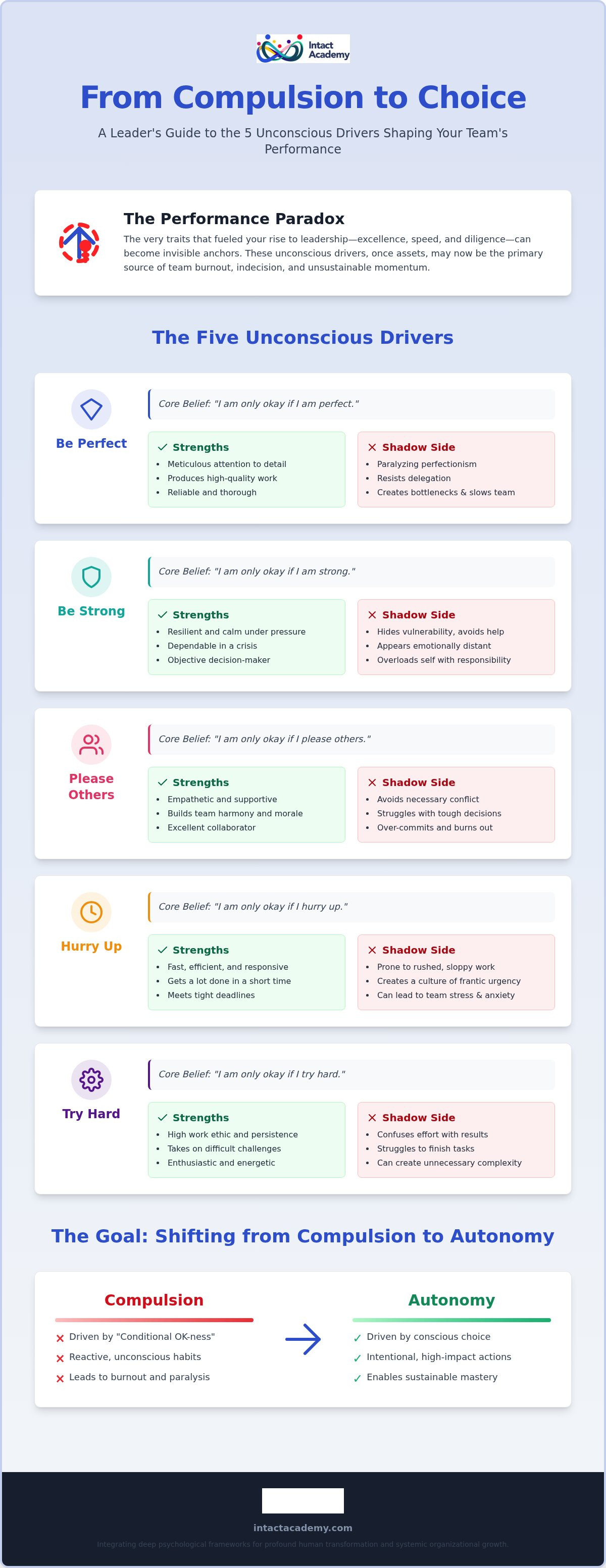
At the heart of this theory lies the concept of "Conditional OK-ness." This is the internal belief that "I am only okay if I..." followed by a specific requirement: if I am perfect, if I am strong, if I please others, if I hurry up, or if I try hard. In a professional context, this creates a fragile foundation for success. If a leader’s sense of value is tied to being "perfect," any minor error feels like a systemic failure. This psychological framework is superior to traditional performance models because it addresses the "why" behind chronic workplace issues, such as unexplained burnout or delegation resistance, which surface-level metrics often miss.
The Origin of Drivers: A Professional Perspective
Drivers don't appear for the first time in an executive suite. They develop in early childhood as survival strategies to gain approval or safety. A child who learns that they only receive attention when they are "the strong one" carries that blueprint into adulthood. Eventually, these strategies migrate into the boardroom. The "Parent" ego state, which contains the rules and values we've internalized, reinforces these behaviors by whispering that we must work harder or faster to remain relevant.
High-achievers are disproportionately influenced by these drivers. The very qualities that lead to early-career promotions, such as meticulous attention to detail or an incredible work ethic, are often the manifestations of "Be Perfect" or "Try Hard" drivers. However, what serves an individual contributor can often sabotage a leader. When the drive for individual excellence becomes a compulsion, it prevents the systemic growth necessary for organizational maturity.
Drivers vs. Ego States: Mapping the Internal Landscape
To understand the impact of these patterns, we must visualize how they manifest within the transactional analysis ego states. Drivers typically represent a brief, intense reaction where the Parent ego state takes control, demanding a specific behavior to alleviate an underlying anxiety. This reaction is a key component of our "Life Script," the unconscious plan we follow to navigate the world. A driver is a functional, albeit restrictive, behavioral response to perceived pressure that offers a temporary sense of relief from the fear of being "not okay."
- The Script Connection: Drivers act as the "entry point" to deeper script patterns that can lead to repetitive professional failures.
- Reactive vs. Proactive: While they feel like choices, drivers are actually reactive reflexes that limit our range of motion as leaders.
- Systemic Impact: One leader’s driver can trigger the drivers of an entire team, creating a self-reinforcing cycle of stress.
By employing TA driver theory for performance improvement, we begin the work of returning to a state of genuineness. We learn to recognize the moment a driver takes the wheel, allowing us to pause and choose a more autonomous, effective response.
The Five Drivers of Behavior: Identifying Strengths and Shadow Sides
Understanding the five drivers is essential for any leader utilizing TA driver theory for performance improvement. These patterns represent the internal engines that propel us toward success, yet they often carry a hidden psychological cost. Each driver offers a specific strength that can be leveraged for professional excellence, but when these behaviors become compulsive, they transform into "brakes" on sustainable growth. By identifying these patterns, we move from being driven by unconscious forces to leading with conscious intent.
- Be Perfect: This driver manifests as a quest for impeccable quality and precision. While it ensures high standards, its shadow side is a paralyzing fear of failure and a tendency to set unrealistic expectations that stifle team creativity.
- Please Others: These individuals are the masters of harmony and collaboration. However, the compulsion to please often results in a lack of boundaries, making it difficult to deliver necessary, direct feedback or make unpopular decisions.
- Be Strong: Resilience and calm under pressure are the hallmarks of this driver. The cost is often emotional suppression and a sense of isolation; the leader becomes a "lone wolf" who struggles to ask for help or connect authentically with their team.
- Hurry Up: This driver produces incredible speed and efficiency. The trade-off is a state of chronic agitation and a higher frequency of avoidable errors, as the internal clock demands "more, faster" at the expense of presence.
- Try Hard: Driven by innovation and the thrill of the new, these leaders are excellent at initiating projects. Their shadow side is a cycle of starting many ventures but struggling with the mundane work of completion, leading to organizational "initiative fatigue."
Recognizing Driver Language and Non-Verbal Cues
Observing these drivers in a professional environment requires attention to subtle linguistic and physical markers. A "Be Perfect" driver often uses qualifiers like "actually," "obviously," or "precisely" to ensure total clarity. Their posture is typically rigid, reflecting an internal demand for correctness. In contrast, those in a "Hurry Up" driver might tap their fingers, check their watches repeatedly, or speak in rapid, clipped sentences during team meetings. In email communication, look for the "Please Others" driver in excessive apologies or qualifiers like "I just wanted to check," which signal a high need for external validation before taking action.
The 'Allower': The Psychological Antidote
The path toward autonomy begins with the "Allower," a psychological antidote designed to neutralize driver-induced stress. An Allower isn't a dismissal of high standards; it's a permission to be human. For the "Be Perfect" leader, the Allower is the internal realization that "You are good enough as you are." For "Be Strong," it's the permission that "You can be open and meet your own needs." These permissions allow a leader to transition from a state of compulsion to a state of choice. When we integrate these insights, we don't lose our drive; we gain the freedom to use it effectively. For those who wish to master these nuances in a professional context, exploring the TA EMCC Senior Practitioner academy offers a structured path toward this level of psychological and professional mastery.
The Performance Paradox: When Unconscious Drivers Sabotage Organizational Growth
Many professionals find themselves trapped in what we might call a "Performance Paradox." The very behaviors that propelled them into senior management often become the primary obstacles to their continued growth. In the early stages of a career, a "Try Hard" or "Be Perfect" driver creates a reputation for reliability and high output. However, as leadership demands shift from individual execution to strategic oversight, these drivers begin to trigger mid-career burnout. Using TA driver theory for performance improvement allows us to see how these unconscious engines, once beneficial, eventually sabotage the systemic health of an organization.
Consider the leader possessed by a "Hurry Up" driver. Their internal clock is perpetually set to "urgent." While this might solve immediate crises, it radiates a culture of chronic anxiety throughout the team. Decisions are rushed. Reflection is viewed as a luxury. Long-term strategy is sacrificed for the dopamine hit of immediate motion. Similarly, a "Be Perfect" driver at the executive level often results in a paralyzing fear of failure. When the person at the top cannot tolerate imperfection, the entire organization becomes risk-averse. Stagnation follows, as innovation requires the messiness of trial and error that a "Be Perfect" driver cannot allow. This internal rigidity is particularly damaging when leading organizational change, as transformation requires a level of psychological flexibility that drivers inherently restrict.
Driver Contagion in Teams
Drivers are rarely isolated. They often create a "contagion" effect where team members unconsciously complement or mirror the leader's behavior. For instance, a leader who needs to "Please Others" may attract a team that avoids conflict at all costs. While the office environment feels harmonious, the lack of healthy friction means that critical truths remain unspoken. Breaking this cycle requires a systemic intervention that addresses the collective "Script" of the team, moving them from reactive compliance to authentic dialogue. When everyone is trying to be "okay" through their drivers, nobody is being real.
The Cost of the 'Strong' Leader
Among executives, the "Be Strong" driver is perhaps the most dangerous for long-term health. It demands total emotional suppression and a refusal to acknowledge vulnerability. This doesn't just impact executive mental health; it impairs systemic decision-making. A leader who cannot admit they are overwhelmed or uncertain loses access to the collective intelligence of their team. Encouraging vulnerability isn't a sign of weakness. It's a performance-enhancing tool. It creates a stable container where truth can be told, allowing the organization to pivot based on reality rather than a facade of strength. Moving beyond this driver is the first step toward true professional mastery.
From Compulsion to Autonomy: Strategies for Sustainable Performance Improvement
Shifting from a state of unconscious compulsion to one of professional autonomy is not a singular event; it's a methodical process of unlearning. When we apply TA driver theory for performance improvement, we aim to replace rigid, reactive habits with a flexible repertoire of responses. This transformation allows a leader to remain effective under pressure without sacrificing their well-being or the health of their team. The journey begins with internal recognition and moves toward systemic application.
The first step is Awareness. By using a Driver Checklist for self-diagnosis, you can identify which of the five drivers most frequently takes the wheel during stressful periods. Once identified, we move to Analysis. This involves uncovering the "Script" triggers that activate the driver. You might ask: "What specific professional scenario makes me feel I must be perfect to be okay?" Following this, we implement Permission. This is the active use of "Allowers" to neutralize the driver. In a high-pressure meeting, a "Hurry Up" leader might consciously tell themselves, "I have the time to think clearly."
The final stages involve Practice and Supervision. You must conduct small behavioral experiments to build new neural pathways, such as intentionally leaving a non-critical task "good enough" rather than "perfect." Refining this practice through professional feedback ensures that these changes aren't just temporary fixes but part of a deeper professional evolution. For leaders seeking to deepen this methodology within their own organizations, the TA EMCC Senior Practitioner academy provides the rigorous training necessary to facilitate these shifts.
Coaching Techniques for Driver Management
In coaching sessions, "Contracting" is a vital tool for managing driver behavior. By setting clear, explicit boundaries for the coaching relationship, you prevent the client's "Please Others" driver from turning the session into a search for approval. Another powerful method is the "Two-Chair" technique. This involves having the client voice the demands of their driver in one chair and their autonomous, adult response in another. This externalization makes the conflict manageable. When providing feedback, it's essential to be "driver-clean," ensuring your delivery doesn't inadvertently trigger a "Be Perfect" or "Be Strong" defense mechanism in the recipient.
Building a Driver-Aware Culture
Institutionalizing TA driver theory for performance improvement requires moving beyond individual coaching into the organizational fabric. You can integrate driver awareness into performance reviews by discussing not just the results, but the psychological cost of achieving them. This transparency builds "Psychological Safety," as team members feel safe acknowledging their own unconscious pressures. Autonomy in Transactional Analysis is the movement from a reactive, script-bound response to a state of conscious choice and genuine presence. When a culture values this autonomy, it moves from a state of collective anxiety to one of resilient, high-impact performance.
Integrating TA Driver Theory into Professional Coaching Mastery
Mastering the nuances of TA driver theory for performance improvement is not merely a technical skill; it's a foundational pillar of senior-level coaching. Within the TA EMCC Senior Practitioner academy, we move beyond the surface-level application of tools to explore the deeper psychological architecture of leadership. For a coach to facilitate sustainable change, they must be able to recognize when a client’s "Hurry Up" or "Be Perfect" driver is hijacking the coaching process itself. This level of intervention requires the coach to operate from a place of profound psychological awareness, shifting the focus from temporary behavioral fixes to lasting systemic transformation.
The journey toward mastery involves a critical transition from "doing" coaching to "being" a coach. While many practitioners focus on which questions to ask, the most impactful work happens when the coach remains present and autonomous, acting as a stable container for the client’s growth. This evolution is the core of professional development for coaches in 2026. By integrating TA driver theory for performance improvement into a broader systemic framework, practitioners learn to address the root causes of organizational dysfunction rather than just the symptoms of stress and burnout.
The Role of Supervision in Mastering Driver Theory
A coach cannot see their own drivers without the mirror of a supervisor. Because drivers are unconscious survival strategies, they often manifest as blind spots in our professional practice. We utilize the "7-Eyed Model" of supervision to analyze the complex transactions between the coach, the client, and the wider system. This process ensures that the coach’s own "Please Others" or "Be Strong" imperatives don't interfere with the client’s autonomy. There is an ethical imperative here; without driver-awareness, a coach risks inadvertently reinforcing the very compulsions that lead to executive exhaustion.
Your Path to Systemic Impact
Intact Academy is committed to the flourishing of global mentors who value depth and integrity. Our 2026 curriculum is designed for those who have the courage to change and the desire to lead others toward wholeness. Whether you are looking to refine your individual practice or lead large-scale organizational change through the TA EMCC Senior Team Coach Academy, our programs provide the structured methodology needed for professional mastery. The process of deep learning doesn't rush; it builds a narrative of evolution. We invite you to join our next intake and transform your coaching practice, moving beyond transactional training into the realm of profound human transformation.
Embracing the Path to Professional Wholeness
The journey from being driven by unconscious imperatives to leading with authentic presence is the hallmark of professional mastery. You've explored how the five drivers, while initially serving your success, eventually create a ceiling on your impact and your team's well-being. By applying TA driver theory for performance improvement, you begin to dismantle the rigid "Conditional OK-ness" that fuels burnout and stagnation. This transformation doesn't happen in isolation; it requires a commitment to deep, systemic awareness and the courage to choose a different path.
If you're ready to move beyond surface-level techniques and facilitate profound human transformation, we invite you to take the next step in your evolution. Elevate your coaching impact—Enroll in the TA EMCC Senior Practitioner Academy. Our programs are accredited by EMCC and ICF, ensuring your development meets the highest international standards. Taught by world-renowned expert Sari van Poelje, this academy focuses on deep systemic transformation rather than just surface skills. It's time to move from the exhaustion of "doing" into the quiet power of "being." We look forward to supporting your flourishing.
Frequently Asked Questions
What are the 5 drivers in Transactional Analysis?
The five drivers identified by Taibi Kahler are Be Perfect, Be Strong, Please Others, Hurry Up, and Try Hard. These represent internal imperatives that we unconsciously adopt to maintain a sense of "OK-ness" when we feel under pressure. Each driver offers a specific professional strength, such as precision or resilience, but becomes a restrictive compulsion when it operates beneath our conscious awareness.
How do TA drivers impact workplace performance?
Drivers act as the "unconscious engines" that initially propel early-career success but eventually lead to mid-career plateaus or burnout. By utilizing TA driver theory for performance improvement, organizations can identify why high-achievers might struggle with delegation or risk-aversion. When these drivers are unmanaged, they create systemic friction, such as chronic team anxiety or an inability to set healthy professional boundaries.
Can a person have more than one TA driver?
Yes, most individuals possess a primary driver accompanied by one or more secondary drivers that manifest in different scenarios. For example, a leader might operate from a "Hurry Up" driver during a crisis while switching to "Be Perfect" when reviewing a final report. Understanding the interplay between these different internal demands is essential for developing a flexible and autonomous leadership style.
How can I identify my primary TA driver?
You can identify your primary driver by observing your linguistic markers and physical responses during high-stress moments. Pay attention to the specific words you repeat, such as "actually" for Be Perfect or "just" for Please Others. Physical cues, like rapid speech or a rigid posture, also provide immediate evidence of which driver has taken control of your professional behavior.
What is the difference between a driver and a personality trait?
A driver is a reactive, situational defense mechanism triggered by stress, whereas a personality trait is a more stable and conscious aspect of your identity. While a trait might be a natural preference for detail, a "Be Perfect" driver is a compulsion that makes you feel "not okay" if a minor error occurs. Drivers are restrictive scripts; traits are part of your authentic self.
How can leaders help employees manage their drivers?
Leaders can support their teams by modeling "Allowers" and fostering an environment where psychological safety is a priority. By integrating TA driver theory for performance improvement into regular feedback loops, you help employees recognize their reactive patterns. This shift allows the team to move from a state of collective anxiety toward a culture of intentional, high-impact choice and genuine collaboration.
Is TA Driver Theory scientifically validated for business?
Transactional Analysis is a globally recognized framework with standards established by organizations like the International Transactional Analysis Association (ITAA). While workplace statistics are often qualitative, the theory is a staple in executive coaching and organizational development. It is widely utilized across 14 countries to address the human elements of systemic transformation and professional mastery in high-stakes environments.
What is an 'Allower' in Transactional Analysis?
An Allower is a psychological permission that acts as the direct antidote to a driver's restrictive demand. For instance, the Allower for "Be Strong" is the permission to be open and acknowledge one's own needs. These permissions don't lower professional standards; instead, they grant individuals the autonomy to pursue excellence from a place of wholeness rather than from a fear-based compulsion.


