

Why do so many team interventions lose their vitality just as the real work begins? You've likely seen the pattern: an energetic kickoff followed by a quiet retreat into the safety of old, hidden scripts by the ninety-day mark. When you're structuring a 6-month team coaching program, you aren't just scheduling sessions; you're building a psychological container strong enough to hold deep resistance and foster systemic autonomy. It's a frustrating reality for practitioners who seek more than superficial changes, yet true growth is found in this deliberate, rhythmic process of returning to a state of completeness and genuineness.
This guide helps you master the architectural depth required to move a team beyond surface-level dysfunction toward lasting transformation. We'll examine a repeatable framework, EMCC-aligned coaching structures, and the psychological tools necessary to navigate the complex human scripts that often stall organizational progress. By the end of this journey, you'll have the methodology to guide teams from dependency to a state of profound, sustainable flourishing, ensuring that every intervention carries the weight of professional pragmatism and human depth.
Key Takeaways
- Discover why a half-year journey serves as the ideal psychological container for shifting organizational life scripts and fostering sustainable growth.
- Learn to navigate multi-level contracting to align administrative requirements with the deep psychological needs of the team system.
- Master a rhythmic framework for structuring a 6-month team coaching program that prioritizes systemic mapping and diagnostic precision.
- Develop the skills to identify and interrupt hidden psychological games that prevent teams from reaching a state of genuine autonomy.
- Understand how to transition the coach out of the system effectively, ensuring the team maintains its momentum without developing unhealthy dependencies.
What Is a 6-Month Team Coaching Journey?
A 6-month team coaching journey is far more than a sequence of workshops; it's a deliberate developmental arc designed to reshape the underlying DNA of a group. When we speak of Coaching in a systemic context, we refer to the process of holding a mirror to the team's collective soul. This timeframe provides the necessary space for the initial enthusiasm to fade and for the real, often uncomfortable, work of cultural shifting to begin. While tactical interventions might solve a specific conflict or clarify a role, systemic transformation addresses the "organizational life scripts" that dictate how the team survives, competes, and relates under pressure.
Successfully structuring a 6-month team coaching program requires a shift in perspective from transactional problem-solving to systemic stewardship. In this framework, the coach acts as a "container," providing a stable psychological environment where the team can safely deconstruct old habits. This period is the "sweet spot" for change. It's long enough to allow new neural and social pathways to take root, yet short enough to maintain a sense of purposeful urgency. According to data from the International Coaching Federation, 87% of organizations report a positive return on investment from such developmental initiatives, primarily because they allow for the consistent follow-through that shorter programs lack.
The Psychology of the 6-Month Arc
From a Transactional Analysis (TA) perspective, a team's evolution mirrors the human process of maturation. In the first two months, teams often exist in a state of polite dependency, testing the boundaries of the coaching container. By month three, however, many teams hit a "crisis of change." This is the point where old scripts are no longer working, but new behaviors feel awkward or threatening. A 6-month structure provides the safety net needed to navigate this turbulence, moving the group from "Forming" to "Performing" by integrating these new ways of being into their daily operations.
Key Objectives of Long-Term Structuring
The primary goal of long-term structuring is to move the team toward systemic autonomy. This begins with establishing psychological safety as a non-negotiable foundation; without it, the team will never reveal the "hidden" scripts that drive their dysfunction. We aim to align individual ego states with collective goals, ensuring that personal motivations don't sabotage the group's success. By creating a sustainable rhythm of reflection and action, we teach the team to coach themselves. This ensures that the transformation continues long after the six-month journey concludes, returning the system to a state of wholeness and genuine power.
Phase 1: The Architecture of Contracting (Months 1-2)
The first sixty days of any systemic intervention are the most critical. When you're structuring a 6-month team coaching program, the initial phase isn't merely about logistical alignment; it's about building an architectural foundation that can withstand the psychological weight of change. This begins with a multi-level contract. While many practitioners focus only on the administrative details, a truly transformative program addresses the professional goals and the unspoken psychological expectations of every stakeholder involved. By purposefully structuring a 6-month team coaching program around these three dimensions, you ensure the system doesn't collapse when the novelty of the intervention fades.
Establishing baseline metrics for ROI during this phase ensures that the journey remains grounded in reality. By integrating effective coaching models like GROW or OSCAR into a systemic framework, you create a bridge between high-level theory and measurable organizational results. This process involves five key steps:
- Step 1: The Multi-Level Contract, covering administrative, professional, and psychological layers.
- Step 2: Diagnostic Interviews to surface the team's lived reality and hidden dynamics.
- Step 3: Defining the 'Primary Task', which is the team's core reason for existence and value creation.
- Step 4: Setting 'Ground Rules' to protect the 6-month container and establish psychological safety.
- Step 5: Establishing baseline metrics to track evolution and ensure a clear return on investment.
The Three-Cornered Contract
In systemic work, the relationship isn't just between the coach and the team. It involves a "three-cornered" dynamic between the sponsor, the team, and the coach. Each party often carries a hidden agenda. One might seek compliance, while another seeks revolution. We use transactional analysis to map the professional ego states of these stakeholders, ensuring that the contract is made between "Adult" parts of the system rather than "Parental" figures or "Rebellious" sub-groups. This clarity prevents the coaching from becoming a tool for organizational manipulation.
Diagnostic Tools for Systemic Mapping
To understand the team's current state, we move beyond surveys into systemic mapping. Tools like 'Social Atoms' or 'Team Constellations' reveal the invisible threads of influence and exclusion. These diagnostics assess the team's 'Life Script', showing how they instinctively handle success or failure. Contracting is the most critical TA competency for coaches, as it provides the ethical safety required to explore these deep undercurrents. If you wish to deepen your mastery of these foundational phases, the TA EMCC Senior Team Coach Academy offers the rigorous training needed to navigate these complex systemic waters.
Phase 2: Deep Interventions and Script Deconstruction (Months 3-4)
By the third and fourth months, the initial novelty of the coaching engagement typically evaporates, replaced by a heavy, palpable resistance. This is the "middle phase" where the real work of transformation begins. When structuring a 6-month team coaching program, you must anticipate this shift from polite cooperation to systemic friction. It's the point where the team's old, survival-based scripts clash with the new, autonomous behaviors you're trying to foster. While a standard guide to structuring a team coaching program might suggest doubling down on goals, a systemic approach requires you to look beneath the surface at the undercurrents of team dynamics.
Addressing the "Mid-Program Plateau" involves using provocative interventions to interrupt the status quo. In this stage, we move the focus from individual accountability to systemic responsibility. Instead of asking who is at fault for a missed deadline, we ask what the system is trying to achieve by failing. This subtle reframe helps the team see that their dysfunctions are often logical, albeit outdated, responses to organizational pressure. By deconstructing these scripts, the team begins to reclaim the energy previously spent on maintaining dysfunctional patterns, returning it to their primary task.
Spotting and Stopping Workplace Games
In the boardroom, conflict often manifests as "Psychological Games," which are repetitive, unconscious patterns that end in a predictable "payoff" of bad feelings. We use the Drama Triangle to analyze these interactions, identifying when members slip into the roles of Persecutor, Rescuer, or Victim. To stop these games, the coach must facilitate a move toward "Adult-Adult" transactions. This requires interpreting silence and resistance not as personal slights against the coach, but as vital systemic data. When a team falls silent, they're often communicating a boundary that hasn't yet been named.
Facilitating High-Stakes Transformation
Transformation doesn't happen in the abstract; it happens in the "here and now" of the session. Facilitating high-stakes change requires "working in the moment," where the coach highlights a dynamic as it occurs. We leverage the Sari van Poelje methods for agile systemic change to ensure these interventions are both deep and professional. This middle phase is essential for breaking old habits because it provides the team with a safe space to fail, learn, and eventually integrate more genuine ways of relating. It's the crucible where a group of individuals finally becomes a cohesive, self-aware system.
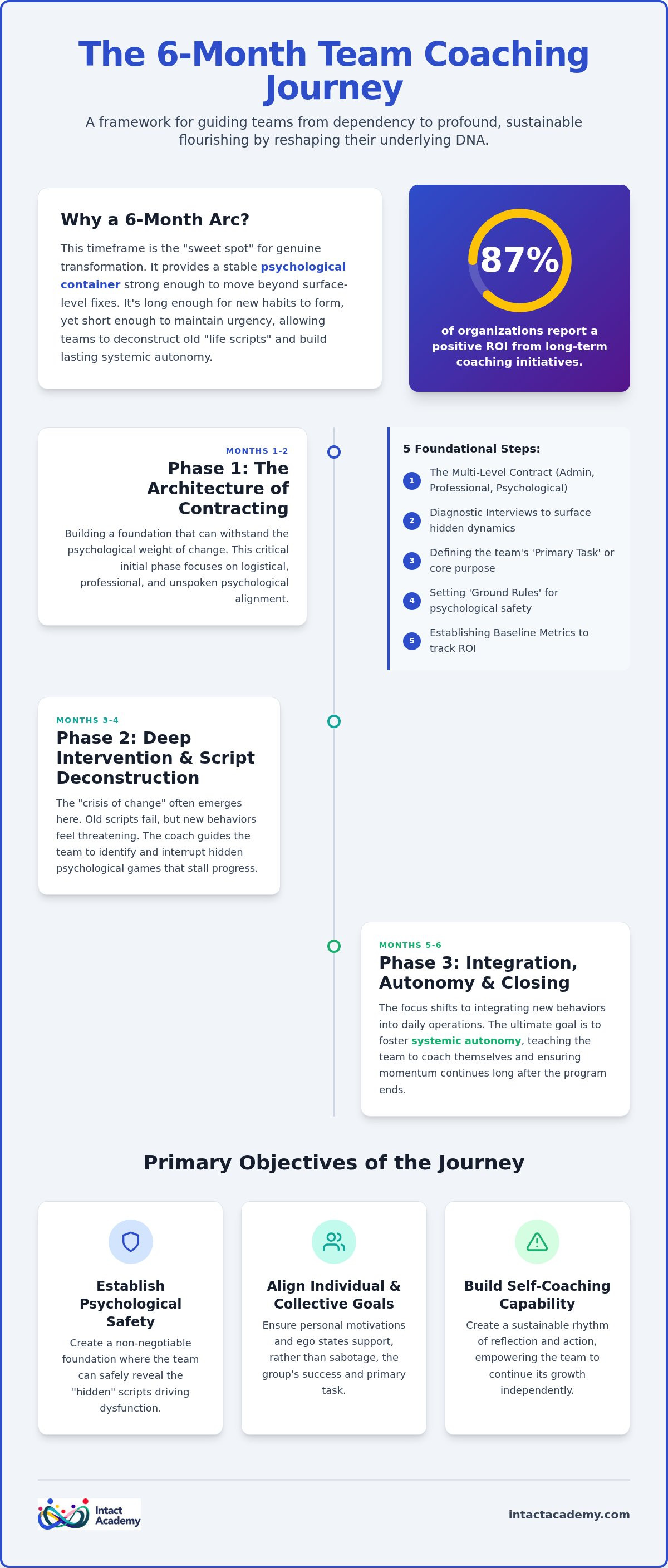
Phase 3: Integration, Autonomy, and Closing (Months 5-6)
The final sixty days of the journey represent a delicate transition from guided evolution to systemic independence. When structuring a 6-month team coaching program, the coach's primary objective is to facilitate their own obsolescence. This isn't a withdrawal of support, but an act of professional integrity. By gradually stepping back, you allow the team to occupy the space you once held, ensuring they don't develop an unhealthy dependency on your presence. It's the moment where the team proves they can maintain their new, genuine ways of interacting without the coach acting as their psychological container. Success is found when the system can return to a state of wholeness on its own.
Measuring progress against the baseline established in Month 1 provides the grounding needed to validate the journey. We return to the initial diagnostic mapping and ask: has the team's lived reality actually shifted? By comparing current behaviors with the early "Psychological Games" surfaced in the contracting phase, we quantify the evolution of the team's culture. This data doesn't just satisfy the coach; it forms the backbone of the final ROI report for stakeholders. It demonstrates that deep human transformation yields measurable business results, proving that a well-structured program integrates growth into the very fabric of the organization.
Achieving Systemic Autonomy
In the context of Transactional Analysis, autonomy isn't merely independence. It's the recovery of three essential human capacities: awareness, spontaneity, and intimacy. Awareness allows the team to see their systemic undercurrents in real-time. Spontaneity gives them the freedom to choose responses outside of their old, limiting scripts. Intimacy enables them to relate to one another without the interference of destructive workplace games. Equipping the team with these tools ensures they can coach themselves through future challenges, turning every obstacle into an opportunity for continued growth and collective wisdom.
The Final Review and Celebration
The ritual of closing is a vital component of the 6-month arc. It serves as a formal recognition of the journey and the results achieved. During the final review, we reflect on the profound script changes observed since the kickoff. This isn't a surface-level feedback loop; it's a deep inquiry into what the team has learned about their collective power and resilience. To ensure the transformation sticks, we co-create a 'Sustainability Plan' that includes scheduled maintenance sessions and peer-supervision structures. If you're ready to lead teams toward this level of systemic mastery, explore our TA EMCC Senior Team Coach Academy for advanced practitioner training.
Mastering the Arc with the TA EMCC Senior Team Coach Academy
The journey of a thousand miles begins with a single step, but the journey of a systemic transformation requires a map that accounts for the terrain of the human soul. At Intact Academy, we believe that structuring a 6-month team coaching program is an act of high-level stewardship. Our curriculum is designed to move beyond the transactional nature of traditional training, offering a path toward profound human flourishing. By integrating Transactional Analysis (TA), systemic methodology, and organizational agility, we provide a framework that allows coaches to hold the complexity of a team's evolution without losing their own grounding. This rigorous approach is the foundation of our team coaching course, which is accredited by the EMCC at the senior practitioner level.
A central pillar of this mastery is the role of systemic supervision. Navigating the intensity of a 6-month journey can be emotionally taxing for even the most experienced practitioners. Supervision provides a stable container for the coach, allowing them to process the "parallel processes" and countertransference that inevitably arise. It ensures that you remain an objective observer and a steady guide, rather than becoming entangled in the team's dysfunctional scripts. This reflective practice is not an optional extra; it's a professional necessity for those committed to the integrity of their work. We've seen that coaches who prioritize this level of support are far better equipped for structuring a 6-month team coaching program that yields sustainable, systemic change.
Why Psychological Depth Matters for Team Coaches
There is a significant difference between a facilitator who manages a meeting and a Senior Team Coach who transforms a system. Facilitation often addresses the "what," while systemic coaching explores the "how" and the "why." TA provides the essential map for this 6-month journey, offering precise language to describe the ego states and games that hinder collective progress. It allows you to see the team not just as a collection of individuals, but as a living entity with its own history, script, and potential for wholeness. We invite you to join our next cohort to experience this professional transformation firsthand, moving from surface-level interventions to deep, authoritative mastery.
Next Steps for Your Coaching Career
As you reflect on your current practice, consider the depth of your own developmental arcs. Are your programs losing momentum, or are they building toward systemic autonomy? To support your growth, we recommend a three-step audit of your current structures:
- Evaluate the strength of your multi-level contracts and diagnostic mapping.
- Analyze your ability to identify and interrupt psychological games in real-time.
- Audit your closing rituals to ensure they foster independence rather than dependency.
If you're ready to deepen your impact and achieve global accreditation, explore our professional development for coaches. This is more than a career move; it's a commitment to the flourishing of the human systems you serve.
Stepping Into Systemic Mastery
The journey from surface-level dysfunction to systemic autonomy is rarely linear, yet it is profoundly rewarding. By mastering the architectural depth of contracting and the precision of script deconstruction, you provide teams with the stable container they need to evolve. Structuring a 6-month team coaching program allows for the necessary rhythm of reflection and action, ensuring that the transformation isn't a fleeting moment but a permanent shift in the team's collective DNA. You move from being a facilitator of tasks to a steward of human flourishing, returning the system to its natural state of wholeness and genuineness.
If you're ready to deepen your impact and join a global community of practitioners, we invite you to enroll in the TA EMCC Senior Team Coach Academy to master systemic transformation. Led by global TA expert Sari van Poelje, this EMCC-accredited program offers the intellectual rigor and psychological depth required for senior practitioner success. Your commitment to this path is a commitment to the profound evolution of every system you touch. Step into your power as a senior coach and lead the way toward a more authentic professional world.
Frequently Asked Questions
How often should a team meet during a 6-month coaching program?
Teams typically meet for intensive sessions on a monthly or bi-monthly basis. This frequency provides enough space between sessions to integrate new behaviors into daily operations while maintaining the momentum of the developmental arc. It's the consistency of the rhythm, rather than the sheer volume of hours, that allows for deep systemic shifts.
What is the difference between team building and a 6-month coaching journey?
Team building is usually a tactical, event-based intervention focused on immediate morale or social bonding. A 6-month coaching journey is a systemic process that addresses the "undercurrents" and hidden scripts of the team. It focuses on long-term evolution and autonomy, moving the group from surface-level cooperation to profound human transformation.
How do you measure the ROI of a long-term team coaching engagement?
We measure ROI by comparing behavioral shifts against the baseline metrics established during the first month. Organizations often see measurable improvements in decision-making speed, conflict resolution, and collective productivity. According to the International Coaching Federation, 87% of organizations report a positive return on investment from such coaching initiatives.
What happens if a team member leaves or joins during the 6-month period?
Any change in composition is a systemic event that requires a recalibration of the psychological contract. We treat the departure or arrival as vital data to be explored within the coaching container. It's essential to integrate new members into the "primary task" without derailing the established arc of the program.
Is 6 months enough time to change a deep-seated organizational culture?
Six months serves as the ideal timeframe for initiating sustainable change in organizational life scripts. While complete cultural transformation is an ongoing process, this period allows for the identification and interruption of dysfunctional patterns. When structuring a 6-month team coaching program, the goal is to create the foundation for systemic autonomy that continues long after the program ends.
How do I handle a team that is resistant to the coaching process in Month 3?
Resistance in Month 3 is a predictable sign that the coaching is reaching the "crisis of change." We handle this by using provocative interventions to surface the hidden scripts causing the friction. Instead of pushing against the team, we invite them to look at what the resistance is protecting, turning the tension into a source of insight.
Do I need a specific certification to structure a 6-month team program?
Structuring a 6-month team coaching program with psychological depth requires specialized training beyond basic facilitation. Accreditation from professional bodies like the EMCC ensures you have the systemic supervision and ethical standards necessary to handle complex human dynamics. The TA EMCC Senior Team Coach Academy provides the rigorous training needed for this level of mastery.
What is the role of the 'Sponsor' in a 6-month team coaching contract?
The Sponsor provides the administrative and professional framework for the engagement. They are a critical party in the "three-cornered contract," ensuring that the team's developmental goals align with the broader organizational strategy. Their role is to provide the necessary resources and support while respecting the confidentiality of the coaching container.


