

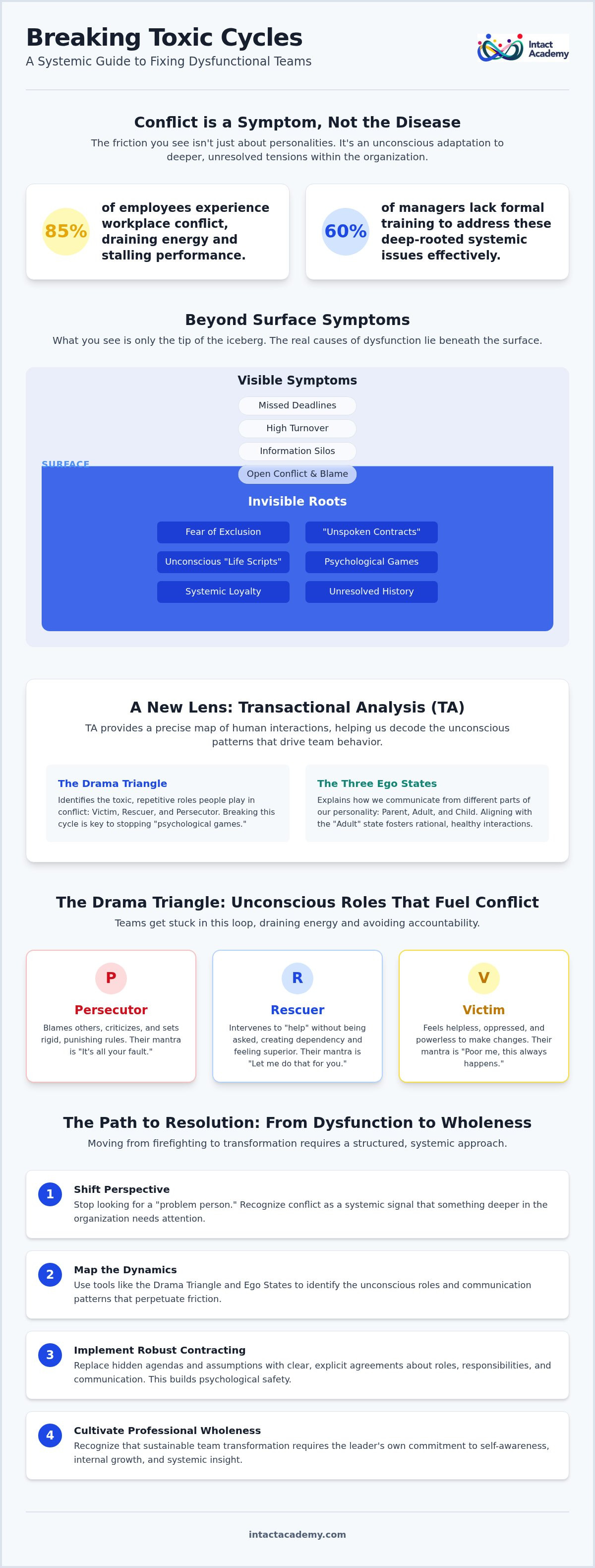
What if the recurring friction in your team isn't a failure of leadership, but a sophisticated survival mechanism designed to maintain a hidden status quo? You've likely spent months acting as the mediator in "he-said-she-said" disputes or watching brilliant individuals refuse to collaborate, leaving you feeling like a fixer who never quite succeeds. It's exhausting to witness a culture of blame take root when you know the potential for excellence exists just beneath the surface. Research indicates that 85% of employees experience workplace conflict, yet 60% of managers have never received formal training to address it effectively.
Learning how to fix a dysfunctional team requires more than a temporary workshop or a shift in policy; it demands a descent into the systemic imbalances and unconscious scripts that drive these behaviors. We'll move beyond surface symptoms to diagnose the deep-rooted psychological patterns that stall performance. This article provides a clear diagnostic framework and specific techniques to break toxic cycles, allowing you to move from reactive firefighting toward a state of sustainable transformation and professional wholeness.
Key Takeaways
- Shift your perspective from viewing conflict as individual failure to recognizing it as a systemic adaptation to deeper organizational tensions.
- Use Transactional Analysis and the "Drama Triangle" to map and dismantle the unconscious roles of Victim, Rescuer, and Persecutor that perpetuate friction.
- Master a structured methodology on how to fix a dysfunctional team by addressing "Parallel Processes" where team dynamics mirror broader systemic imbalances.
- Implement a robust contracting framework to replace hidden agendas with clear, explicit agreements that foster genuine collaboration and accountability.
- Cultivate professional wholeness by recognizing that sustainable team transformation requires the leader's own commitment to internal growth and systemic insight.
Beyond Surface Symptoms: Identifying the Systemic Roots of Team Dysfunction
When a team stalls, the instinct is often to hunt for the "problem person" or schedule a high-energy retreat. These are technical responses to what is almost always an adaptive, systemic challenge. If you're looking for how to fix a dysfunctional team, you must first accept that the dysfunction itself serves a purpose. It's an unconscious adaptation to unresolved tension elsewhere in the organization; it's a way of maintaining a precarious balance when the environment feels unsafe or unpredictable.
Standard fixes fail because they treat symptoms rather than the source. A skills gap is a technical problem that training can solve, but a chronic refusal to share information is a psychological pattern that requires a different lens. Learning how to fix a dysfunctional team is a process of unearthing hidden dynamics rather than simply rearranging the furniture. We often see leaders try to solve relational issues with productivity tools, ignoring the "Unspoken Contract" that governs how members actually interact. To understand these invisible scripts, practitioners frequently utilize Transactional Analysis, a framework that illuminates the social "games" people play to avoid genuine intimacy or accountability.
The Visible vs. Invisible Signs of a Broken Team
Visible symptoms like missed deadlines, silos, and high turnover rates are merely the tip of the iceberg. Beneath the surface lie the invisible roots: systemic loyalty to a departed leader, a collective fear of exclusion, or even unresolved historical trauma within the company. Distinguishing between a simple skill gap and a complex psychological game is the first step toward clarity. While a skill gap requires education, a psychological game requires a shift in the team's underlying emotional architecture. You can't train someone out of a survival strategy; you have to change the system that makes that strategy necessary.
Why 'Communication' Isn't Always the Answer
There is a persistent myth that more meetings or "open communication" will bridge deep-seated relational gaps. In reality, in a low-trust environment, mandated transparency often becomes a weapon for passive-aggression rather than a tool for connection. When the system feels threatened, it uses "communication" to reinforce existing silos and protect individual interests. Systemic dysfunction acts as a protective mechanism for the team's status quo. True resolution doesn't come from talking more; it comes from changing the systemic conditions that make silence or conflict feel necessary for survival. It requires the courage to look at the patterns we've all agreed to ignore.
The Psychology of Conflict: Using Transactional Analysis to Map Team Dynamics
To move from diagnosing a problem to actively healing a collective, we need a precise map of human interaction. Transactional Analysis (TA) provides this blueprint. While most frameworks focus on abstract concepts like trust or "vibe," TA looks at the granular exchanges between individuals. It asks a simple yet profound question: what is happening between us right now? Understanding these interactions is the cornerstone of how to fix a dysfunctional team. Without this lens, you are simply managing personalities; with it, you are adjusting the system's emotional frequency. You can find a deeper exploration of this methodology in our guide on What is Transactional Analysis?
Individual "Life Scripts"—those unconscious life plans formed in early development—often dictate how members show up in a professional setting. A person scripted to be "the strong one" may compulsively take on the burden of others, while another scripted to "never succeed" might unconsciously sabotage group goals. These scripts lead to "Psychological Games," which are repetitive, unproductive patterns of behavior that end in a predictable "payoff" of bad feelings. These games drain energy and distract from the primary task of the organization.
The Three Ego States in Team Interactions
The three ego states—Parent, Adult, and Child—shape every meeting and email exchange. When a leader operates from a "Critical Parent" state, they inadvertently invite an "Adapted Child" response from their staff, characterized by compliance or passive-aggression. This creates a cycle of dependency that stalls innovation. Professional problem-solving, however, thrives in Adult-to-Adult transactions. In this state, information is exchanged without the weight of historical baggage or emotional manipulation. It's a space of clarity and presence.
Breaking the Drama Triangle
Dysfunction often crystallizes into the "Drama Triangle," a social dynamic where members rotate between three roles:
- The Persecutor: Blames others and sets rigid, unattainable standards to maintain control.
- The Victim: Acts as if they are helpless, inviting others to take care of them while avoiding accountability.
- The Rescuer: Intervenes to "help" without being asked, which secretly keeps the Victim dependent and disempowered.
The "Rescuer" leader is a common trap; they feel indispensable but actually prevent the team from developing its own competence. To break this cycle, one must move from "Victim" to "Creator" and from "Rescuer" to "Coach." This shift requires systemic awareness and the courage to stop a game in its tracks by refusing to play the expected role. If you find yourself stuck in these loops, professional Team Coaching can provide the external perspective needed to identify and dissolve these patterns once and for all.
Mapping the System: Ego States, Boundaries, and Leadership Mirroring
Organizations function as fractals; the dynamics at the highest levels of leadership are often mirrored in the teams below. This phenomenon, known as a "Parallel Process," suggests that a team's internal friction is frequently a symptom of broader organizational tension. If you're investigating how to fix a dysfunctional team, you must look beyond the immediate group to see what they might be unconsciously reflecting. A team's behavior is rarely an isolated event; it's a systemic response to the environment it inhabits. When the executive level is fragmented, the teams beneath it will inevitably create silos to protect themselves from the resulting instability.
Learning how to fix a dysfunctional team means recognizing that you are never an impartial bystander; you are always an actor in the play. Often, a team remains "loyal" to a past leader or a legacy strategy that no longer serves the current mission. This loyalty is a survival mechanism, a way of clinging to a known identity when the future feels uncertain. To move forward, the team must be given permission to let go of these historical ghosts and align with the current reality. This requires a leader who can hold the space for both grief and growth.
The Leader as a Systemic Mirror
Leaders often see themselves as external observers attempting to repair a broken machine from the outside. However, a systemic perspective acknowledges that the leader is a vital component of the very system they wish to transform. Your own "Ego State" serves as a catalyst for the team's behavior. If you consistently operate from a Parent state, you inadvertently invite a Child state from your staff, reinforcing dependency or rebellion. For those navigating these complexities, Leading Organizational Change involves a deep awareness of these psychological undercurrents. In 2026, Systemic Supervision has emerged as an essential practice for leaders. It provides a reflective space to examine how your leadership style might be sustaining the status quo you claim to want to change.
Defining Healthy Boundaries and Authority
Healthy boundaries are the invisible architecture of a high-performing group. They define who is in, who is out, and what rules govern their interactions. When these boundaries are porous or rigid, the team loses its sense of purpose and psychological safety. You must distinguish between "Power Over," which is rooted in dominance and control, and "Power With," which is built on shared authority and mutual respect. Clear boundaries create the container for psychological safety. By re-centering the group on its "Primary Task," you strip away the relational noise and allow the team to focus on the work they were actually hired to do. This clarity is the foundation of any sustainable transformation.
The Path to Resolution: Contracting for Healthy Team Dynamics
Resolution begins when the invisible is made visible. While diagnosis provides the "why" of stagnation, the process of contracting provides the "how" of movement. In many struggling groups, the primary obstacle isn't a lack of desire to succeed; it's a web of conflicting, unspoken expectations that pull individuals in opposite directions. To understand how to fix a dysfunctional team, one must master the art of the multi-layered contract. This isn't a rigid legal document, but a living agreement that aligns the administrative, professional, and psychological dimensions of the work.
A systemic re-contracting session allows a team to reset its foundation through three distinct lenses. First, the Administrative Contract establishes the structural boundaries: time, resources, and specific goals. Second, the Professional Contract defines the required competencies and the measurable outputs the team must deliver. Finally, and most crucially, the Psychological Contract addresses the "unspoken" expectations regarding trust, recognition, and values. It's often in this third layer where the most profound transformations occur, as it requires members to voice their needs rather than acting them out through conflict.
Moving from Implicit to Explicit Agreements
Dysfunctional teams are often governed by "secret rules" that no one has ever written down but everyone follows. These might include rules like "never challenge the senior developer" or "don't bring up last year's failed merger." These implicit scripts create a culture of walking on eggshells. By facilitating a session where these rules are identified and challenged, you replace the ambiguity of "I thought you knew" with the clarity of "We agree that..." This shift moves the team into an Adult ego state, where collaboration is based on reality rather than historical projections. A skilled team coach acts as the guardian of this new contract, ensuring that the group doesn't slip back into old, comfortable patterns of avoidance.
Sustaining Change Through Accountability
Transformation is not a one-time event; it's a practice of continuous alignment. Developing a "Team Compass" based on shared systemic values ensures that the group has a North Star during times of high pressure. This requires establishing feedback loops that operate in the Adult state, allowing for course correction without the weight of blame or defensiveness. For professionals seeking to lead these complex interventions, Professional Development for Coaches offers the rigorous training needed to hold this space effectively. If you are ready to move from surface-level fixes to profound systemic change, consider joining the TA EMCC Senior Team Coach Academy to master these methodologies at an elite level.
Mastering Systemic Change: From Dysfunction to Professional Wholeness
The journey of learning how to fix a dysfunctional team inevitably leads back to the leader's own internal landscape. You cannot lead a team to a place of psychological safety and high performance if you remain trapped in the role of the "fixer" who stands outside the system. True mastery requires a shift from viewing the team as a broken machine to seeing it as a living organism that mirrors your own presence and ego states. This evolution marks the transition from a manager who solves problems to a transformational leader who facilitates growth through professional wholeness.
Professional wholeness is the integration of your personal depth with your business impact. It's the state of being where your actions are aligned with your values, and your leadership is grounded in systemic insight rather than reactive firefighting. When you operate from this state, you provide a stable container for your team to navigate their own transformations. The Intact Academy approach to Systemic Team Coaching emphasizes this return to completeness, moving beyond mere metrics to honor the human experience within the organization. It's about creating a space where everyone can show up as their genuine selves, contributing to a collective mission without the burden of toxic scripts.
The Role of Accredited Training in Team Mastery
Navigating the complex psychological undercurrents of a modern organization requires more than intuition; it demands a rigorous, evidence-based toolkit. For those dealing with deeply entrenched patterns, EMCC Senior Practitioner level training provides the depth necessary to hold complex systemic cases. Transactional Analysis offers a lifelong framework for understanding these organizational shifts, allowing you to decode transactions in real-time and intervene with precision. For leaders who wish to deepen their impact, pursuing an Executive Coaching Certification can be a profound step toward mastering the intersection of human behavior and business strategy. This level of accreditation ensures that your interventions are grounded in global standards of excellence.
Your Next Steps Toward Systemic Excellence
If you're currently wondering how to fix a dysfunctional team, the first 30 days of recovery should focus on observation and re-contracting. Stop the "Rescuer" impulses and begin to name the "Games" as they occur in your meetings. Establish clear, Adult-to-Adult agreements regarding communication and accountability, and stick to them. However, some systemic cycles are too deeply rooted to be resolved from within. When you feel like you're spinning in circles despite your best efforts, it's time to seek external systemic supervision or professional team coaching. These interventions provide the "safety net" needed to explore psychosocial hazards without causing further disruption. To begin your own journey toward professional mastery, we invite you to explore the TA EMCC Senior Team Coach Academy and discover how systemic depth can lead to sustainable organizational flourishing.
Cultivating the Future of Collective Flourishing
The journey from friction to flow requires more than a tactical adjustment; it demands a profound shift in how we perceive human systems. By moving beyond surface level symptoms and utilizing Transactional Analysis, you gain the clarity to see the hidden scripts that drive behavior. You've learned that understanding how to fix a dysfunctional team is fundamentally about addressing the psychological contracts and systemic loyalties that bind us to the past. It's a process of returning to a state of professional wholeness, where the leader and the team evolve together in a shared container of safety and purpose.
This transition is often the most challenging work a professional will undertake. It requires a stable methodology and the courage to look inward before acting outward. If you're ready to master these systemic complexities, we invite you to deepen your impact with our TA EMCC Senior Team Coach Academy. Led by global expert Sari van Poelje, our International EMCC and ICF Accredited Programs have transformed leaders across 14+ countries. The path to transformation is open, and the potential for your team to thrive is within reach. Your commitment to this depth is the first step toward a more genuine and effective professional reality.
Frequently Asked Questions
What are the first signs that a team is becoming dysfunctional?
The earliest indicators are often subtle shifts in communication, such as a move from direct dialogue to "whisper networks" or passive-aggressive silence. You might notice a sudden drop in risk-taking or a rigid adherence to rules over results. These signs suggest the team's "Unspoken Contract" is shifting toward self-preservation rather than collective goals. It's a signal that the system is prioritizing safety over performance.
Can a single toxic employee cause an entire team to be dysfunctional?
While one individual's behavior can be disruptive, a systemic view suggests that "toxic" behavior is often a symptom of the team's wider environment. The individual may be acting out a role the system needs to maintain its current, albeit painful, balance. Addressing the individual without looking at the systemic "payoff" for their behavior rarely provides a lasting fix. True transformation looks at the group's collective script.
How long does it typically take to fix a dysfunctional team dynamic?
Transformation usually requires six to twelve months of consistent, deliberate work to rewrite deep-seated psychological scripts. While you can establish new administrative contracts in a few weeks, shifting the underlying "Psychological Contract" takes time. This duration allows for the integration of new behaviors and the stabilization of a healthier systemic status quo. Learning how to fix a dysfunctional team is a marathon of consistency rather than a sprint of interventions.
What is the difference between team conflict and team dysfunction?
Conflict is a visible, often healthy disagreement over tasks or ideas, whereas dysfunction is a chronic, systemic inability to resolve those disagreements. In a functional team, conflict leads to growth and clarity. In a dysfunctional one, it leads to repetitive "Psychological Games" that drain energy and prevent the team from achieving its primary task. Conflict is about the work; dysfunction is about the system's survival mechanisms.
How can Transactional Analysis help in resolving workplace arguments?
Transactional Analysis helps by allowing individuals to identify the "Ego State" from which they are communicating, such as Parent, Adult, or Child. When you recognize that an argument is a "Game" between a Critical Parent and a Rebellious Child, you can consciously shift back to an Adult-to-Adult transaction. This shift de-escalates the emotional charge and refocuses the conversation on reality. It provides a clear, objective language for complex emotional exchanges.
Is it possible to fix a dysfunctional team without firing anyone?
It is often possible to fix a dysfunctional team by changing the systemic conditions and renegotiating the "Psychological Contract" between members. When the rules of engagement shift from implicit survival to explicit collaboration, many individuals find they no longer need their toxic defenses. This requires a collective commitment to radical honesty and professional wholeness. However, the system must be strong enough to support this level of individual growth.
What role does the leader play in creating team dysfunction?
The leader often serves as a "Systemic Mirror," unconsciously reinforcing the very dynamics they wish to change through their own Ego States. If a leader operates from a "Rescuer" position, they inadvertently create "Victims" within the team, stalling growth and accountability. Understanding how to fix a dysfunctional team requires the leader to first examine their own role in the system's current architecture. The leader's internal transformation is often the catalyst for the team's recovery.
When should a manager hire an external team coach?
A manager should consider an external team coach when they feel stuck in a "Parallel Process" or when internal attempts at mediation have failed. External experts provide a neutral, systemic perspective that is difficult to maintain from within. They offer a "safety net" for the team to explore deep-rooted patterns without fear of retribution. This is especially vital when the conflict has become personalized or when the leader is part of the friction.


