

What if the recurring friction in your executive coaching sessions isn't a lack of professional will, but an invisible script being played out through shifting identities? You've likely felt the quiet frustration of watching a brilliant leader revert to defensive or over-controlling behaviors, even when the path forward seems clear. It's a common plateau where standard goal-setting tools often lose their edge, leaving you searching for a more rigorous psychological framework. By mastering transactional analysis ego states in coaching, you can move beyond surface-level symptoms to diagnose the underlying systemic patterns that keep your clients stuck in self-sabotaging loops.
You recognize that true change requires more than just new habits; it demands a return to a state of completeness and genuineness. This guide provides the methodology to master the Parent-Adult-Child model, allowing you to resolve complex blocks and elevate your practice toward a Senior Practitioner level. We'll explore how to identify these states in real-time, facilitate sustainable transformation, and sharpen your diagnostic precision for high-conflict executive dynamics. Through this lens, you'll gain the clarity needed to guide your clients toward lasting organizational success and profound personal wholeness.
Key Takeaways
- Learn why mastering transactional analysis ego states in coaching provides the psychological rigor needed to diagnose deep-seated behavioral patterns and systemic blocks.
- Distinguish between internal structural content and external functional behaviors to facilitate change that is both profound and sustainable.
- Identify advanced dynamics such as contamination and exclusion to help clients move beyond rigid identities and reclaim their professional autonomy.
- Apply a methodical four-step process for facilitating real-time state shifts, ensuring your coaching remains anchored in a professional Adult-Adult contract.
- Understand how these advanced diagnostic skills bridge the gap between foundational practice and the mastery required for EMCC Senior Practitioner accreditation.
Understanding Ego States: The Map of Human Interaction in Coaching
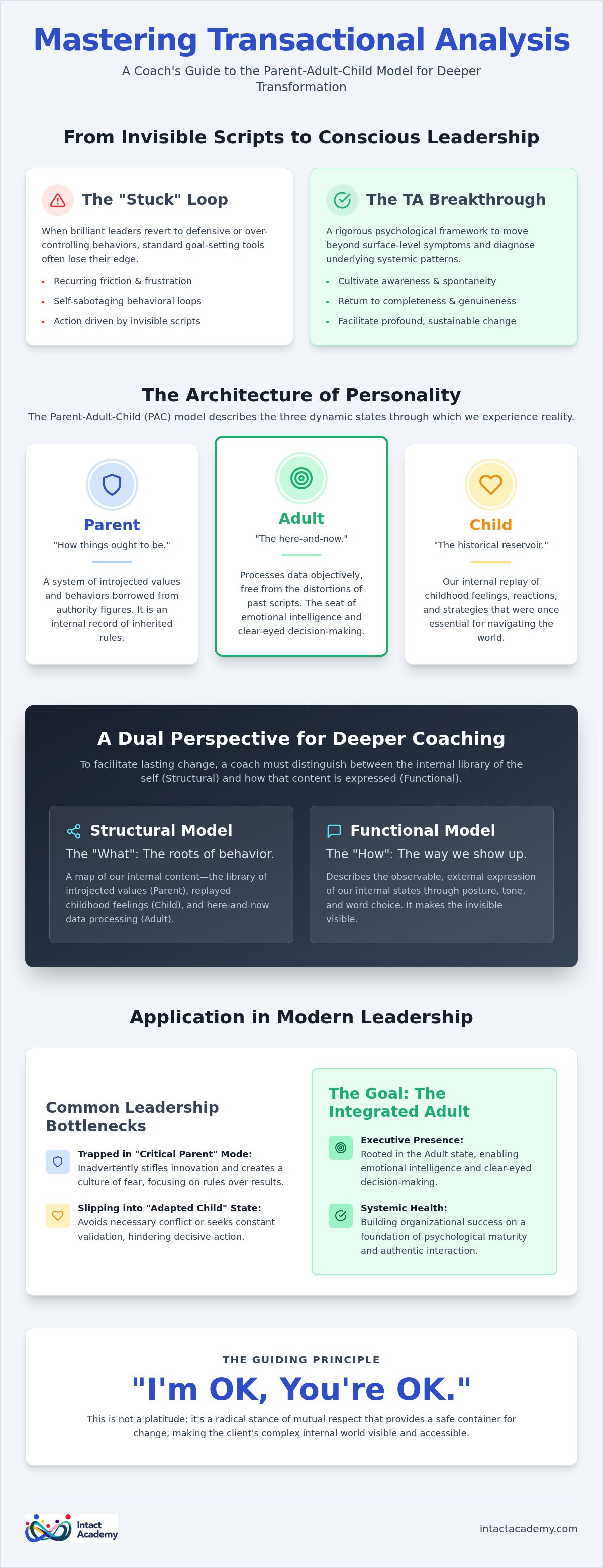
To truly understand a client's world, we must first look at the lenses through which they experience reality. In the context of Transactional Analysis, an ego state is defined as a consistent system of feelings accompanied by a related set of behavior patterns. It's not a static personality trait, but a dynamic, real-time expression of how a person processes their environment and relationships. For the professional, utilizing transactional analysis ego states in coaching offers a gold standard for psychological depth. It moves the dialogue from surface-level performance metrics to the foundational structures of human interaction. The goal of this work isn't just behavioral adjustment; it's the cultivation of awareness, spontaneity, and the capacity for genuine intimacy.
We work with three primary states that form the architecture of our personality. The Parent ego state consists of introjected values and behaviors borrowed from authority figures. It dictates how things ought to be. The Child is our historical reservoir, containing the feelings and reactions we developed in our early years. In contrast, the Adult ego state represents the here-and-now. It processes data objectively, free from the distortions of past scripts or inherited rules. By distinguishing these states, a coach helps the client return to a state of completeness and genuineness.
The Origins of the Parent-Adult-Child (PAC) Model
Eric Berne revolutionized developmental work by shifting the focus from hidden psychoanalytic drives to observable transactions. He realized that while we can't see a thought, we can observe the shift in a client's posture, tone, and word choice as they move between states. This model is built on the philosophical foundation of "I'm OK, You're OK." This isn't a mere platitude; it's a radical stance of mutual respect that provides a safe container for change. It allows coaches to see the client's complex internal world through the window of their external behavior, making the invisible visible.
Why Ego States Matter for Modern Leadership
Modern leadership demands a shift from transactional control to transformational presence. When a leader is trapped in a "Critical Parent" mode, they inadvertently stifle innovation and create a culture of fear. Conversely, when they slip into an "Adapted Child" state, they may avoid necessary conflict or seek constant validation. Integrating transactional analysis ego states in coaching allows leaders to identify these bottlenecks. Executive presence is rooted in the Adult state, where emotional intelligence and clear-eyed decision-making reside. By fostering this awareness, we ensure that organizational success is built on a foundation of psychological maturity and systemic health.
The Architecture of Personality: Structural vs. Functional Ego States
To facilitate deep, sustainable change, a coach must look beneath the surface of behavior. While many focus on what a client says, the systemic coach observes the underlying architecture of the personality. Structural ego states tell us what is inside the internal library of the self, while functional states describe how that content is currently being expressed in the world. Mastering transactional analysis ego states in coaching requires this dual perspective. Without it, we risk addressing the symptom while leaving the root cause untouched.
The Structural Model: The Roots of Behavior
The structural model is a map of internal content. The Parent ego state is a collection of introjected values and behaviors from authority figures; it functions as an internal record of inherited rules. The Child ego state represents a re-play of childhood feelings and strategies that were once essential for navigating the world. In contrast, the Adult is the integration of here-and-now data processing without historical contamination. As defined by the International Transactional Analysis Association, these states form the core of our psychological reality, influencing our professional presence and decision-making long before we speak a word.
The Functional Model: How We Show Up
If the structural model is the what, the functional model is the how. It's the observable part of the personality that interacts with others. We categorize the Parent into the Nurturing Parent (NP), who supports growth, and the Controlling or Critical Parent (CP), who sets limits. The Child is divided into the Natural or Free Child (FC), which is the source of raw emotion, and the Adapted Child (AC), who responds to social rules through compliance or rebellion. Understanding these distinctions allows you to see the systemic impact of a leader's presence in real time.
| Functional State | Positive manifestation (Corporate) | Negative manifestation (Corporate) |
|---|---|---|
| Controlling Parent | Clear boundaries and high standards. | Micromanagement and harsh judgment. |
| Nurturing Parent | Mentorship and psychological safety. | Over-protection that stifles autonomy. |
| Free Child | Innovation and authentic enthusiasm. | Unprofessionalism or lack of boundaries. |
| Adapted Child | Reliability and team cooperation. | Passive-aggression or fear of taking risks. |
In high-stakes moments, the Adult ego state must function as the Executive. It acts as a calm mediator, deciding when to deploy the Nurturing Parent’s empathy or the Free Child’s creativity while filtering out the unhelpful scripts of the Critical Parent. Achieving this level of mastery allows you to help clients return to a state of completeness and genuineness. For those seeking to deepen their diagnostic skills, exploring a professional development path in TA can transform how you navigate complex executive dynamics and systemic blocks.
Advanced Dynamics: Contamination, Exclusion, and Symbiosis
True mastery in systemic work begins when we move beyond labeling ego states and start observing their dynamic interactions. In high-pressure environments, the boundaries between a client’s Adult, Parent, and Child can become blurred through contamination or entirely shut off through exclusion. Exclusion happens when a client is "stuck" in one state, such as a leader who operates solely from a "Constant Parent" position and cannot access their Child’s creativity or their Adult’s flexibility. When we apply transactional analysis ego states in coaching, our goal isn't to diagnose like a clinician. Rather, we use these concepts as a strategic map to understand why a brilliant leader might suddenly lose their objectivity or why a team remains stuck in a cycle of dependency. It’s about creating the psychological safety required for the client to return to their natural state of completeness.
Recognizing Contamination in the C-Suite
Contamination occurs when the Adult ego state’s objective reality is interfered with by either the Parent or the Child. In the C-suite, this often manifests as Parent-contamination, where rigid corporate dogmas and "shoulds" are mistaken for current data. A leader might say, "A CEO must never show vulnerability," treating a borrowed rule as an absolute truth. Conversely, Child-contamination involves fears or illusions clouding decision-making. This looks like "magical thinking" about market trends or catastrophic anxiety regarding a minor setback. To help a client de-contaminate their Adult, we might ask:
- "Which part of this perspective is based on today’s data, and which part is a rule you’ve carried for a long time?"
- "If you stripped away the fear of the outcome, what does the objective reality tell you right now?"
Symbiosis and Dependency in Teams
Systemic symbiosis is a frequent bottleneck in organizational culture. It happens when two or more people function as if they are a single person, with one party using only their Parent and Adult states while the others remain in their Child state. You’ll see this when a leader acts as the "Constant Parent," making every decision, while the team stays in "Adapted Child," waiting for instructions and avoiding responsibility. This creates a fragile ecosystem where growth is impossible because no one is fully present. It’s a pattern that drains energy and stifles the very spontaneity required for innovation.
In the coaching room, you’ll encounter "Invitations to Symbiosis." A client might try to pull you into a Parent role by asking, "Just tell me what to do," or into a Child role by becoming overly defensive. Your power lies in remaining in your Adult. By refusing to play the counterpart in their script, you force the client to re-engage their own Adult state. This is the core of the work we do in the TA EMCC Senior Practitioner academy, where we train coaches to hold this Adult-Adult contract even amidst intense systemic pressure. Staying grounded in this way allows the client to see their own patterns without feeling judged, opening the door to genuine transformation.
Transactional Analysis in Practice: Shifting States for Transformation
Transformation is not an accident; it's a deliberate movement from a historical script toward present-moment autonomy. When applying transactional analysis ego states in coaching, the professional must maintain an unwavering "Adult-Adult" contract. When you remain grounded in your Adult state, you provide the stable container necessary for the client to risk stepping out of their own Parent or Child states. This level of psychological discipline is a core component of achieving an Executive Coaching Certification. It ensures that the coaching relationship remains a space for growth rather than a replay of old dependencies.
The 4-Step Shift Methodology
Facilitating a shift in transactional analysis ego states in coaching involves a methodical four-step approach that moves the client from unconscious reaction to conscious action. This process allows the client to look inward before they attempt to change their outward environment. The steps include:
- Step 1: Observation. We notice the subtle shifts in tone, posture, and language that signal a change in state. A sudden tightening of the jaw or a "should" statement often points to the Parent ego state.
- Step 2: Inquiry. We gently bring the client's awareness to their current state without judgment. You might ask, "I notice your voice has become quite firm; what's happening for you right now?"
- Step 3: Choice. We explore different functional options. We might ask, "What would your Nurturing Parent say here instead of the Critical Parent?" or "How would your Adult process this data?"
- Step 4: Integration. We anchor the new perspective into a concrete action plan, ensuring the shift translates into the client's professional reality.
Using Egograms to Map Leadership Style
An Egogram serves as a powerful visual tool, representing the specific amount of psychological energy a client spends in each functional ego state. By drawing a simple bar chart, clients often experience a profound realization about the imbalance in their leadership style. A leader who sees a towering "Critical Parent" bar and a dormant "Free Child" bar begins to understand why their team lacks innovation. This clarity is essential for leading organizational change, as a leader's energy distribution directly shapes the team's culture and performance.
This tool is grounded in the Constancy Hypothesis. This principle suggests that psychological energy is finite; if the intensity of one ego state increases, the others must decrease to maintain the system's balance. By consciously deciding to increase their Adult or Nurturing Parent energy, a leader naturally reduces the space available for unhelpful Critical Parent behaviors. Rebalancing this energy is the work of a master practitioner. If you're ready to move beyond the basics and master these advanced techniques, consider joining our TA EMCC Senior Practitioner academy to refine your systemic impact and professional presence.
Path to Mastery: TA in Senior Practitioner Accreditation
The transition from a foundational coach to a Senior Practitioner is marked by a shift in depth rather than just a collection of hours. It's the difference between following a process and holding a system. While many practitioners can facilitate a goal-setting session, the master coach recognizes the invisible scripts and ego state shifts that dictate a client's success. Mastering transactional analysis ego states in coaching is the bridge to this level of professional maturity. It provides the diagnostic rigor required to navigate high-stakes executive environments where surface-level interventions often fail. This journey begins with a clear understanding of what is transactional analysis and how its systemic application can transform organizational culture.
Meeting EMCC and ICF Senior Standards with TA
Aligning your practice with EMCC and ICF senior standards requires a commitment to continuous professional development for coaches. Transactional Analysis offers a robust framework for meeting core competencies such as "Self-development" and "Managing the Contract." To manage a contract at a senior level, you must maintain a clean Adult-Adult agreement, ensuring that neither you nor the client slips into Parent or Child dependencies. This psychological clarity creates the safety required for executives to explore their most challenging systemic blocks. Furthermore, regular supervision is essential. It acts as a mirror, helping you maintain your own Adult state and ensuring your internal Parent or Child scripts don't contaminate the coaching container.
Joining the Intact Academy Community
At Intact Academy, we don't just teach theory; we facilitate a return to a state of completeness and genuineness. Led by Sari van Poelje, our programs emphasize a unique systemic perspective that has been refined across 14 countries. You aren't just learning a model; you're joining an international community of peers dedicated to profound human transformation. Whether you engage with us in Utrecht or through our global online reach, you'll find a space that honors your intelligence and pushes your practice toward excellence. We move fluidly between high-level theoretical frameworks and direct, actionable directives, ensuring you leave with both insight and methodology.
Mastering transactional analysis ego states in coaching is a lifelong path of evolution. It requires the courage to look inward before taking outward action and the integrity to hold a mirror up to the most powerful leaders. If you're ready to elevate your practice and meet the rigorous requirements for senior accreditation, we invite you to take the next step. Apply for the TA EMCC Senior Practitioner academy today to begin your journey toward systemic mastery and lasting professional impact.
Advancing Toward Systemic Mastery and Wholeness
Mastering the nuances of transactional analysis ego states in coaching is a journey of returning to a state of completeness. You've explored how the Parent-Adult-Child model serves as more than just a map; it's a real-time diagnostic language for mapping systemic patterns. By distinguishing between structural roots and functional behaviors, and recognizing the subtle pull of contamination or symbiosis, you move beyond surface-level interventions. This level of psychological rigor is what separates a foundational coach from a master practitioner capable of facilitating sustainable transformation in the most complex executive environments.
If you're ready to bridge the gap between theory and profound organizational impact, we invite you to deepen your expertise. Our programs are accredited by EMCC and ICF, providing a stable container for your growth under the guidance of world-renowned expert Sari van Poelje. You can elevate your practice at the TA EMCC Senior Practitioner Academy to master these systemic tools and sharpen your professional presence. The path to senior mastery isn't just about what you do, but about the depth of who you are in the coaching room. We look forward to supporting your evolution.
Frequently Asked Questions
What are the three ego states in Transactional Analysis?
The three ego states are the Parent, the Adult, and the Child. The Parent ego state consists of introjected values and behaviors from authority figures, while the Child state represents a reservoir of our early emotional reactions and strategies. The Adult ego state is our capacity to process here-and-now data objectively, functioning as the mediator between our historical scripts and our current reality.
How do I know which ego state my coaching client is in?
You identify a client's state by observing shifts in their physiology, tone of voice, and vocabulary. A client in a Parent state might use "should" or "must" while displaying a rigid posture; one in a Child state might show heightened emotionality or a defensive stance. Utilizing transactional analysis ego states in coaching requires this keen observational skill to catch these subtle transitions as they happen in real time.
Can a coach use Transactional Analysis without being a therapist?
Yes, coaches use TA as a practical communication map rather than a therapeutic tool for clinical diagnosis. While therapists might explore deep-seated trauma, coaches use these frameworks to resolve systemic blocks and improve professional interpersonal dynamics. It's about enhancing awareness, spontaneity, and professional effectiveness in the workplace without crossing into clinical psychotherapy.
What is ego state contamination in a leadership context?
Contamination occurs when the Adult's objective reality is clouded by unexamined scripts from the Parent or Child ego states. In a leadership context, this often looks like an executive making critical decisions based on rigid corporate dogmas or irrational fears rather than current market data. De-contaminating the Adult is essential for maintaining executive presence and making clear-eyed, strategic choices.
How does the Adult-to-Adult transaction improve team performance?
Adult-to-Adult transactions create a culture of psychological safety and shared responsibility by eliminating "Parent-Child" dependency loops. When a leader communicates from their Adult state, they invite team members to do the same, which fosters objective problem-solving and mutual accountability. This shift ensures that conflict is handled through logical negotiation rather than emotional reaction or micro-management.
Is Transactional Analysis accredited by the EMCC or ICF?
Transactional Analysis is a theoretical model, but specific training programs that teach it can be accredited by major coaching bodies. Intact Academy's programs are recognized by the EMCC, ICF, and EATA, ensuring the training meets rigorous global standards. This accreditation is vital for coaches who wish to align their practice with senior practitioner requirements and professional ethics.
What is a functional ego state vs. a structural ego state?
The structural model describes the internal content and history of the personality, while the functional model describes how that content is expressed externally. Structural ego states are the "what" of our internal psychological library. Functional ego states are the "how" of our interactions, categorized into observable behaviors like the Nurturing Parent, the Controlling Parent, or the Adapted Child.
How can I start learning TA for my coaching practice?
You can begin by exploring foundational concepts and then enrolling in a structured, accredited program led by experienced mentors. The TA EMCC Senior Practitioner academy is the logical next step for those seeking to integrate transactional analysis ego states in coaching at a mastery level. This path provides the stable container needed for deep learning and the systemic transformation of your coaching practice.


