

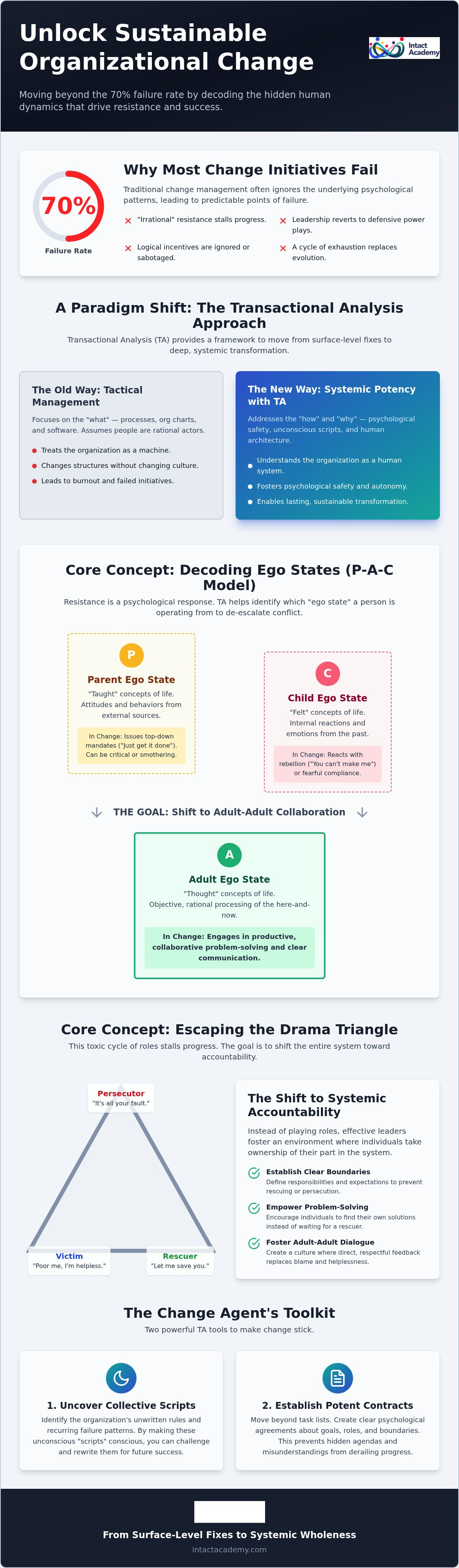
Why do the most meticulously planned organizational shifts often crumble under the weight of "irrational" resistance? You've likely witnessed the phenomenon: a leadership team that agrees on strategy in the boardroom but reverts to defensive power plays in the corridor, or a change initiative that stalls despite every logical incentive being in place. It's a painful reality confirmed by industry data, with reports from McKinsey and Prosci historically indicating that 70% of change programs fail to meet their goals. When surface-level coaching fails to address these deep-seated cultural patterns, the result is a cycle of exhaustion rather than evolution.
By integrating the psychological depth of transactional analysis in change management, we can move beyond the symptoms of resistance to understand the underlying systemic scripts. You'll discover how to leverage this framework to decode the unconscious patterns that define your culture, providing a clear map to de-escalate workplace drama and foster genuine psychological safety. This article previews a path toward professional mastery, where you learn to facilitate change that isn't just a temporary shift in behavior, but a profound return to organizational wholeness and effectiveness.
Key Takeaways
- Understand how to use the PAC model to identify ego states, allowing you to move from reactive Parent-Child resistance toward productive Adult-Adult collaboration.
- Learn to decode the unconscious Collective Scripts that cause recurring failure patterns, using transactional analysis in change management to ensure sustainable transformation.
- Master the tools to exit the Drama Triangle, shifting leadership teams away from the roles of Persecutor, Rescuer, and Victim toward a state of systemic accountability.
- Develop the skill of professional Contracting to establish clear psychological boundaries and goals, preventing the hidden undercurrents of human behavior from derailing progress.
- Transition from surface-level coaching to systemic potency, gaining the intellectual and emotional depth required to lead complex organizational transitions with clarity.
Beyond Surface-Level Shifts: Why Change Management Requires Transactional Analysis
Traditional change management often treats the organization as a collection of spreadsheets, flowcharts, and logical imperatives. It assumes that if the business case is sound, the transition will follow a linear path toward success. Yet, we know that the "human factor" is rarely linear. Transactional analysis provides the sophisticated map required to navigate this human architecture, offering a way to see the invisible threads of communication and motivation that either bind a team together or pull it apart. Without this depth, leaders are often left shouting into a void, wondering why their well-crafted strategies are met with silence or subtle sabotage.
In a change context, we define this methodology as a tool for reclaiming organizational autonomy. It's about moving from a state of reactive habit to one of conscious choice. Transactional Analysis serves as a rigorous systemic framework that enables organizational agility in 2026 by aligning unconscious psychological drivers with conscious strategic objectives.
The Human Architecture of Organizational Systems
Organizations aren't just structures; they're intricate webs of psychological transactions. When we look through the lens of transactional analysis in change management, we stop seeing "rational" employees and start seeing "psychological" humans. Every meeting, email, and hallway conversation is a transaction that carries emotional weight. If these transactions are rooted in fear or outdated organizational scripts, no amount of technical restructuring will create lasting change. True systemic shifts require a foundation of psychological safety. In this space, individuals feel seen in their wholeness, allowing them to drop defensive postures and engage with the transition from a place of genuine curiosity and Adult-level problem solving.
Moving from Tactical to Systemic Change
Most change initiatives are tactical. They move boxes on an org chart or implement new software without addressing the underlying culture. This is why surface-level restructuring rarely leads to genuine evolution; it changes the "what" without touching the "how" or the "why." To achieve deep transformation, the change agent must act as a "systemic witness." This role requires you to observe the patterns of interaction and call out the unconscious dynamics that stall progress before they become entrenched. By leading organizational change through this systemic lens, you move from merely fixing problems to facilitating a state of organizational health. You don't just change the system; you help the system learn how to change itself, ensuring that the transformation isn't just a temporary peak, but a new baseline for excellence.
The Architecture of Resistance: Decoding Ego States in Organizational Transitions
Resistance is often mislabeled as a lack of commitment or a failure of communication. In reality, it's a structural psychological response. By applying transactional analysis in change management, we can see that resistance is the outward manifestation of ego states shifting under pressure. When the stability of an organization is threatened, individuals often retreat from their Adult state, the seat of objective, here and now processing, into Parent or Child states. This regression isn't a sign of weakness; it's a survival mechanism. Research into TA in Managerial Training suggests that when leaders recognize these internal shifts, they can adapt their communication to stabilize the system rather than inflame it.
Consider the C-suite during a merger. If a CEO adopts a "Critical Parent" stance, issuing top-down mandates without consultation, they inadvertently invite an "Adapted Child" response from their directors. This might look like outward compliance followed by subtle sabotage or a "Rebellious Child" response of open defiance. These crossed transactions, where the psychological level of the message contradicts the social level, are where most change initiatives begin to leak energy. The Adult ego state remains the only foundation for objective decision making and true change agility, yet it's the first state to be compromised when uncertainty rises.
Identifying Ego States in High-Stakes Teams
In teams facing forced restructuring, the "Rebellious Child" often surfaces through cynicism or the withholding of vital information. To counter this, leaders must move away from "Critical Parent" behaviors, such as blame or rigid control, and instead lean into "Nurturing Parent" or, ideally, "Adult" states. Inviting the Adult during stakeholder consultations involves presenting data transparently and asking open-ended questions that require cognitive processing rather than emotional reaction. This shift honors the intelligence of the team and creates a container for genuine engagement. It's about moving from a "doing to" approach to a "doing with" philosophy.
De-escalating Conflict During Restructuring
Employee complaints are rarely just about the new process; they're often coded messages about a loss of autonomy or security. Using transactional analysis in change management to decode these messages allows the change agent to listen for the underlying ego state. If a team is stuck in a reactive "Child" state, practical steps include clarifying the "contract" for the transition and providing structured spaces for reflection. For instance, a leadership team I mentored moved from a cycle of blame to systemic responsibility by identifying when they were speaking from "Parent" scripts and consciously choosing to return to "Adult" inquiry. This level of systemic organizational change requires more than just new tools; it requires a new way of being that prioritizes wholeness over habit.
Mapping the Unseen: How Life Scripts and Organizational Culture Block Progress
While ego states explain the immediate interactions of a team, Life Scripts reveal the long-term narratives that dictate organizational behavior. In the context of transactional analysis in change management, a script is an unconscious professional narrative; a blueprint for work and success written during the foundational stages of an organization's history. These scripts determine how a company responds to crisis, how it handles victory, and, most importantly, how it resists or embraces transformation. Gaining a deep understanding of what is transactional analysis allows us to see these blueprints as historical decisions rather than immutable laws of nature.
The Collective Script: Why Cultures Resist Transformation
Every organization carries a "Collective Script," a shared unconscious story often rooted in the founder’s original vision or an early, defining crisis. This script becomes the invisible architecture of the culture. For many companies, "the way we do things here" is not a rational choice but a survival strategy designed to avoid a repetition of past pain. You might recognize a script of failure through the "Gallows Humor" shared in the corridors. These jokes about projects failing or initiatives being "flavor of the month" are often signals of deep-seated injunctions, such as "Don’t Succeed" or "Don’t Change." These injunctions act as psychological brakes, silently sabotaging even the most well-funded change programs.
Uncovering Unconscious Organizational Narratives
To move toward a "Winning Script" that supports innovation, change consultants must audit these hidden narratives. This process involves looking beyond official mission statements to the stories employees tell about risk and reward. Just as individuals use Transactional Analysis for Professional Growth to rediscover their authentic potential, organizations can use these tools to shed restrictive patterns. The alignment between an individual’s life script and the organizational script determines their long-term engagement. When these narratives clash, the result is often burnout or stagnation. When they align toward growth, the system achieves a state of potency.
A systemic script audit might include:
- Identifying recurring "tragic" themes in previous failed initiatives.
- Tracing the origin of "Don't" injunctions back to previous leadership eras or economic shocks.
- Replacing scripts of scarcity with a culture of permission and systemic wholeness.
By mapping these unseen blueprints, we provide the leadership team with the awareness needed to choose a different ending to their story. This is the work of professional mastery: helping a system return to its state of completeness and genuineness by rewriting the scripts that no longer serve its flourishing.
The Change Agent’s Toolkit: Navigating Drama and Establishing Potent Contracts
While understanding scripts provides the "why" behind organizational stagnation, the change agent requires active tools to handle the "how" of daily transformation. Change initiatives don't just stall; they often suffocate under the weight of unresolved interpersonal drama. By employing transactional analysis in change management, the practitioner gains a precise vocabulary to identify these dynamics before they deplete the system's energy. This toolkit moves beyond simple communication tips, focusing instead on the structural integrity of the change process itself.
Escaping the Drama Triangle in High-Stakes Transitions
The Drama Triangle, consisting of the Persecutor, Rescuer, and Victim roles, is perhaps the most common source of change fatigue. In the heat of a transition, it's easy for the change manager to slip into the Rescuer role, attempting to "save" the organization by taking on more than their share of the emotional labor. This inevitably leads to burnout and a sense of being unappreciated. Conversely, employees may adopt the Victim role, feeling overwhelmed by new technologies or structures. Shifting these stakeholders toward a "Creator" mindset is essential during digital transformations. To exit the triangle, a practitioner must provide Potency through their professional authority, Protection through a secure psychological container, and Permission for the system to think and act in ways it previously did not allow.
The Power of Multi-Cornered Contracting
Success in systemic change is born from the quality of the contract established at the outset. Vague aspirations like "improving collaboration" lack the psychological weight necessary to drive real evolution. We must move toward multi-cornered contracting, a process that explicitly aligns the expectations of the coach, the executive leader, and the organizational system. This level of precision helps identify ulterior transactions; those hidden agendas where the spoken agreement is undermined by unspoken fears or power plays. Maintaining the integrity of these complex agreements often requires the support of professional supervision, ensuring the change agent stays aligned with the system's growth rather than its defensive habits.
To sustain momentum during long-term transitions, the change agent must also master the use of "strokes," or units of recognition. By intentionally acknowledging Adult-level behaviors and small wins, you provide the psychological fuel necessary for the team to persist through the "messy middle" of change. For those seeking to lead at this level of systemic depth, our TA EMCC Senior Practitioner academy offers the rigorous training needed to master these advanced methodologies.
Professional Evolution: Integrating TA into Your Change Management Practice
The transition from understanding the theoretical components of ego states and life scripts to achieving true systemic potency is a journey of professional maturation. It's one thing to identify a "Rebellious Child" response in a meeting; it's quite another to hold the psychological space required for an entire leadership team to rewrite its collective narrative. As we look toward 2026, the complexity of global organizational transitions demands more than surface-level coaching tools. Senior practitioners need a framework that is as robust as the systems they seek to influence. Mastering transactional analysis in change management provides this depth, moving you from a facilitator of tasks to a catalyst for profound human transformation.
At Intact Academy, our philosophy is rooted in the idea of returning to a state of completeness and genuineness. We believe that for an organization to flourish, its leaders and consultants must first do the work of personal and professional integration. This isn't merely about adding a new methodology to your resume. It's about evolving your executive presence so that your very way of being invites the system into a state of Adult-level awareness and health.
From Theory to Potency: The Intact Academy Approach
Our approach combines deep psychological insight with a relentless focus on professional pragmatism. By learning from global experts like Sari van Poelje, you gain access to decades of experience in applying systemic TA to the world's most complex organizational challenges. We don't just teach you how to use a toolkit; we show you how to integrate these concepts into systemic team coaching and high-level consulting. This integration allows you to remain calm and authoritative in the face of intense resistance, providing the "protection" and "permission" the system needs to shed its outdated scripts. You'll learn to see the organization as a living entity, capable of movement and evolution when the right psychological levers are pulled.
The Journey to EMCC Senior Practitioner Accreditation
The path to professional mastery is often a solitary one, yet it's best traveled within an international community of practice. In the TA EMCC Senior Practitioner academy, you join a cohort of peers from over 14 countries, all dedicated to the highest standards of systemic change. This diversity of perspective reflects the global citizenship of our brand and ensures that your learning is as broad as it is deep. Accredited training through the EMCC and ICF doesn't just validate your expertise; it elevates your impact as an international consultant, providing you with the credentials to match your systemic potency.
If you're ready to move beyond transactional coaching and into the realm of lasting organizational wholeness, we invite you to take the next step. Join our next intake for the TA EMCC Senior Team Coach Academy and begin your own evolution toward professional mastery.
Mastering the Systemic Art of Organizational Wholeness
The journey toward sustainable transformation is rarely found in tactical adjustments; it's discovered in the psychological bedrock of the organization. By applying transactional analysis in change management, you gain the ability to see beyond the immediate friction of a transition to the deeper systemic currents that drive behavior. You've learned to decode ego states to stabilize high-stakes teams. You've discovered how to rewrite collective scripts that previously anchored the culture in failure. By using potent contracting, you can finally exit the repetitive cycles of the Drama Triangle.
This level of mastery requires more than just knowledge; it demands an evolution of your own professional presence. Our programs, led by global expert Sari van Poelje and accredited by the EMCC and ICF, provide the stable container needed for this deep learning. It's time to move toward a state of genuine organizational health and professional excellence. Elevate your impact with the TA EMCC Senior Practitioner Academy. The path to systemic potency is open to those with the courage to look beneath the surface and the commitment to lead with depth.
Frequently Asked Questions
How does Transactional Analysis differ from traditional change management models?
Transactional Analysis moves beyond the tactical checklists of traditional models to address the unconscious psychological undercurrents of an organization. While conventional frameworks focus on the "what" of restructuring, TA provides a map for the "how" of human interaction. It allows practitioners to decode the hidden transactions that either fuel progress or anchor a system in repetitive failure patterns.
Can I use TA in change management without being a therapist?
You absolutely can. Transactional Analysis is applied across four distinct professional fields, with the "Organizations" specialization designed specifically for leaders, coaches, and consultants. In this context, the focus is on professional dynamics, systemic health, and organizational agility rather than clinical treatment. It's a methodology for professional mastery and systemic evolution.
What are the three ego states and how do they manifest during a corporate merger?
The three ego states are Parent, Adult, and Child. During a merger, the Parent state often manifests as rigid, top-down mandates from leadership that can feel critical or overbearing. The Child state appears as anxiety, withdrawal, or rebellion among employees facing uncertainty. The Adult state is the seat of objective, here and now processing, where teams can engage in collaborative problem-solving and strategic alignment.
How can TA help identify the root cause of "resistance to change"?
TA identifies resistance as a structural psychological response rather than a personal failing. By applying transactional analysis in change management, we see that resistance often stems from unconscious injunctions like "Don't Change" or "Don't Succeed" that are embedded in the culture. This insight allows consultants to address the psychological source of the stall rather than merely managing its outward symptoms.
What is an organizational "Life Script" and why does it matter?
An organizational Life Script is a shared unconscious narrative, often rooted in the founder's vision, that dictates how a company responds to risk and growth. It matters because it acts as an invisible blueprint for the culture. If a script is written toward scarcity or survival, it will silently sabotage innovation until the leadership team consciously chooses to rewrite the ending of their story.
How do I avoid the Drama Triangle as a change management consultant?
Avoiding the Drama Triangle requires a commitment to Adult-Adult transactions and rigorous professional contracting. Consultants often fall into the "Rescuer" role, attempting to carry the emotional weight of a transition, which inevitably leads to burnout. By maintaining clear boundaries and providing systemic potency, you allow the organization to reclaim its own autonomy and responsibility for change.
Is TA training accredited for senior-level coaching and consulting?
High-level programs like the TA EMCC Senior Practitioner academy are fully accredited by international bodies including the EMCC and ICF. These certifications ensure that your application of transactional analysis in change management meets the highest global standards for professional competence. This accreditation bridges the gap between deep psychological theory and pragmatic executive-level consulting.
How long does it take to master Transactional Analysis for organizational use?
Mastering TA is a multi-year journey of professional and personal integration. While foundational concepts can be grasped in an introductory TA 101 course, achieving the level of a Certified Transactional Analyst typically involves at least four years of structured training and supervised practice. It's a deliberate process of becoming a more potent and grounded change agent.


