
The most effective coaching tool isn't always the most sophisticated one. It's the one that matches the depth of the problem you're trying to solve. If you've been exploring the debate around transactional analysis vs NLP, you're likely already asking a more important question beneath it: why do some clients transform completely, while others cycle through the same patterns no matter how skilled the intervention?
That frustration is real, and it's shared by serious practitioners at every level. You've seen clients leave sessions energized, only to return weeks later having quietly reverted. You've wondered whether your methodology is reaching the root, or simply reshaping the surface. These aren't signs of failure; they're signs that you're ready to go deeper.
This article gives you a clear, honest comparison of both frameworks: their philosophical foundations, their clinical depth, their accreditation pathways, and the kind of transformation each one is genuinely built to support. By the end, you'll have a principled basis for choosing the path that leads not just to competence, but to the level of mastery where lasting change becomes your professional signature.
Key Takeaways
- Understanding the transactional analysis vs NLP debate reveals a deeper professional question: whether you need a behavioral toolkit or a comprehensive psychological framework for lasting client transformation.
- NLP and TA serve fundamentally different purposes — NLP addresses how we process information, while TA maps why we relate the way we do, making your choice of framework a direct reflection of the depth of change you intend to create.
- The concept of the Life Script explains why high-performing executives repeatedly self-sabotage, and why surface-level coaching strategies consistently fail to break the cycle.
- Accredited, TA-rooted training — recognized by bodies such as EMCC and ICF — offers a measurably different professional trajectory than short-form certification programs, particularly for practitioners working at senior and systemic levels.
- You will discover how a systemic, TA-grounded approach equips coaches and consultants to work not just with individuals, but with the relational and organizational patterns that sustain or undermine lasting change.
Transactional Analysis vs NLP: Decoding the Professional's Choice
Both Transactional Analysis and Neuro-Linguistic Programming share a common ambition: to make human growth more deliberate, more accessible, and more repeatable. Both frameworks have helped practitioners around the world facilitate breakthroughs in communication, self-awareness, and behavior. Yet choosing between them is not simply a matter of preference. It's a declaration about the kind of practitioner you intend to become.
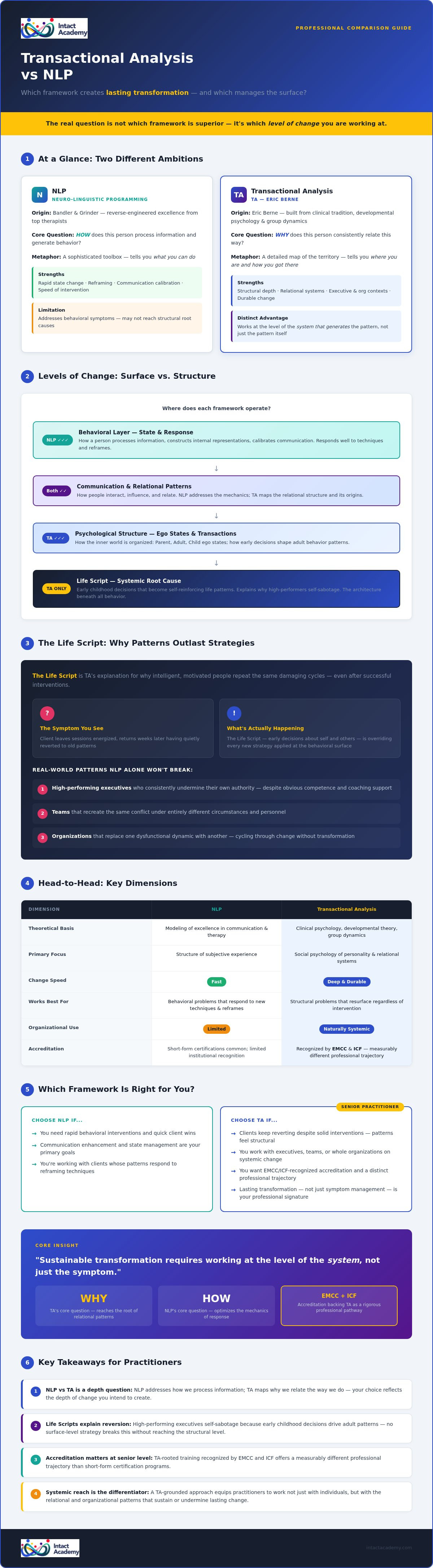
At its core, Transactional Analysis is a social psychology of personality and relational systems. Developed by psychiatrist Eric Berne, it offers a comprehensive map of how people structure their inner world, how they communicate across that structure, and how early decisions about life become self-reinforcing patterns that persist into adulthood. NLP, by contrast, is a study of the structure of subjective experience. Developed by Richard Bandler and John Grinder through the modeling of exceptional therapists, it asks a precise question: how do high-performing individuals organize their thinking, language, and behavior to produce results?
The tension at the heart of the transactional analysis vs NLP debate is not about which framework is superior. It's about which level of change you're working at. Are you managing a client's state, or are you transforming the system that generates that state in the first place?
The Origins of Impact: Clinical Depth vs. Modeling Excellence
Berne built TA from within the clinical tradition, grounding it in observable relational data, developmental psychology, and group dynamics. This lineage gives TA a structural rigor that translates naturally into executive and organizational contexts, where patterns are systemic and change must be durable. NLP evolved differently. Bandler and Grinder weren't building a theory; they were reverse-engineering excellence. The result is a powerful behavioral toolkit, one that excels at rapid state change, reframing, and communication calibration. Its speed is genuinely useful. But speed and depth are different virtues.
The Practitioner's Dilemma: Fixing a Symptom or Evolving a System?
Pause and consider your current client challenges honestly. Are the patterns you're encountering behavioral, meaning they respond to new techniques and reframes? Or are they structural, meaning they resurface regardless of the intervention? A leader who consistently undermines their own authority, a team that recreates the same conflict under different circumstances, an organization that replaces one dysfunctional dynamic with another: these are not behavioral problems. They are systemic ones.
Sustainable transformation, the kind that defines a Senior Practitioner's reputation, requires working at the level of the system, not just the symptom. This is the professional territory that Sari van Poelje: Mastering Systemic Change has spent decades mapping, bringing together TA's structural depth with a rigorous understanding of how organizations evolve, resist, and ultimately transform.
Framing transactional analysis vs NLP as a simple toolkit comparison misses the point entirely. The real question is whether your methodology can reach the architecture of change, not just its surface expression.
The Structural Difference: Psychological Frameworks vs. Behavioral Techniques
Think of NLP as a sophisticated toolbox and Transactional Analysis as a detailed map of the territory itself. Both are genuinely useful. But a toolbox tells you what you can do; a map tells you where you are, how you got there, and why certain routes keep leading back to the same destination. That distinction is the heart of the transactional analysis vs NLP debate, and it has profound implications for the kind of practitioner you become.
NLP asks how: how does this person process information, construct their internal representations, and generate their behavioral responses? TA asks why: why does this person consistently relate this way, what early decisions are driving that pattern, and what relational system is sustaining it? One optimizes performance; the other transforms the architecture beneath it. Transactional Analysis, at its most precise, is a comprehensive theory of personality and social dynamics, offering practitioners a complete language for understanding human behavior from the inside out.
NLP: The Science of State Management and Excellence
NLP is built on four foundational pillars: Rapport, Sensory Awareness, Outcome Thinking, and Behavioral Flexibility. Together, they create a framework for calibrating communication and shifting internal states with speed and precision. Techniques like Anchoring (linking a resourceful state to a physical cue), Reframing (changing the meaning attributed to an experience), and the Swish Pattern (replacing an unwanted automatic response with a desired one) give coaches practical tools for rapid intervention. These methods genuinely shine in short-term performance coaching, habit disruption, and communication skills development, contexts where the goal is behavioral change rather than structural transformation.
Transactional Analysis: The Art of Systemic Awareness and Ego States
TA introduces the Parent-Adult-Child (PAC) model, not as a metaphor, but as a real-time analytical instrument. In any given interaction, a leader may respond from their Critical Parent, a team member may withdraw into their Adaptive Child, and the Adult ego state that could facilitate genuine resolution remains entirely absent. Recognizing these dynamics in the room changes everything a coach can do with them.
Understanding what transactional analysis is reveals something that NLP rarely addresses: organizational culture is itself a relational system, shaped by the unspoken psychological contracts between people. Teams don't just have communication problems; they have embedded transactional patterns that replicate themselves across projects, leadership changes, and restructures.
This is where TA's systemic depth becomes a professional differentiator. If your ambition is to work at the level where those patterns actually live, exploring TA-grounded senior practitioner training offers a rigorous foundation that behavioral techniques alone simply cannot provide.
Beyond Surface-Level Change: Why Life Scripts Outlast Strategies
Here's the objection that surfaces regularly in professional development circles: isn't Transactional Analysis too focused on the past to be relevant in business coaching? It's a fair question, and it deserves a precise answer. TA isn't interested in the past for its own sake. It's interested in the past because the past is still running the present, quietly, automatically, and often invisibly to the very leaders who are paying for coaching.
Berne described the Life Script as an unconscious life plan, formed in early childhood through decisions made in response to parental messages and environmental pressures. These decisions aren't random; they're survival strategies, and as Salarah K Starre notes, identifying when these subconscious cycles are active is essential for moving from survival to true autonomy. The script doesn't announce itself. It simply shapes which opportunities feel possible, which relationships feel safe, and which outcomes feel deserved.
Consider a conditional scenario that will be familiar to any senior practitioner. A high-performing leader uses NLP-based techniques to manage their anxiety in high-stakes presentations. They anchor a calm state, they reframe pressure as excitement, and they perform well. But six months later, their team is exhausted and disengaged. Why? Because the same leader's script carries an early decision: I am only safe when I control everything. No anchoring technique touches that. The calm exterior remains; the micromanagement intensifies. NLP addressed the symptom. The script continued its work beneath it.
This is the defining fault line in the transactional analysis vs NLP debate: NLP's Outcome Thinking asks "what do you want instead?" TA's Script Analysis asks "what decision are you unconsciously committed to, and why does it feel more real than what you say you want?" One optimizes toward a goal. The other examines the architecture that quietly dismantles goals before they can take root.
NLP for Tactical Shifts and Immediate Results
NLP genuinely excels in specific, bounded contexts. Overcoming stage fright before a keynote, building immediate rapport with a new stakeholder, or interrupting a specific habitual response: these are legitimate use cases where NLP's speed is an asset. Think of it as a first-aid kit for the modern executive. Effective, targeted, and valuable precisely because it doesn't require excavating the deeper system. The limitation appears when the technique is no longer actively applied and the underlying pattern reasserts itself, as it reliably does.
TA for Sustainable Transformation and Organizational Change
TA gives coaches something NLP's toolkit rarely provides: a language for Psychological Games, the repetitive, unconscious transactional sequences that teams play out to confirm their shared script beliefs. A leadership team that cycles through blame, withdrawal, and false resolution isn't dysfunctional by accident. They're enacting a collective script, and no reframe will interrupt it at the level where it actually lives.
Leading organizational change from a TA perspective means working with the company's collective script: the unspoken agreements about who has power, what failure means, and which voices are permitted. That's systemic work, and it requires a framework built for systemic depth.
Ultimately, TA points toward something more fundamental than behavioral change. Berne called it autonomy: the recovered capacity for awareness, spontaneity, and genuine intimacy. In an organizational context, autonomy means leaders who respond to what's actually happening rather than to the script's instructions. That's not a technique. It's a transformation.
Implementation: Choosing the Right Path for Your Coaching Mastery
Choosing a methodology isn't a philosophical exercise. It's a practical decision with real consequences for your clients, your credibility, and your career trajectory. The transactional analysis vs NLP question ultimately resolves into a single, clarifying question you need to answer honestly: what level of change are you being called to create?
Start with your current client base and your genuine professional ambitions. Not where you hope to work eventually, but where you're working now, and what your clients actually need from you. That honest assessment is the only reliable compass for this decision.
When to Prioritize NLP Training
NLP is a legitimate starting point for coaches entering the profession or those focused on specific, bounded performance outcomes. It's well-suited to:
- New coaches building their first toolkit for communication and state management
- Sports performance or public speaking contexts where rapid behavioral shifts are the goal
- Short-term executive preparation, such as high-stakes presentations or negotiation readiness
One critical consideration: NLP training quality varies enormously. Weekend certifications exist on a spectrum from rigorous to superficial, and the absence of an ethical framework in some programs has contributed to perceptions of manipulation. If you pursue NLP training, ensure it includes explicit attention to practitioner ethics and the boundaries of appropriate application.
When TA is the Essential Path for Senior Mastery
If you're working with executive leaders, senior teams, or organizations navigating structural change, NLP's toolkit reaches its ceiling quickly. This is the professional territory where TA's systemic depth becomes not just useful, but necessary.
TA is the essential path for practitioners who are:
- Coaching leaders whose patterns persist across roles, organizations, and coaching relationships
- Working with team dynamics that recreate themselves regardless of personnel changes
- Consulting on cultural transformation or long-term organizational development
- Building toward EMCC Senior Practitioner or Senior Team Coach recognition
The TA Foundation Year is consistently described by practitioners as a career inflection point, not because it adds techniques, but because it changes the level at which they understand what's happening in the room. That shift in perception changes everything downstream.
Accredited, structured training also matters in ways that short-form certification simply can't replicate. Programs recognized by EMCC and ICF offer a developmental architecture, supervision, peer learning, and assessed competence, that builds genuine mastery rather than the appearance of it. Intact Academy's programs, drawing participants from more than 14 countries, reflect exactly that standard.
Professional development for coaches isn't a destination you reach; it's a continuous journey toward greater wholeness, both in your clients and in yourself. The framework you choose determines the depth of that journey.
This pursuit of wholeness often encompasses physical health as a foundation for mental clarity; for those interested in supporting their body's natural processes during periods of professional growth, you can learn more about ah! fertility nutrition and their guidance on holistic detoxification.
Ready to work at the level where lasting change actually lives? Explore Intact Academy's TA-grounded Senior Practitioner programs and find the pathway that matches your ambition.
The Journey to Systemic Mastery at Intact Academy
There's a point in every serious practitioner's development where accumulating more tools stops being the answer. You've worked the frameworks, refined your interventions, and still something remains just beyond reach: the capacity to hold the full complexity of a human system and move it with precision. Intact Academy exists precisely for that inflection point.
What distinguishes Intact Academy from other advanced training providers isn't simply the TA foundation, though that depth matters enormously. It's the integration of systemic thinking, agile organizational methodology, and clinical rigor into a single developmental architecture. This is where the transactional analysis vs NLP question resolves into something more generative: not which framework to choose, but how deeply you're willing to understand the systems you're being trusted to change.
Learning alongside coaches and consultants from more than 14 countries isn't a logistical detail. It's a core part of the pedagogy. When your cohort brings lived experience of organizational culture from Singapore to São Paulo, from Amsterdam to Nairobi, you stop treating systemic patterns as local phenomena. You start recognizing them as universal structures with culturally specific expressions. That recognition alone changes the quality of your presence in the room.
The TA EMCC Senior Practitioner Academy
EMCC accreditation signals something specific to sophisticated clients: that your practice has been assessed against a rigorous international standard, not self-certified through a weekend program. The TA EMCC Senior Practitioner Academy is built around exactly that standard, with deep supervision at its center. The 7-Eyed Model of supervision, which attends simultaneously to the client system, the coach-client relationship, the coach's internal process, and the broader organizational field, gives practitioners a genuinely multi-layered lens for examining their own work. This program doesn't just develop your competence; it develops your capacity for honest self-observation. The coach who transforms is the coach who can transform others.
Advancing Your Impact: Senior Team and Supervisor Levels
For practitioners called to work with collective intelligence rather than individual leaders, the TA EMCC Senior Team Coach Academy offers the systemic framework for facilitating genuine group-level shifts. Teams don't change because individuals change; they change when the relational field itself is addressed. Professional supervision, available through Intact Academy's Senior Supervisor pathway, ensures that this demanding work is held with ongoing integrity and depth.
Mastery isn't a credential you receive. It's a capacity you build, slowly, in the company of serious practitioners, under rigorous guidance. If you're ready to move beyond tools and into the art and science of lasting systemic change, join the next cohort and begin that journey at Intact Academy.
Your Next Step Toward Lasting Systemic Change
The transactional analysis vs NLP debate ultimately asks you to make a decision about depth. NLP offers genuine value for bounded, behavioral goals. But when your clients carry patterns that outlast every technique, when teams recreate the same dysfunction under different names, the work demands something more fundamental than a toolkit.
TA gives you the map. It gives you the language for what's actually happening beneath the surface, and the framework to move it with precision and integrity. That's the difference between managing change and becoming someone who creates it durably.
Intact Academy's programs, recognized by both EMCC and ICF, are led by international TA expert Sari van Poelje and draw practitioners from more than 14 countries. That breadth of experience isn't incidental; it sharpens your ability to recognize systemic patterns wherever they appear.
If you're ready to work at the level where transformation actually takes root, Discover our TA EMCC Senior Practitioner Academy and elevate your impact. The practitioners who change systems are the ones who committed to understanding them fully. That commitment starts here.
Frequently Asked Questions: Transactional Analysis vs NLP
Which is better for executive coaching: Transactional Analysis or NLP?
For executive coaching at a senior level, Transactional Analysis is generally the more powerful framework. NLP can produce rapid behavioral shifts, but executives rarely struggle with isolated behaviors. They struggle with recurring patterns, relational dynamics, and unconscious decisions that persist across roles and organizations. TA's structural depth gives coaches the tools to work at that level.
That said, "better" depends entirely on the presenting challenge. A leader preparing for a high-stakes board presentation might benefit from NLP's state management techniques. A leader whose team consistently disengages under their authority needs something more fundamental. Know your client's actual need before choosing your framework.
Can I combine Transactional Analysis and NLP in my coaching practice?
Yes, and many experienced practitioners do. The key is understanding what each framework is genuinely equipped to address. NLP techniques can be useful for creating immediate shifts in state or communication style, while TA provides the diagnostic map that tells you what you're actually looking at. Using NLP without TA's structural understanding risks treating symptoms; using TA with selective NLP tools can accelerate specific moments within a deeper process.
The caution here is sequencing. Reaching for an NLP technique when the situation calls for script-level work will produce the familiar pattern: short-term relief, long-term recurrence. Integration works when you're clear about depth, not when you're using one framework to avoid the discomfort the other reveals.
Is Transactional Analysis a form of therapy or can it be used in business?
TA originated in clinical psychiatry, but it's been applied rigorously in organizational and business contexts for decades. Its concepts, including ego states, psychological games, and life scripts, translate directly into team dynamics, leadership behavior, and organizational culture. Many senior coaches and consultants find TA more practically useful in business than in clinical settings precisely because it makes invisible relational patterns visible and workable.
The distinction that matters professionally is scope of practice. TA-trained coaches working in business aren't doing therapy; they're using a sophisticated psychological framework to understand and shift relational and organizational patterns. Intact Academy's programs are specifically designed for this professional context, not for clinical application.
How long does it take to become certified in Transactional Analysis vs NLP?
NLP certifications range from a weekend to several months, depending on the level and provider. Practitioner certification is often available in five to seven days of training, with Master Practitioner adding further depth. The brevity is part of NLP's design philosophy; it's intended to be accessible and immediately applicable. Quality, however, varies significantly across providers.
TA certification follows a more rigorous developmental arc. The foundational Certificate of Proficiency typically requires around 100 hours of training and supervised practice. Full Certified Transactional Analyst status involves years of supervised client work, written examinations, and an oral assessment. For practitioners pursuing EMCC Senior Practitioner recognition through programs like those at Intact Academy, the journey is structured and assessed over an extended period, reflecting the depth of competence being built.
While the focus here is on psychological and systemic mastery, many practitioners also seek accredited qualifications in related fields to broaden their service offering; Active Health Group provides health coach training UK that ensures the foundation of your practice meets the same rigorous standards required for senior-level coaching.
What is the difference between an NLP 'state' and a TA 'ego state'?
An NLP state refers to a person's current emotional and physiological condition: confident, anxious, resourceful, overwhelmed. It's essentially a snapshot of how someone is feeling and functioning in a given moment, and NLP offers techniques to shift that state deliberately. The focus is on the present experience and how to change it efficiently.
A TA ego state is something structurally different. Parent, Adult, and Child aren't moods; they're distinct psychological positions, each with its own set of thoughts, feelings, and behavioral patterns rooted in lived experience. A person operating from their Critical Parent ego state isn't simply "feeling critical." They're drawing on an internalized set of rules and judgments absorbed from significant figures in their history. Understanding which ego state is active in a given moment tells a coach far more than identifying the current emotional state alone.
Does Transactional Analysis training count toward EMCC or ICF accreditation?
Yes, accredited TA training programs can count toward both EMCC and ICF credentialing pathways, provided the specific program holds the relevant recognition. Intact Academy's programs are recognized by EMCC and ICF, meaning the training hours, supervision, and assessed competencies contribute directly to practitioners' professional credentialing at Senior Practitioner level and above.
It's worth verifying this directly with any training provider before enrolling, since recognition varies by program and awarding body. Not all TA training carries the same accreditation status, and the difference between an accredited program and an unaccredited one matters significantly when you're building toward senior-level professional recognition.
Why is TA considered a 'systemic' approach compared to NLP?
TA is systemic because it doesn't treat individuals in isolation. It maps how people relate within systems, how those relational patterns become self-reinforcing, and how collective scripts shape the behavior of entire groups and organizations. Concepts like psychological games and organizational scripts describe phenomena that only exist between people, not within a single individual's neurology.
In the transactional analysis vs NLP comparison, this distinction is significant. NLP primarily models the internal structure of individual experience: how one person processes information, constructs meaning, and generates behavior. TA holds both the individual and the relational field simultaneously. For practitioners working with teams, leadership cultures, or organizational change, that systemic lens isn't a theoretical preference; it's a practical necessity.
Is NLP still relevant in 2026 for senior-level leadership coaching?
NLP remains relevant for specific applications, particularly communication calibration, rapport-building, and short-term behavioral shifts. These are genuine skills that serve coaches at every level. The framework's accessibility and speed continue to make it a useful starting point for practitioners early in their development or working in performance-focused contexts with clear, bounded goals.
At senior leadership levels, however, NLP's ceiling becomes apparent. The challenges facing senior leaders and their organizations are rarely behavioral in origin. They're structural, relational, and systemic. Practitioners who have built their entire methodology on NLP techniques often find themselves reaching for tools that don't quite fit the problem in front of them. The most effective senior coaches tend to hold NLP as one instrument within a broader, deeper framework rather than as the framework itself.


