

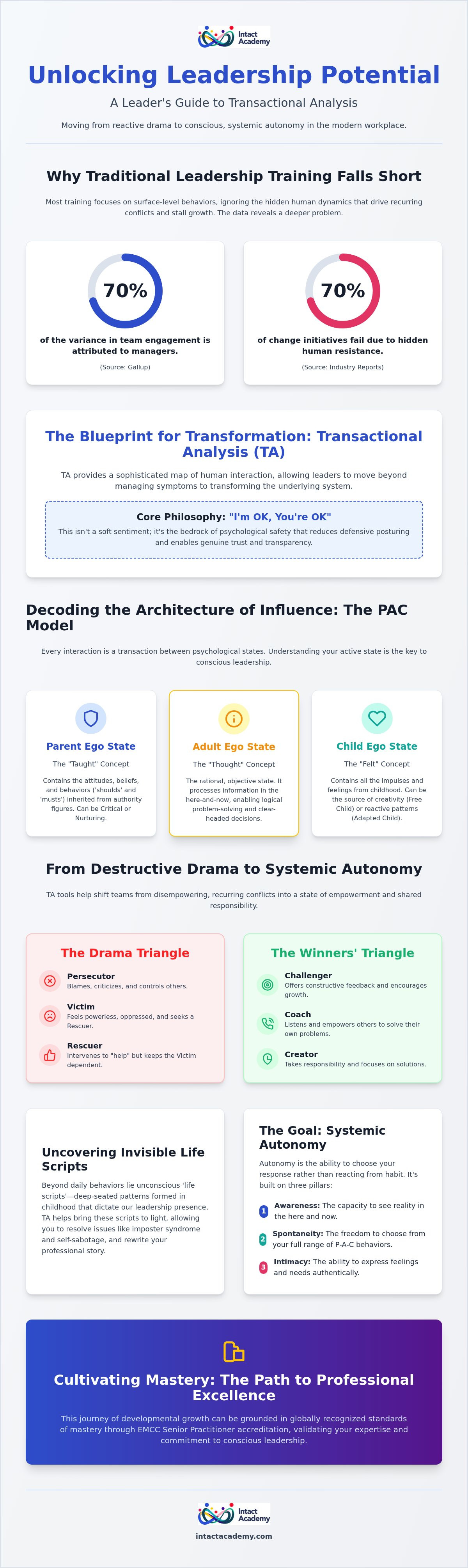
Why does the same "drama" resurface in your boardroom, even after your team has completed the most expensive leadership workshops? You likely recognize the exhaustion of feeling stuck in reactive patterns, where even the most logical change initiatives stall against a wall of hidden human resistance. It's a common struggle; Gallup's 2026 State of the Global Workplace report reminds us that managers account for 70% of the variance in team engagement. When those leaders are caught in unconscious scripts, the entire organization falters. Mastering transactional analysis for leadership development provides the psychological depth needed to move beyond surface-level tactics and into a space of genuine systemic autonomy.
By understanding the hidden architecture of your team's interactions, you can begin to lead from a place of completeness rather than habit. This article will show you how to decode these complex workplace dynamics and evolve your leadership style for the demands of 2026. You'll discover how to transform recurring conflict into creative energy and learn about the path toward recognized professional excellence through EMCC accreditation. It's time to stop managing the drama and start leading the transformation.
Key Takeaways
- Move beyond surface-level management tactics by adopting a systemic blueprint that decodes the hidden human dynamics driving your organizational culture.
- Learn to identify and shift your Ego States in real-time, ensuring you maintain an Adult presence during high-stakes negotiations and complex boardroom interactions.
- Uncover the unconscious Life Scripts that shape your leadership presence, allowing you to resolve deep-seated patterns like imposter syndrome.
- Utilize transactional analysis for leadership development to transition your team from the destructive Drama Triangle into a state of systemic autonomy and the Winners’ Triangle.
- Explore the professional journey toward EMCC Senior Practitioner accreditation, grounding your developmental growth in globally recognized standards of mastery.
Beyond Surface-Level Tactics: Why Transactional Analysis is the Blueprint for Modern Leadership
Modern leadership often feels like a series of firefighting exercises. You solve one conflict only for another to spark elsewhere. This happens because most training focuses on surface-level behaviors rather than the underlying systems. Transactional Analysis (TA) offers a more profound alternative. It isn't just a communication tool; it's a sophisticated map for human interaction and organizational culture. By utilizing transactional analysis for leadership development, you stop managing transactions and start leading transformations. You move from a style that merely directs to one that empowers through deep psychological insight.
The foundational principles of Transactional Analysis rest on the radical idea that "I'm OK, You're OK." In an executive context, this isn't a soft sentiment. It's the bedrock of psychological safety. When a leader operates from this position, they invite others to do the same. This reduces the defensive posturing that often derails high-stakes meetings. It allows for a level of transparency and trust that surface-level tactics simply can't replicate. It creates a space where every voice is heard and every contribution is valued, even in moments of intense pressure.
Consider the sobering reality that 70% of change initiatives fail. Most of these failures aren't due to poor strategy, but hidden human resistance. Leaders often address the symptoms of this resistance while ignoring the unconscious scripts running beneath the surface. TA allows you to look into the invisible architecture of the organization to find why people are actually pushing back. It transforms the boardroom from a place of reactive drama into a theater of conscious, systemic evolution.
The Systemic Shift: From Symptoms to Root Causes
Traditional coaching often treats leadership gaps as isolated skill deficits. If a manager lacks empathy, they're told to listen more. If they're too aggressive, they're told to soften. This approach ignores the systemic reality. True growth requires a move toward systemic organizational change. We must ask why a leader feels the need to be aggressive within the specific context of their team. Quick fixes fail because they don't account for the complex web of interactions that sustain old patterns. We aim for autonomy: the ability to choose a response rather than reacting out of habit.
The Philosophy of Autonomy and Wholeness
At the heart of our approach is the "Intact" philosophy. This is the belief that every individual has the capacity to return to a state of completeness and genuineness. In a professional setting, this means fostering awareness, spontaneity, and the capacity for intimacy. It's about shedding the masks we wear to survive corporate politics. Professional autonomy is the integration of Adult-state awareness with systemic impact; it's the moment you realize you're no longer bound by old scripts and can finally influence the system with clarity and purpose. This journey isn't just about becoming a better boss, but about becoming a more complete human being.
Decoding the Architecture of Influence: The PAC Model in the Boardroom
Influence in leadership is rarely about the volume of one's voice. It's about the psychological state from which you speak. Using transactional analysis for leadership development allows us to observe these states—Parent, Adult, and Child—as they manifest in real-time. When you enter a negotiation, are you responding to the present reality, or are you repeating a pattern from your past? Understanding these internal structures is the first step toward systemic autonomy and more effective organizational influence.
The Parent-Adult-Child (PAC) Framework for Executives
The Parent ego state contains the "shoulds" and "musts" we’ve inherited. A Critical Parent leader might inadvertently stifle a team by focusing solely on mistakes, while a Nurturing Parent might rescue employees from necessary challenges, preventing their growth. Recent research on TA and leadership styles suggests that the most effective leaders move fluidly into the Adult state. This is the "here-and-now" processor. It isn't just cold logic; it's the ability to see the board, the team, and the market clearly without the distortion of old biases. Finally, the Child state isn't "childish." The Natural Child is the source of your executive intuition and creativity. However, the Adapted Child can lead to defensive reactions when a CEO feels "reprimanded" by their board, triggering a rebellious or overly compliant stance that limits professional growth.
Mapping Transactions in Team Dynamics
Communication breaks down when transactions cross. If you ask an Adult question ("What is the status of the project?") and receive an Adapted Child response ("Why are you always checking up on me?"), productivity halts. These "Crossed Transactions" are the root of most workplace friction. Even more subtle are Ulterior Transactions, where the social message seems Adult, but the psychological message is Parent-to-Child. "I'm sure you did your best" can often carry an underlying sting of "You failed me." To maintain a high-performing culture, leaders should aim for:
- Complementary Transactions: Where the response comes from the expected ego state, allowing communication to flow indefinitely.
- Adult-to-Adult Dialogue: The gold standard for objective decision-making, mutual respect, and strategic alignment.
- Conscious Redirection: The ability to recognize a crossed transaction and invite the other person back into their Adult state through calm, factual inquiry.
To regain control, you must consciously shift the transaction back to an Adult-to-Adult dialogue. This requires pausing to identify your own state before responding. You might try this exercise: look at your last three email threads. Were you inviting an Adult response, or were you unconsciously prompting your team to act like children? Developing this level of self-awareness is a core component of the systemic journey to professional mastery.
Identifying the Invisible Blueprint: Life Scripts and Leadership Presence
While many leaders focus on acquiring new skills, few examine the invisible blueprint that dictates their every move. In the context of transactional analysis for leadership development, we call this blueprint a Life Script. It's an unconscious professional narrative written in your early years, often before you had the language to describe it. These scripts act as a silent director, influencing how you handle success, how you manage failure, and how you perceive your own authority in the boardroom. Without awareness, you aren't leading; you're simply performing a role you didn't consciously choose.
Consider the injunctions "Don't Succeed" or "Don't Be Important." In an executive setting, these manifest as the persistent shadow of imposter syndrome. You might reach the C-suite, yet feel like a guest who hasn't quite earned their seat. This isn't a lack of competence; it's a script conflict. By exploring what is transactional analysis, you can begin to identify these internal prohibitions that limit your presence and impact. Awareness is the first step toward reclaiming your executive presence and leading with genuine authority.
Research into the organizational applications of transactional analysis reveals that individual scripts often mesh to form a collective organizational script. If a leadership team is dominated by a "Work Hard" driver, the company culture will inevitably reward burnout over efficiency. If the script is "Be Perfect," innovation dies because the system cannot tolerate the messiness of experimentation. Recognizing when you are acting out a script rather than responding to reality is the hallmark of a mature, autonomous leader.
Uncovering Your Unconscious Professional Narrative
Identifying your "drivers" is a critical step in this evolution. Do you feel you must "Be Perfect" to be acceptable? Or perhaps you believe you must "Work Hard" to justify your position? These drivers provide a temporary sense of OK-ness but ultimately lead to systemic exhaustion. When a leader acts out these scripts, they stop being present for their team. They become a character in a pre-written play, unable to see the unique needs of the current moment or the potential in their people.
Rewriting the Script for Systemic Impact
Rewriting your leadership narrative requires "re-decisioning" at an executive level. This involves consciously choosing to replace old injunctions with new, autonomous permissions. It's the process of deciding that it's safe to be important and effective to be imperfect. Sari van Poelje has pioneered the use of agile TA to facilitate this script change within complex organizations. By breaking free from your own narrative, you create the systemic space for your entire team to break free from theirs. You move from a state of reactive repetition to one of creative, professional wholeness.
From Drama to Autonomy: Practical TA Tools for Executive and Team Coaching
When leadership patterns remain reactive, the boardroom often descends into what we call the "Drama Triangle." This social dynamic, comprised of the Victim, the Rescuer, and the Persecutor, creates a cycle of blame and helplessness that drains organizational energy. Utilizing transactional analysis for leadership development allows you to step outside this triangle and enter the "Winners' Triangle." In this healthier framework, the Victim becomes Vulnerable and Creative, the Rescuer becomes Caring and Supportive without over-functioning, and the Persecutor becomes Assertive and Clear. This shift isn't just about conflict resolution; it's about reclaiming the team's capacity for systemic autonomy.
De-escalating Workplace Games
Psychological games are repetitive sequences of transactions that end in a "payoff" of negative feelings. You've likely seen the "Yes, But" game, where a leader offers solutions and a team member finds a flaw in every one. Or "If It Weren't For You," where systemic failures are pinned on a single department. To stop these, you must "cross the transaction" by refusing the payoff and returning to an Adult-to-Adult dialogue. As a leader, your role is to provide "Potency," the steady, grounded presence that makes it safe for others to drop their masks and engage in honest work. This is a foundational element of systemic team coaching.
The Art of Professional Contracting
Mastery in Transactional Analysis is often mastery in contracting. We operate on three distinct levels: Administrative, Professional, and Psychological. The Administrative level covers the logistics and timelines, while the Professional level defines the specific goals and competencies we aim to develop. However, the Psychological level is where the unspoken expectations and hidden "hooks" reside. Most leadership failures are actually contracting failures; we assume everyone is on the same page when the psychological contract is actually full of holes.
- Administrative: The "what, when, and how much" of the professional relationship.
- Professional: The "why" and the specific outcomes the organization requires.
- Psychological: The "hidden" contract regarding trust, safety, and emotional investment.
Clear, Adult-level contracting prevents the "Rescuer" trap in coaching by establishing that the leader supports growth without taking ownership of the employee's specific tasks or emotional burdens. When the contract is solid, the work becomes transparent, effective, and profoundly human. If you are ready to master these systemic dynamics, our TA EMCC Senior Team Coach Academy provides the structured methodology needed for profound organizational impact.
Cultivating Mastery: The Path to EMCC Senior Practitioner Accreditation
True mastery in organizational influence requires more than just an understanding of models; it demands a transformation of the leader's own internal system. This is why transactional analysis for leadership development has become the preferred framework for those seeking executive coaching certification. It provides a rigorous, evidence-based language for the often-invisible forces that shape organizational behavior. The journey from initial awareness to professional mastery culminates in the TA EMCC Senior Practitioner academy, where theory, practice, and supervision converge to create a stable container for deep growth.
Why Systemic Depth Matters for Coaches and Leaders
Surface-level coaching certificates often focus on external techniques, yet they rarely address the leader's own psychological scripts. High-level TA academies distinguish themselves by insisting on systemic depth. This focus on professional development for coaches ensures that you aren't just applying a tool, but evolving your capacity to hold space for complex change. Without this depth, leaders risk falling into "parallel processes," where they unconsciously mirror the very dysfunction they seek to resolve. Systemic supervision acts as a vital mirror, helping you maintain ethical standards and professional clarity amidst the turbulence of organizational life.
Steps to Achieving Global Accreditation
Achieving the EMCC Senior Practitioner level is a mark of global excellence. It requires a minimum of 250 hours of verified coaching practice and a commitment to ongoing professional evolution. Intact Academy supports this journey by providing the structured methodology and supervised practice necessary to build a robust accreditation portfolio. Our programs bring together participants from over 14 countries, creating a rich tapestry of global perspectives that challenge and expand your worldview. The process is methodical. You ground yourself in theory, test it in practice, and refine it through supervision. As of July 2026, the EMCC Global Individual Accreditation fee for the Senior Practitioner level is €245, with a required annual membership of €90. This investment reflects a commitment to a standard of excellence that remains valid for five years before renewal.
Ultimately, the use of transactional analysis for leadership development is about returning to a state of wholeness. It's the path for those who refuse to settle for transactional fixes and instead seek to lead from a place of systemic integrity. By aligning your personal growth with globally recognized standards, you ensure that your impact is both profound and sustainable. You move beyond the role of a manager and into the mastery of a wise global mentor.
Stepping Into Systemic Autonomy
The evolution from a reactive manager to an autonomous leader is a journey from unconscious repetition to conscious presence. By decoding the hidden architecture of ego states and rewriting the scripts that limit your executive presence, you create space for genuine organizational flourishing. We've seen how moving beyond the Drama Triangle and mastering the art of professional contracting can transform conflict into a catalyst for growth. Embracing transactional analysis for leadership development isn't merely about learning a new tool; it's about committing to a state of professional wholeness that resonates through every level of your organization.
This path toward mastery requires a stable container and expert guidance. You're invited to apply for the TA EMCC Senior Practitioner Academy to ground your development in a systemic methodology that ensures sustainable change. Led by global expert Sari van Poelje, our EMCC and ICF accredited programs offer the psychological depth and professional pragmatism needed to navigate the complexities of 2026. The invitation to change is always present. It's time to step into your full potential as a leader of impact and integrity.
Frequently Asked Questions
What is the primary benefit of Transactional Analysis for leaders?
The primary benefit is the achievement of systemic autonomy through a clear understanding of the unconscious patterns that drive human interaction. Leaders gain a precise map to navigate boardroom dynamics and resolve recurring interpersonal friction. This psychological depth allows for more authentic communication and sustainable influence, moving beyond surface-level management into a realm of profound professional transformation.
How does the Parent-Adult-Child model apply to workplace conflict?
The Parent-Adult-Child model identifies when a transaction has crossed, such as when a leader asks an Adult question and receives an Adapted Child response. Recognizing these shifts allows you to consciously invite the other person back into an Adult-to-Adult dialogue. This redirection halts escalating drama and refocuses the team on objective problem solving and mutual respect.
What is the difference between TA coaching and clinical therapy?
TA coaching focuses on professional growth and systemic effectiveness within a work context, whereas clinical therapy addresses psychological healing and mental health. While both utilize the same theoretical framework, coaching is contractually bound to organizational outcomes and professional autonomy. It's about moving from functional behavior to optimal performance in a leadership role.
Can Transactional Analysis help with organizational change management?
Transactional Analysis is exceptionally effective for change management because it addresses the hidden psychological resistance that often stalls organizational initiatives. By analyzing the organizational script, leaders can identify systemic blocks and create the psychological safety needed for genuine transformation. It moves change from a top-down directive to a collective systemic evolution.
How long does it take to become an EMCC Senior Practitioner using TA?
Becoming an EMCC Senior Practitioner requires a minimum of 250 hours of coaching practice and the completion of a recognized program. The timeframe varies based on your existing experience and the intensity of the training modules you select. Most professionals complete this journey within one to two years of focused study and supervised practice.
What are 'Psychological Games' in a corporate context?
Psychological Games are repetitive, unconscious sequences of transactions that lead to a predictable negative payoff for everyone involved. In corporate settings, these manifest as patterns like "Yes, But," which drain productivity and erode trust. Effective transactional analysis for leadership development teaches you to recognize these hooks and decline the invitation to play, preserving organizational energy.
Is Transactional Analysis still relevant for leadership in 2026?
Transactional Analysis remains essential in 2026 as organizations prioritize human-centered leadership and navigate the complexities of AI integration. With global employee engagement reaching record lows, the need for deep psychological insight into manager-team dynamics is critical. Utilizing transactional analysis for leadership development provides the stable framework required to foster trust and purpose in a rapidly evolving landscape.
How does 'Life Script' theory impact executive presence?
Life Script theory impacts executive presence by revealing the unconscious narratives that either support or undermine your authority. If your script contains early injunctions like "Don't Be Important," you may struggle with imposter syndrome despite your professional achievements. Rewriting these scripts through awareness allows you to embody a presence that is grounded, authentic, and free from reactive patterns.


