

Why is it that a room full of brilliant individuals often produces a collective result that feels stagnant, or even regressive? You've likely experienced those moments where, despite a clear agenda and logical arguments, the team seems to have a mind of its own. It's a common struggle to face persistent conflicts that refuse to resolve or to feel a heavy resistance to change that no amount of data can pierce. When you step into a leadership role, you aren't just managing people; you're engaging with the complex, often invisible web of group dynamics.
We recognize that these systemic tensions can feel overwhelming, yet they are also the gateway to profound human transformation. In this exploration, you'll discover the hidden forces shaping collective behavior and learn how to facilitate a deeper sense of psychological safety within any professional group. We'll move beyond surface-level fixes to provide a systemic lens for your organizational interventions. This article offers a path to identifying unconscious patterns and leading your team toward a state of genuine, high-performance wholeness.
Key Takeaways
- Learn to distinguish between the explicit tasks your team performs and the underlying psychological processes that truly drive collective performance.
- Gain a systemic lens to understand how members subconsciously project internal maps onto the collective, creating an invisible architecture of behavior.
- Use Transactional Analysis to identify when a "Collective Child" or "Critical Parent" ego state is stalling progress so you're able to return the group to an Adult dynamic.
- Master the art of systemic observation to navigate complex group dynamics, making it easier to facilitate interventions that foster lasting psychological safety.
- Build the necessary foundation for senior-level team coaching by transitioning from individual problem-solving to holistic, systemic transformation.
What Are Group Dynamics? Beyond Surface-Level Teamwork
To truly understand a team, one must look past the individuals and see the space between them. We often mistake a collection of people for a unified entity, yet any seasoned leader knows that a group is more than the sum of its parts. What Are Group Dynamics? At its core, this field describes the complex system of behaviors and psychological processes occurring within or between social groups. It is the invisible current that determines whether a team sails toward innovation or drifts into stagnation. These forces are not random; they are the result of deep-seated human needs for belonging, status, and safety.
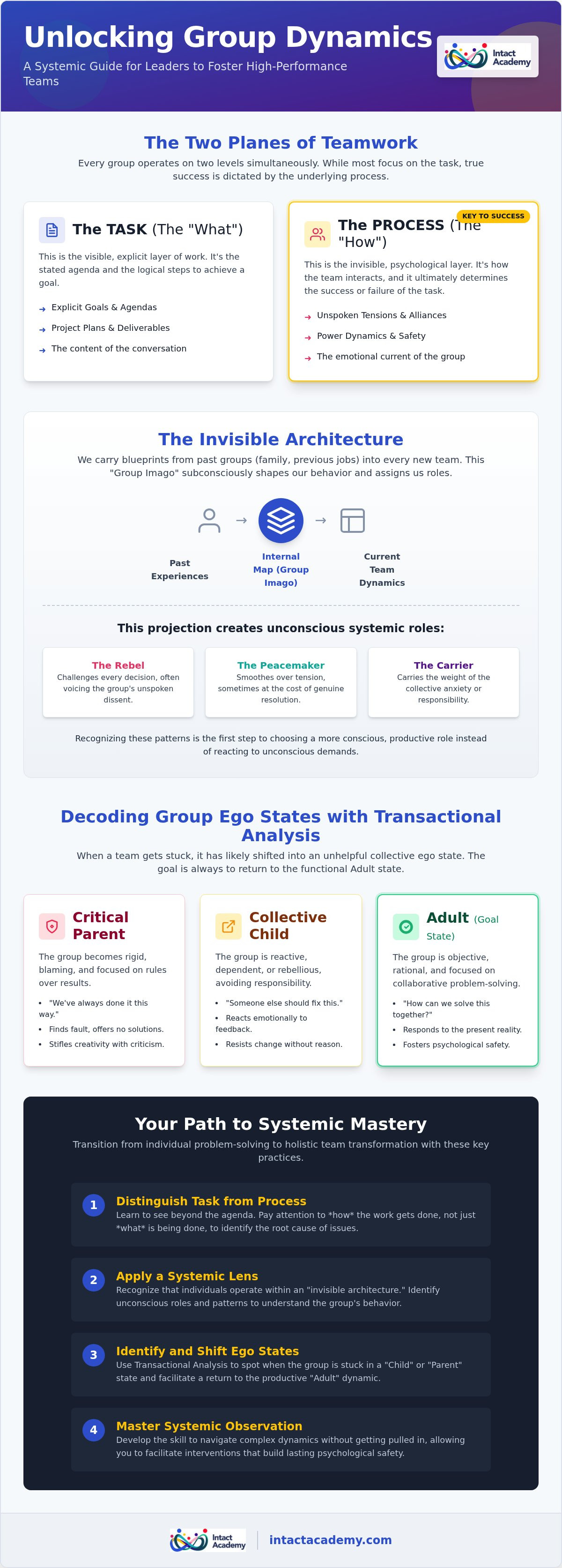
Every professional group operates on two distinct planes simultaneously. There is the Task, which represents the explicit goals, the "what" of the work, and the stated agenda. Then, there is the Process, the "how" of the interaction, where the real work of group dynamics happens. While many organizations obsess over the task, it is the process that usually dictates success. If the process is fractured, the task will inevitably suffer, regardless of how clear the agenda might be.
The study of these collective forces traces back to social psychologist Kurt Lewin in the 1940s. He recognized that individuals change their behavior based on the social field they inhabit. Modern systemic theory has evolved this understanding, viewing the group as an interdependent organism. Understanding these forces is the hidden key to organizational success and employee well-being. It allows us to move beyond surface-level fixes and address the root causes of collective dysfunction.
The Science of Collective Interaction
When individuals join a group, their personal identities often weave into a collective group identity. This shift brings both strength and shadow. Social influence can foster cohesion, but it can also lead to conformity and the silent paralysis of groupthink. In professional settings, this often manifests as a reluctance to challenge the status quo, even when a change is clearly necessary. Group dynamics is a living, breathing system that evolves over time.
Why Leaders Must Master the Dynamic
The difference between a healthy and toxic dynamic shows up in the bottom line. It isn't just about creating a pleasant atmosphere; it's about the speed of innovation and the clarity of decision-making. If a system is clogged with unspoken tension or unresolved conflict, even the smartest strategies will fail. Mastery requires a shift in perspective. You must move from managing people to navigating systems, learning to observe the patterns that others simply feel but cannot name.
The Invisible Architecture: A Systemic View of Group Behavior
To view a team through a systemic lens is to recognize that we're never truly "new" to a group. We carry a blueprint of every collective we've ever belonged to, from our earliest family structures to our previous corporate roles. This invisible architecture dictates how we perceive authority, how we handle dissent, and how we find our place within the group dynamics of the present moment. It's the difference between seeing a collection of individuals and seeing a living system in constant flux. When we understand that the group is more than the sum of its parts, we can begin to address the underlying tensions that logic alone cannot reach.
The Group Imago and Unconscious Mapping
The concept of the "Group Imago" suggests that we subconsciously map our internal world onto the external team. We often unconsciously seek out or are pushed into specific "slots." You might recognize the rebel who challenges every decision, the peacemaker who smoothes over every tension, or the leader who carries the weight of the collective. These aren't just personality traits; they're systemic roles. Insights from Sari van Poelje on systemic change reveal how these roles can either trap a team in old scripts or serve as catalysts for growth. When we identify these patterns, we can begin to choose how we show up rather than simply reacting to the group's unconscious demands.
Boundaries, Power, and Psychological Safety
Psychological safety isn't merely a feeling; it's a structural achievement. It relies on the clarity of boundaries and the healthy exercise of authority. When boundaries are diffused, roles become murky and anxiety rises. When they're too rigid, innovation dies. A "stable container" for high-stakes work requires a balance where formal authority is respected and informal power is acknowledged. Organizational culture often sets the tone for these micro-dynamics, but the team leader has the power to reshape them. By employing Practical Strategies for Facilitating Group Transformation, leaders can foster inclusion and feedback that strengthen the team's core. For those ready to lead these profound shifts, our TA EMCC Senior Team Coach Academy offers a path to systemic mastery.
Transactional Analysis: A Tool for Decoding Group Interaction
To move beyond mere observation and into active facilitation, we need a precise language for human interaction. What is transactional analysis if not a map of our psychological exchanges? When applied to group dynamics, this framework reveals why certain teams fall into repetitive, unproductive loops. We aren't just individuals speaking; we are ego states interacting, often without realizing which part of us is leading the conversation. By understanding these transactions, we can begin to untangle the knots of collective behavior.
Research presented in A Systemic View of Group Behavior suggests that the most successful teams aren't necessarily those with the most talented individuals, but those with the most balanced communication patterns. Transactional Analysis (TA) provides the tools to achieve this balance. It allows us to see when a team has moved away from its objective goals and into the realm of psychological games. These games are not played for fun; they're played to confirm old, often negative, beliefs about ourselves and others.
Ego States in the Collective
In many hierarchical settings, a "Critical Parent" culture emerges where leaders dictate and teams respond from an "Adapted Child" state. This dynamic stifles creativity and breeds a quiet resentment that undermines every initiative. The "Collective Child" might manifest as a team that waits for permission for every small step, while a "Critical Parent" group culture focuses on blame rather than solutions. The goal of any intervention is to return the group to an "Adult-Adult" transaction. In this state, communication is direct, mutual respect is the baseline, and the focus remains firmly on the reality of the present moment.
Identifying and Stopping Group Games
Office politics are frequently just a series of psychological games played out on the Drama Triangle. You've likely seen the roles: the Victim who feels powerless, the Rescuer who tries to fix everything, and the Persecutor who blames. Common games include:
- "Why Don’t You – Yes But": Where a member asks for help but rejects every suggestion, aiming to prove the "Rescuer" is incompetent.
- "See What You Made Me Do": Where a member abdicates responsibility for a mistake by blaming the interference of others.
The cost of these games is measured in lost productivity and emotional burnout. To break these unproductive loops, we must learn to "cross the transaction." This involves refusing to step into the expected role and instead responding from a calm, Adult perspective. By uncovering the "Group Script", the unconscious narrative that dictates "we always fail at the last minute", we can begin to rewrite the team's story toward success and wholeness.
Practical Strategies for Facilitating Group Transformation
Facilitating a group requires more than just a clear agenda; it demands the courage to look beneath the surface of daily operations. When we move from understanding theory to active intervention, we must first establish a psychological contract. This is the foundation of any successful transformation. Contracting for change involves setting clear ground rules that define how the group will handle conflict, dissent, and the inevitable discomfort of growth. Without this stable container, even the most skilled intervention will likely meet with high resistance.
Systemic transformation isn't a one-time event but a continuous process of refinement. To lead these shifts effectively, professionals must engage in ongoing professional development for coaches. This commitment to growth ensures that your interventions remain grounded in the latest systemic methodologies rather than becoming reactive or surface-level. Mastery in group dynamics is built through the disciplined application of insight and the willingness to hold a mirror up to the collective.
The Art of Systemic Observation
The most powerful data in a room is often what remains unsaid. Systemic observation involves listening for the unspoken, the heavy silences, the quick glances between colleagues, or the sudden drop in energy when certain topics arise. Track the flow of influence: who is being silenced, and who is carrying the voice of the entire system? The coach acts as a neutral observer, mirroring the system's current reality without becoming entangled in its emotional wake.
Intervention Techniques for Leaders and Coaches
Once a pattern is observed, the next step is naming the dynamic. Bringing the unconscious into the conscious mind is often enough to break a stagnant loop. When you say, "I notice that every time we discuss innovation, the conversation shifts to past failures," you invite the group to move back into an Adult ego state. This allows for crucial conversations that address root causes rather than symptoms. For complex issues, we often employ the Seven-Eyed Model, a tool from systemic supervision that provides multiple perspectives on the interaction between the coach, the team, and the wider organizational context.
If you're ready to deepen your impact and lead teams through profound change, explore our Team Coaching services to begin your journey toward systemic mastery.
Evolving Toward Mastery: The Path for Team Coaches
Mastering group dynamics is the threshold where professional coaching transforms into systemic leadership. While individual coaching focuses on the growth of a single person, team coaching addresses the collective soul of the organization—a concept that resonates with the holistic healing traditions promoted by Tribu Spirit. It requires a profound shift in perspective. You must learn to see the patterns, the heavy silences, and the invisible threads that bind a group together. This transition from the individual to the systemic is not merely a change in scale; it's a fundamental change in how we perceive human interaction and organizational health. It demands that the coach remains calm and authoritative while the system around them may be in flux.
For those facilitating organizational change, the weight of responsibility is significant. This is why accredited training is essential. It provides the theoretical rigor and ethical framework needed to hold a space for profound transformation. Choosing the right team coaching course is about more than acquiring a certificate. It's about finding a methodology that honors the complexity of the human experience while delivering pragmatic, actionable results. Professionals who invest in this level of training move beyond surface-level fixes and into the realm of true systemic intervention.
Training for Systemic Impact
The TA EMCC Senior Team Coach Academy is designed specifically for those who seek this level of mastery. Through a blend of Transactional Analysis and systemic theory, participants learn to navigate the turbulent waters of group interaction with grace and clarity. Supervised practice is the heartbeat of this program. It allows you to test your insights in a safe, professional environment, accelerating your ability to sense and respond to shifting group dynamics in real time. This practical application ensures that theoretical concepts become integrated into your professional identity, allowing you to act with confidence in high-stakes environments.
Join a Global Community of Change Makers
At Intact Academy, we embrace the role of the Global Mentor. Having witnessed the inner workings of countless organizations across more than 14 countries, we remain dedicated to the flourishing of both the system and the individual. This approach moves beyond transactional training and into the realm of professional wholeness. It is an invitation to return to a state of genuineness and integrity in your leadership. If you're ready to deepen your impact and facilitate true systemic change, the path forward is one of continuous learning and courageous insight. The evolution of your practice begins with the decision to look deeper and the commitment to stay the course.
Embrace the Path of Systemic Transformation
You've moved beyond the surface of team management to recognize the profound forces that dictate collective success. By understanding the Group Imago and the intricate ego states at play, you're now equipped to see the invisible architecture that others simply feel. True mastery in group dynamics involves more than just observation; it requires a commitment to your own evolution as a facilitator of change. This journey from individual coaching to systemic intervention is the threshold of professional excellence. It's a shift from solving immediate problems to nurturing long term organizational health.
If you're ready to deepen your impact and join a community dedicated to human flourishing, we invite you to take the next step. Explore our TA EMCC Senior Team Coach Academy to achieve your EMCC Senior Practitioner Level Accreditation. Our programs provide expert led systemic supervision and connect you with a global network of professional coaches who share your commitment to depth and integrity. The transition from managing tasks to navigating human systems is a courageous act of leadership. We look forward to supporting your journey toward wholeness and professional mastery.
Frequently Asked Questions
What are the 5 stages of group dynamics?
The evolution of any collective follows the stages of Forming, Storming, Norming, Performing, and Adjourning. These stages, originally defined by Bruce Tuckman, describe the psychological journey from initial orientation to high-level collaboration. A systemic lens allows us to see these not just as linear steps, but as shifts in the group's collective energy and safety. Recognizing whether a team is stuck in "Storming" or has reached "Performing" is essential for choosing the right intervention.
How do you identify toxic group dynamics in a remote team?
In a remote setting, toxicity often manifests as digital silences, fragmented communication, or the formation of exclusive sub-groups that bypass the collective. When members feel unsafe, they often withdraw into "Adapted Child" ego states, avoiding risk and honest feedback during video calls. Leaders must observe these subtle shifts in digital interaction to maintain healthy group dynamics across physical distances. Identifying these patterns early prevents the erosion of trust and the rise of systemic resentment.
Can Transactional Analysis be used for large-scale organizational change?
Transactional Analysis offers a powerful framework for large-scale transformation by identifying the unconscious "Organizational Script" that drives an entire company. We analyze the "Parent" culture of leadership and how it interacts with the "Child" responses of the workforce. By shifting these systemic transactions toward an "Adult" state, we facilitate sustainable growth. This methodology ensures that change isn't just a surface-level adjustment but a profound shift in the organization's collective way of being.
What is the difference between group dynamics and team building?
Team building is typically a discrete event focused on social bonding, while group dynamics refers to the ongoing, often unconscious psychological processes within the system. One is a specific intervention; the other is the living reality of the group's interaction. Understanding the dynamic allows for deeper, systemic change that lasts long after a team-building event ends. It moves the focus from "having fun" to "functioning with integrity and wholeness."
How does a leader’s ego state affect the group dynamic?
A leader's ego state sets the psychological field for the entire team, often inviting members into complementary roles. If a leader consistently operates from a "Critical Parent" state, the team will likely respond with either rebellion or over-compliance. Conversely, a leader who maintains a calm "Adult" state invites others to do the same, fostering mutual respect. This modeling is the most direct way a leader can influence the collective behavior and psychological safety of the group.
What are the first steps to take when a group dynamic becomes unproductive?
The first step is to name the dynamic without blame, bringing the unconscious process into the collective awareness for reflection. This requires a "contracting" conversation where the group agrees to look at how they are working, not just what they are doing. Shifting the focus from the task to the process allows the team to identify and stop unproductive psychological games. It creates a "stop and reflect" moment that is necessary for any systemic recalibration.
Why is psychological safety essential for healthy group dynamics?
Psychological safety provides the "stable container" necessary for honest communication, healthy dissent, and creative risk-taking. Without this safety, a group remains trapped in defensive ego states, fearing the consequences of failure or interpersonal conflict. Safety allows individuals to bring their whole selves to the collective, which is the foundation of innovation. It ensures that the group dynamics are characterized by trust and openness rather than fear and hidden agendas.
How can I get certified in systemic team coaching?
Certification requires a blend of theoretical study and supervised practice recognized by global bodies like the EMCC or ICF. Our TA EMCC Senior Team Coach Academy offers a comprehensive path to accreditation, focusing on Transactional Analysis and systemic methodologies. This level of training ensures you can navigate complex group dynamics with the authority and depth required for senior-level mastery. It is a journey toward professional wholeness and global practitioner excellence.


