

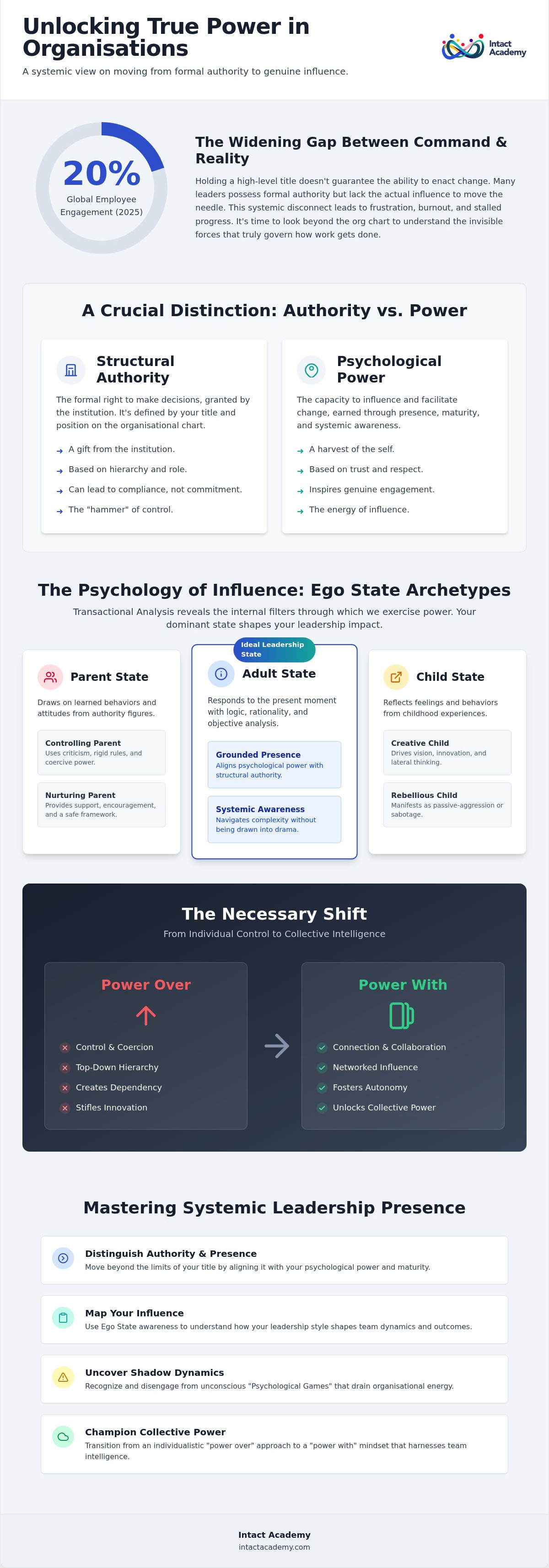
If you hold the highest title in the room, why does it feel like you're shouting into a void whenever you try to initiate change? It's a common, exhausting paradox to possess formal authority while lacking the actual capacity to move the needle. You're likely feeling the weight of a systemic disconnect; with global employee engagement dropping to 20% in 2025, the gap between executive command and team-level reality has never been wider. Truly understanding power in organisations requires looking past the boxes on an org chart to the invisible, systemic threads that dictate how decisions are actually made.
I've seen how these dynamics can stifle a brilliant team or act as a catalyst for profound transformation. This guide moves beyond the surface of traditional leadership to explore the deep psychological and systemic forces at play. We'll examine how to move from the friction of toxic politics to a state of systemic influence. You'll gain the tools to navigate complex dynamics without burnout, allowing you to foster the collective power necessary for sustainable change. By aligning your formal authority with informal influence, you can return to a state of professional wholeness and genuine, effective leadership.
Key Takeaways
- Distinguish between structural authority and psychological presence to move beyond the inherent limitations of traditional organisational hierarchies.
- Utilise Transactional Analysis to map your influence, identifying how specific ego states shape your leadership style and impact.
- Uncover the unconscious "Psychological Games" and the Drama Triangle that frequently drain the vitality of power in organisations.
- Transition from individualistic control to a "power with" approach that harnesses the collective intelligence of the entire team system.
- Recognise the role of systemic supervision and self-reflection in maintaining an ethical, grounded, and transformative leadership presence.
Beyond Hierarchy: A Systemic View of Power in Organisations
In many corporate settings, power is viewed as a static asset, something one possesses by virtue of a seat at the executive table. This perspective is increasingly obsolete. In the face of complex, agile environments, traditional "power over" models are failing because they rely on control rather than connection. Real power in organisations is better understood as a systemic capacity to facilitate transformation and sustainable growth. It's an energy that flows through a collective, rather than a hammer held by an individual. Authority is a gift from the institution; power is a harvest of the self.
At Intact Academy, we view power as an instrument for wholeness. It isn't just about making things happen. It's about creating the conditions where everyone can return to a state of completeness and genuineness. To understand this deeply, we must look at the foundational concepts of Power (social and political) and how they translate into the living, breathing organism of a business. When power is used to heal the system rather than just drive the parts, it becomes a catalyst for profound human transformation.
The Energy of Influence in Systems
Authority vs. Power: A Crucial Distinction
There's a vital difference between the authority your contract gives you and the power your presence commands. Authority is granted by the organisation; it's a structural right to decide. Power, however, is realised through an individual's psychological maturity and their ability to remain in an "Adult" ego state. When a leader has authority without the psychological power to back it up, the system feels the vacuum. This often leads to overcompensation through micromanagement or a total lack of direction. Navigating the tension between formal reporting lines and informal networks requires more than just management skills. It demands a deep understanding of how power in organisations is truly distributed. When you align your structural role with your psychological presence, you move from being a manager of tasks to a steward of systemic health—a transition facilitated by Workplace Harmonics through its focus on leadership stability for industrial organisations.
The Psychology of Influence: Ego States and Power Dynamics
To understand the true nature of power in organisations, we must look at the internal architecture of the leader. Transactional Analysis offers a precise map through the concept of Ego States. These are not just theoretical models. They are the psychological filters through which we exercise influence and respond to authority. When you step into a boardroom, you aren't just bringing your expertise; you're bringing a complex history of how you've learned to occupy space and command attention.
The 'Parent' ego state often dominates traditional leadership. Within this archetype, we find two distinct paths. The Controlling Parent uses coercive power to enforce compliance, often through criticism or rigid rules. The Nurturing Parent provides the supportive framework necessary for growth. While both have their place, relying solely on a 'Parent' state can create a dependency that stifles innovation. Understanding the 7 Types Of Power helps us see that legitimate or coercive power often stems from these Parental roots, whereas referent power requires a more sophisticated psychological alignment. Influence is a reflection of internal alignment; power is the external manifestation of that truth.
Parent, Adult, and Child Power Archetypes
The 'Child' ego state is equally influential, though often overlooked in professional settings. A leader operating from a 'Creative Child' state can drive vision and lateral thinking. When the 'Rebellious Child' takes over, it manifests as subtle sabotage or passive-aggression within the hierarchy. The 'Adaptive Child' maintains toxic power structures by complying with unhealthy demands just to remain safe. The 'Adult' ego state serves as the essential foundation for ethical, sustainable power in organisations. It acts as a neutral observer. It processes data in the present moment without the baggage of past reactions. Mastering this state allows you to navigate high-stakes politics with clarity rather than reactivity.
The Script of the Powerful Leader
Our comfort with holding power is rarely a matter of current circumstances alone. It's often dictated by our 'Life Script', which consists of unconscious decisions made in early childhood about our value and place in the world. Scripts like 'Don't be important' or 'Don't succeed' can act as invisible glass ceilings, limiting a leader's impact regardless of their formal title. Breaking these scripts is the work of true transformation. You can explore these concepts further in our guide on What Is Transactional Analysis? A Systemic Guide to Professional Transformation. Engaging with programs like the TA EMCC Senior Practitioner academy can help you align your psychological script with your professional goals, ensuring your influence remains grounded and genuine.
Navigating the Shadow: Psychological Games and Power Misuse
Power isn't always found in the light of strategy meetings or formal directives. It often lurks in the "shadow," manifesting as unconscious psychological games that drain the vitality of a system. These games are repetitive patterns of interaction that result in a predictable "payoff" for the participants, usually at the cost of genuine connection and organisational energy. While some might see coercive power simply as a tool for punishment, a deeper look reveals it's often a defense mechanism against systemic vulnerability. This is supported by a study on organizational power and leadership which highlights how these internal psychological dynamics shape external leadership outcomes.
Uncovering the Drama Triangle in the C-Suite
The Drama Triangle provides a precise map for these dysfunctional interactions. It consists of three primary roles that participants rotate through to maintain the game's momentum, often without even realising they've stepped onto the stage:
- The Persecutor: This role uses coercive power in organisations to mask deep-seated insecurity. They demand compliance through fear and rigid control, often believing that without their constant pressure, the system would collapse.
- The Rescuer: This is perhaps the most deceptive role. Rescuers appear helpful, yet their constant intervention disempowers the team. This creates a subtle "power over" dynamic that breeds dependency and stifles individual growth.
- The Victim: Here, perceived "powerlessness" is used as a tactical tool to avoid accountability. Victims effectively control the system by refusing to act, forcing others to step into Rescuer or Persecutor roles to fill the vacuum.
These roles are fluid and exhausting. A Rescuer who feels unappreciated quickly flips to become a Persecutor, while a Victim might become a Persecutor when they finally gain leverage. This cycle replaces purpose with drama, ensuring that power in organisations becomes a source of conflict rather than a catalyst for transformation.
Strategies for Game-Free Leadership
Stepping out of these games requires the courage to move toward a state of "I'm OK, You're OK." This is a position of mutual respect where power is shared rather than hoarded or avoided. To achieve this, leaders must recognise the "payoff" they receive from staying in the triangle. Does it make you feel indispensable? Does it protect you from the vulnerability of failure? Once identified, you can replace these games with clear, Adult-to-Adult boundaries. Adult contracting eliminates the need for psychological games by making expectations and responsibilities explicit. This process isn't just about efficiency; it's about returning the organisation to a state of health where energy is spent on creation rather than conflict.
From 'Power Over' to 'Power With': Systemic Team Dynamics
The traditional image of the leader as a solitary figure holding the reins of authority is a relic. In modern, complex systems, the most effective power in organisations is no longer held over people, but generated with them. This evolution represents a shift from individualistic control to collective systemic intelligence. When we view a team as a living organism rather than a collection of parts, we begin to see that power isn't a finite resource to be divided. It's a synergistic energy that increases when it's shared. This shift allows the system to breathe and adapt, moving from a rigid hierarchy to a fluid, responsive network.
Moving toward this 'power with' model is central to Leading Organizational Change: A Systemic and Psychological Perspective. It requires a fundamental rewiring of how we perceive influence and power in organisations. Systemic team coaching plays a pivotal role here. By focusing on the relationships and the 'space between' members, a coach helps redistribute power to the whole system. This prevents the common trap where a few dominant voices drown out the collective wisdom of the group.
Collective Power in High-Performing Teams
High-performing teams successfully transition from competitive 'silo power' to collaborative 'systemic power'. In silos, information is hoarded and influence is used to protect territory. In a systemic model, power is a tool for alignment and shared vision. A leader facilitates the emergence of the team's collective authority by ensuring every stakeholder's voice is heard and integrated. This transition involves several key shifts:
- From hoarding to sharing: Information becomes a collective asset rather than a personal leverage point.
- From control to facilitation: The leader's role changes from directing parts to nurturing the whole system.
- From individual to collective: Success is defined by systemic health rather than personal achievement.
Balancing these forces requires a deliberate focus on the team's shared purpose rather than individual agendas. It's about moving from "my team" to "our system," where every part acknowledges its role in the whole.
Psychological Safety and Power Transparency
Psychological safety acts as a potent power multiplier. When team members feel safe enough to be vulnerable, they're also safe enough to be powerful. Transparency about both formal reporting lines and informal networks increases trust and reduces the anxiety that leads to power games. A resilient organisation is one where authority can be challenged without fear of retribution or social cost. This 'Adult-to-Adult' transparency ensures that power remains visible, healthy, and accountable. To maintain this health, many leadership teams use systemic supervision to audit their power dynamics. This process acts as a mirror, revealing where power has stagnated or become toxic, and providing a pathway back to collective flourishing.
To begin transforming your team's dynamics through a systemic lens, explore our accredited team coaching programs.
Mastering Power: Developing Systemic Leadership Presence
True mastery of power in organisations isn't a destination reached with a promotion or a specific title. It's a lifelong journey of self-reflection and systemic awareness. When we stop looking at power as something we "have" and start seeing it as something we "steward," our leadership presence shifts from the transactional to the transformative. This stewardship requires a commitment to psychological depth that most standard management training simply doesn't address. It demands the courage to look inward before attempting to change the outward system.
The Role of Supervision in Power Mastery
Even the most experienced leaders need a "safe container" to explore the nuances of their impact. Systemic supervision provides this space, allowing you to examine how you're using your influence without the pressure of corporate performance. By employing the 7-Eyed Model, a leader can see power from multiple systemic perspectives—ranging from individual psychological triggers to the broader cultural patterns of the organisation. This practice eventually helps you develop an "Internal Supervisor." This mental faculty acts as a real-time monitor, helping you stay grounded in your Adult ego state even during high-stakes political maneuvers. It's the difference between reacting to a power struggle and consciously navigating a systemic shift.
Your Path to Professional Mastery
Choosing a path toward professional mastery means validating your influence through rigorous, globally accredited frameworks. The TA EMCC Senior Practitioner academy is designed for those who recognise that effective leadership requires a sophisticated understanding of human behaviour. This level of training builds the capacity for systemic influence, ensuring your power is used as a catalyst for health rather than a tool for control. Global accreditation through bodies like the EMCC and ICF provides the necessary validation for your role as a change agent in complex environments.
We invite you to evolve your impact from transactional management to systemic transformation. By integrating psychological depth with professional pragmatism, you can navigate the complexities of power in organisations while maintaining your integrity and wholeness. This is the work of returning to a state of genuineness, where your leadership becomes a gift to the entire system. If you're ready to deepen your impact and master these dynamics, our systemic supervision and coaching academies provide the structured methodology to help you flourish.
Evolving Your Systemic Influence
Reclaiming your agency begins with a shift in perspective. Mastering power in organisations is not about winning a static prize; it's about stewarding a dynamic energy. By identifying the ego states that drive your leadership and stepping out of the exhausting Drama Triangle, you create space for genuine authority. This transition from individual control to collective intelligence doesn't just improve performance. It restores a sense of wholeness to your professional life. It moves you from the friction of office politics into the flow of systemic transformation.
If you're ready to master these dynamics with a global cohort, I invite you to deepen your systemic impact with our TA EMCC Senior Practitioner Academy. Led by Sari van Poelje, an international expert in systemic change, our programs are accredited by the EMCC and ICF. We've trained participants from over 14 countries, bridging psychological depth with practical business rigour. Your journey toward becoming a stable, wise presence in a turbulent world starts with the courage to look deeper. We're here to support your evolution toward professional mastery.
Frequently Asked Questions
What are the primary types of power in organisations?
Power manifests through five traditional channels: legitimate, reward, coercive, expert, and referent power. Legitimate power stems from formal hierarchy, while referent power is rooted in the leader's psychological presence and integrity. In modern systems, we also recognise "connection power" as the ability to bridge disparate groups. Understanding these types of power in organisations allows a leader to move beyond simple command and control toward a more nuanced, relational influence.
How does Transactional Analysis help in understanding power dynamics?
Transactional Analysis (TA) provides a diagnostic map of how individuals occupy and react to authority through Ego States. By identifying whether a transaction is occurring between Parent, Adult, or Child states, leaders can decode the underlying psychological contracts. TA exposes the "hidden agenda" in interactions, allowing for a shift from reactive, script-driven behavior to conscious, Adult-to-Adult engagement. This clarity is essential for anyone seeking to master systemic leadership and professional transformation.
What is the difference between formal and informal power?
Formal power is the structural authority granted by an organisation's hierarchy, often codified in titles and reporting lines. In contrast, informal power is earned through expertise, trust, and the quality of one's relationships. While formal power can enforce compliance, informal power is what drives true engagement and cultural change. A leader’s effectiveness often depends on their ability to align these two forces, ensuring that their structural mandate is supported by genuine systemic influence.
How can a leader avoid the 'Drama Triangle' when using their authority?
Avoiding the Drama Triangle requires a shift into the Adult ego state and the use of explicit contracting. When you recognise the impulse to rescue a team member or persecute a perceived failure, you must pause and return to a position of mutual accountability. Clear, Adult-to-Adult contracts define expectations and boundaries; they eliminate the ambiguity that fuels games. This practice transforms the triangle of Persecutor, Rescuer, and Victim into a circle of shared responsibility and systemic health.
Why do change initiatives often fail due to power imbalances?
Change initiatives frequently stall when formal directives clash with the informal organisational script or hidden power structures. If the redistribution of power feels threatening to key influencers, they may engage in subtle sabotage to maintain the status quo. Successful transformation requires a systemic approach that addresses these underlying anxieties. By using tools like "Contracting for Change," leaders can balance power in organisations, ensuring that the system's energy is aligned with the new strategic direction.
What is 'systemic power' and how does it differ from traditional leadership?
Systemic power is the collective capacity of an entire organisation to facilitate growth and adaptation, whereas traditional leadership focuses on individualistic control. It views power as a flow that moves through relationships and cultural patterns rather than a static asset held by a few. In this model, the leader’s role is to act as a steward of the system’s health. This approach fosters a "power with" dynamic that leverages the intelligence of the whole rather than the parts.
How can I develop a more effective leadership presence through TA?
Developing leadership presence through Transactional Analysis involves a deep exploration of your Life Script and habitual ego states. By identifying the unconscious decisions that limit your willingness to hold authority, you can begin to rewrite your professional narrative. Practicing the Adult state allows you to remain a neutral, observant presence even in high-stakes environments. This psychological maturity creates a grounded authority that others naturally trust, moving your leadership from transactional management to profound systemic impact.
Why is coaching supervision necessary for managing power ethically?
Coaching supervision provides a vital safe container where leaders and coaches can reflect on the ethical use of their influence. It offers a space to examine the unconscious biases and psychological games that can distort power dynamics. Through the 7-Eyed Model, supervision helps you see your impact from multiple systemic perspectives, ensuring that your authority remains aligned with the system's needs. This ongoing reflection is the hallmark of a mature, ethical leader committed to sustainable growth.


