

A maturity rating is most useful when the people doing the work help shape it. When assessing team maturity, ask members to rate relevant dimensions independently, then discuss the combined results together. Anonymity need not be the default, but it can help people speak candidly when trust or psychological safety is fragile.
It’s natural to want a clear picture of how well a team works. A score, though, is useful only if people can discuss what lies behind it without turning the exercise into a judgment of individuals. Keep the focus on observable behaviors and aspects of the work the team can influence.
This article explains who should take part, when anonymous input can support a more candid conversation, and how to turn findings into a small set of SMART goals. It also explores how trust, self-awareness, and shared responsibility shape collaboration, so the assessment becomes a starting point for progress rather than a label the team has to live with.
Key Takeaways
- Keep an assessment focused on observable behaviors and work the team can influence, rather than trying to measure everything.
- Choose one or two improvement areas, then turn each into a SMART goal with a clear sign of progress.
- Use maturity models as prompts for discussion, not fixed labels; teams may develop unevenly across different areas.
- Notice how trust, early problem-solving, and shared responsibility shape collaboration, and let those patterns inform the team’s next steps.
Keeping team maturity assessments simple and actionable
Focus the assessment on behaviors the team can change. Use the findings to guide a conversation and agree on practical next steps.
Maturity and Performance Distinctions
Team maturity describes how consistently a group collaborates, learns, and adapts; performance describes the results it delivers. A team may meet a deadline through unsustainable workarounds, so a successful outcome alone doesn’t show whether its practices will last. Consider both: delivery offers a snapshot, while behaviors such as raising problems early reveal how the team works.
Assessment Frameworks and Models
Frameworks organize observations into dimensions, such as collaboration, workflow, and learning. An agile assessment can draw on relevant principles from the Agile Manifesto, which has 12 principles, without testing every principle. Other models use maturity levels with descriptions of observable behaviors. Choose a model that reflects the team’s work, then adapt its dimensions rather than treating a framework as a universal scorecard.
Assessment Methods
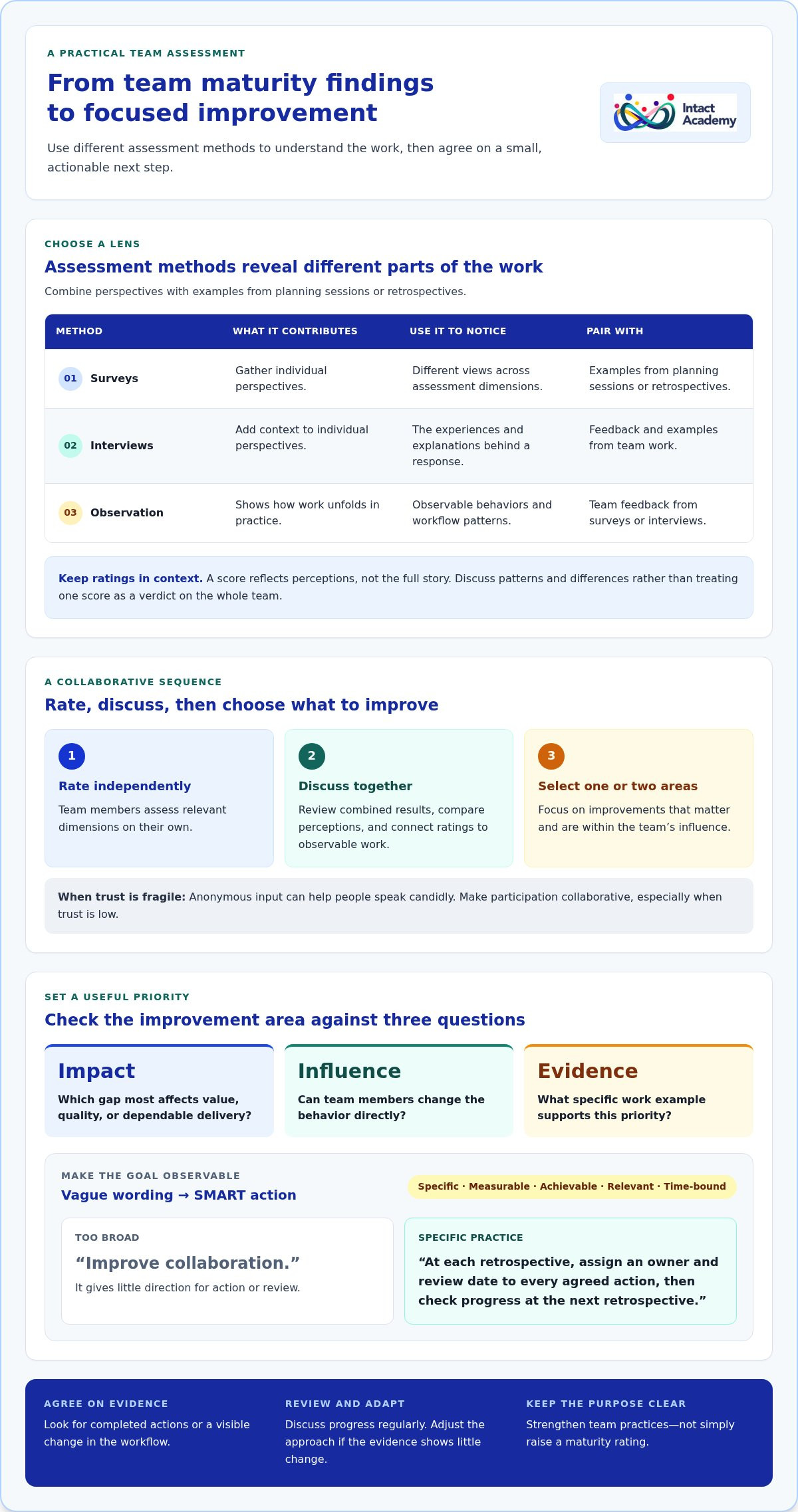
Surveys gather individual perspectives, interviews add context, and observation shows how work unfolds in practice. Team members can rate dimensions independently before discussing the combined results, helping surface different perceptions. Compare feedback with examples from planning sessions or retrospectives. Assess when the team needs a baseline, then revisit the questions when its work changes or an improvement goal is ready for review. If trust is low, an imposed assessment can undermine self-organization, so make participation collaborative.
Questionnaire Content
Ask about actions the team can see and influence: Does it prioritize backlog items by value? Does work flow predictably from idea to done? Are problems raised early, and does anything change after a retrospective? These questions connect ratings to practice instead of personality. Use clear behavior descriptions for each level, then compare independent responses. A score of 1 for prioritization might describe many unplanned items; a score of 2 for estimation might mean sprint work is estimated accurately, but not forecast several sprints ahead. Interpret results by dimension, not as a verdict on the whole team. Focus on patterns, discuss differences, and select measures the team can act on. Avoid false precision: a rating can reflect perceptions, not the full context behind them.
Selecting improvement areas and setting SMART goals
When assessing team maturity, treat each finding as a possible direction, not a demand to fix every weakness. Choose one or two improvement areas that matter to the work and are within the team’s influence. For example, if retrospective actions repeatedly go unfinished, clearer ownership and follow-through may be a useful focus.
Compare possible priorities with the team’s responsibilities and constraints. A challenge may affect the team but depend on decisions beyond its control. Distinguish practices the team can change from wider organizational barriers. Then identify a small experiment to try, while making those larger constraints visible to the people who can address them.
- Impact: Which gap most affects value, quality, or dependable delivery?
- Influence: Can team members change the behavior directly?
- Evidence: What specific work example supports this priority?
Turn the selected area into a SMART goal: specific, measurable, achievable, relevant, and time-bound. “Improve collaboration” gives little direction. A clearer goal might be: “At each retrospective, assign an owner and review date to every agreed action, then check progress at the next retrospective.” This makes it easier to see whether ownership is clear and follow-through is discussed.
Before starting, agree on what evidence would indicate progress. It might be completed actions or a visible change in the workflow. Don’t make a higher maturity rating the sole measure of success. The purpose of assessing team maturity is to strengthen practices, not polish a score. If progress depends on wider systems, organizational change work can help connect team learning with its surrounding conditions.
Review the goal in regular team conversations. If the evidence shows little progress, consider whether the action is realistic, responsibilities are understood, or external constraints remain. Adjust the approach as the team learns, while keeping the improvement area in focus.
Team dynamics, trust, and collaboration
Assess interaction patterns as well as work practices. Consider early problem-solving, shared decision-making, trust, and how openly the team handles disagreement. These criteria help show whether collaboration supports the work.
Stages of Team Maturity
Tuckman’s model describes team development through forming, storming, norming, performing, and adjourning. These stages offer a lens for understanding changing relationships, not a fixed scorecard. A team may revisit earlier dynamics when responsibilities shift or new members join. Context matters: disagreement can signal unresolved expectations, while respectful discussion can help members establish clearer ways of working.
- Forming: Members orient themselves and clarify roles, purpose, and expectations.
- Storming: Differences or competing assumptions become visible; the team needs constructive ways to address them.
- Norming: Members build shared agreements and more consistent collaboration.
- Performing: The team coordinates effectively, adapts, and works toward shared outcomes.
- Adjourning: The group closes or transitions, making reflection and knowledge-sharing useful.
Use these descriptions to prompt inquiry, not to label people. If a team avoids raising problems, for example, explore what makes speaking up difficult before assigning a maturity level.
Assessment Criteria
Team maturity criteria describe observable behaviors that shape collaboration, trust, and shared responsibility. They help teams identify patterns beneath outcomes. Include whether members surface problems early, consult one another before decisions, share information, and follow through on agreements. A level 0 example is individuals making decisions in silos without consulting teammates. That behavior points to a specific opportunity for more inclusive coordination.
- Trust and openness: Can members raise concerns and discuss disagreements directly?
- Shared responsibility: Are decisions and commitments understood across the team?
- Learning: Does reflection lead to changes in how the team works?
- Capacity: Do leaders recognize when overload contributes to friction or weaker outcomes?
Self-awareness matters, too. Leaders can reflect on the assumptions shaping their responses, while team members can examine how misperceptions affect trust. Effective delegation depends on trust in both directions: clear expectations and follow-up points, coaching when useful, and room for colleagues to do their work. Discuss these criteria using specific examples rather than treating a rating as a judgment of character.
What are the stages of team maturity, such as Tuckman's model?
Tuckman’s model describes how group relationships develop, while maturity scales assess behaviors across selected dimensions. The distinction matters: a team can experience changing dynamics without needing the highest rating in every area.
Forming, storming, norming, performing, and adjourning offer a lens for interpreting transitions, not a fixed ladder. A new project or shifting responsibilities can bring old tensions back into view. Use the stage names to discuss what the team is experiencing, then connect that conversation to observable behaviors, such as how members make decisions or raise concerns.
Other maturity models may use numbered levels to describe how consistently a team demonstrates specific practices. Anchor each level in behavior. For example, describe what shared decision-making looks like at each level instead of calling a team “advanced” or “immature.” The same team may show different patterns across different dimensions.
- Collaboration: Are decisions made together or in silos?
- Workflow: Does work move predictably from idea to completion?
- Learning: Do retrospective insights lead to visible changes?
- Value: Does the team prioritize work by its contribution?
Interpret ratings dimension by dimension. Teams don’t necessarily need to reach Level 5 in every assessment dimension. A lower rating can identify a useful focus, while a higher rating can show a strength worth sustaining. Discuss differences between ratings with examples from current work, rather than collapsing every result into one overall label.
Use the model to explore what the team needs next. If members are clarifying roles, make expectations more explicit. If collaboration is strained, discuss how people handle concerns and disagreements. If practices are working well, protect the conditions that support them. This turns a stage or score into a conversation about action, not a verdict on capability.
For leaders connecting team development with wider organizational shifts, explore organizational change support as a way to work with the broader conditions shaping collaboration.
Intact Academy: TA EMCC Senior Practitioner academy
Intact Academy’s TA EMCC Senior Practitioner academy supports professionals developing their coaching practice. If an assessment reveals recurring patterns in communication, decision-making, or team development, deeper coaching skills can help you work thoughtfully with those dynamics.
For those focused specifically on team development, Intact Academy’s TA EMCC Senior Team Coach Academy is a relevant next step. The TA EMCC Senior Supervisor academy and Executive Coaching offer other professional development paths, depending on your role and focus. Each can deepen reflection on the human systems behind team goals and collaboration.
If you’d like to explore these learning options, visit intactacademy.com.
Let the next conversation create momentum
A meaningful shift may begin with a different kind of conversation. Instead of asking who is performing well or poorly, invite the team to explore what conditions help people contribute with clarity and confidence. This can make room for perspectives that routine status meetings often miss.
As you continue assessing team maturity, treat curiosity as a leadership practice. Notice whose experience shapes decisions, whose concerns go unspoken, and what assumptions influence the team’s shared story. These observations can inform how you lead, not just what the team measures. A fuller understanding grows through honest reflection and sustained attention.
If you want to develop your capacity to support that work, contact Intact Academy to discuss team maturity. A thoughtful next conversation can help you clarify what your team needs and how you want to contribute. Progress begins with attention, and your next step can be taken with care.
Frequently Asked Questions
Who should take part, and should the ratings be anonymous?
The people doing the day-to-day work should shape the assessment. A manager or facilitator can support the conversation, but shouldn’t replace the team’s experience with their own judgment. Use anonymous responses when people may fear consequences for speaking candidly. If the team can discuss differences safely, named examples can make follow-up clearer. When trust is strained, address safety before introducing ratings.
What is team maturity and how is it defined?
Team maturity is a team’s developing capacity to coordinate, adapt, and learn together. It is defined through agreed behaviors, not tenure, seniority, or one successful delivery. For example, a group that responds to changing priorities by clarifying impacts and reorganizing work demonstrates adaptive capacity. Define maturity in relation to the team’s purpose, since reliable practices vary across roles and working contexts.
How can a team improve its maturity after an assessment?
Turn a finding into a shared experiment with an owner, a practical action, and a point to reflect on what happened. If handoffs create delays, for example, the team could clarify what information each handoff needs and discuss the effect at its next review. Invite members to raise obstacles as they arise. If progress stalls, revisit the conditions around the behavior rather than blaming individuals.
How often should organizations assess team maturity?
Assess when the team needs a baseline, then revisit the questions when its work changes or an improvement goal is ready for review.

Article by
Drs. Sari van Poelje
Sari van Poelje is an international master executive and team coach, supervisor and expert in agile business innovation. She has 40 years of experience. She is Managing Director of Intact Academy. The academy offers EMCC level 7 accredited training to coaches and consultants in 10 countries. She was also a director in multinationals such as Shell, EMI Music, KLM and ASML for 23 years.
Sari works with multinationals, family businesses and start-ups in a wide range of industries. She coaches leadership teams to create inspiring leadership, cooperative cultures and agile innovation processes.
She is an accredited EMCC Master Coach, Master Team Coach and Master Supervisor. She holds an MSc in systemic team coaching and an MSc in supervision. She is a Teaching and Supervising Transactional Analyst (TSTA-O) and a PCM coach trainer. She has published 34 articles and 5 books on leadership, coaching and organisational change.


