

Connection isn’t a by-product of working online; teams need to create the conditions for it. Team coaching for remote teams gives colleagues structured space to notice communication patterns, address strain, and agree on practices that support well-being and shared responsibility. This matters because distance can make disconnection and misunderstandings harder to spot until they affect trust, participation, and decisions.
Tools and meeting schedules matter, but strong collaboration also depends on how people experience working together. Practical ways to nurture that human foundation include shared agreements, intentional rituals, peer coaching, and virtual meetings that support equitable participation. Leaders can make the work more focused and reflective, helping remote teams build connection without separating well-being from performance.
Key Takeaways
- Create shared agreements and simple team rituals to make expectations clear and connection more intentional.
- Use peer coaching and recurring team reflection to help colleagues learn from one another and notice patterns in how they work together.
- Make virtual meetings more equitable by varying how people contribute and inviting input from quieter voices.
- Design remote coaching sessions with clear expectations, focused agendas, and space for reflection so teams can turn insight into action.
2. Team agreements and intentional virtual rituals
Start team coaching by agreeing on a shared purpose, gathering the team’s needs, and choosing a recurring session format. Set participation norms, check how the team is doing, and review what changes after each session. This gives coaching a clear structure while leaving room for honest conversation.
Begin each coaching session with a two-minute mood check. Invite participants to rate their energy on a scale from 0 to 5, then add a word about what is shaping that rating. Treat the scale as a conversation prompt, not a diagnosis. A low score may open discussion about workload, unclear priorities, or isolation. A high score may reveal conditions the team should preserve. Ask what would make participation easier today.
Turn observations into shared agreements. Decide how quickly colleagues should respond, how they can signal they need support, and what to do when messages are missed. For example, agree to flag urgent requests clearly rather than expecting everyone to monitor every channel. Keep the agreements somewhere all members can find them, and revisit them when work patterns or team needs change.
Use connection rituals to make contact purposeful rather than performative. Send a weekly alignment message that names priorities and asks where coordination is needed. Hold regular learning reflections on what helped or hindered collaboration. Rotate personal check-ins so different members can share what matters beyond task updates. Celebrate milestones by recognizing the contributions behind the result, not just the result itself.
Short check-ins can complement deeper coaching conversations. Schedule 15-minute check-ins for team members to surface concerns, share progress, or ask for help. Keep the purpose visible, so the meeting doesn’t become another status report. In team coaching for remote teams, consistency matters more than a crowded calendar: choose rituals the group can sustain, then use feedback to adjust them. A ritual builds connection when people can participate meaningfully, even across time zones.
3. Building a coaching culture through peer and team coaching
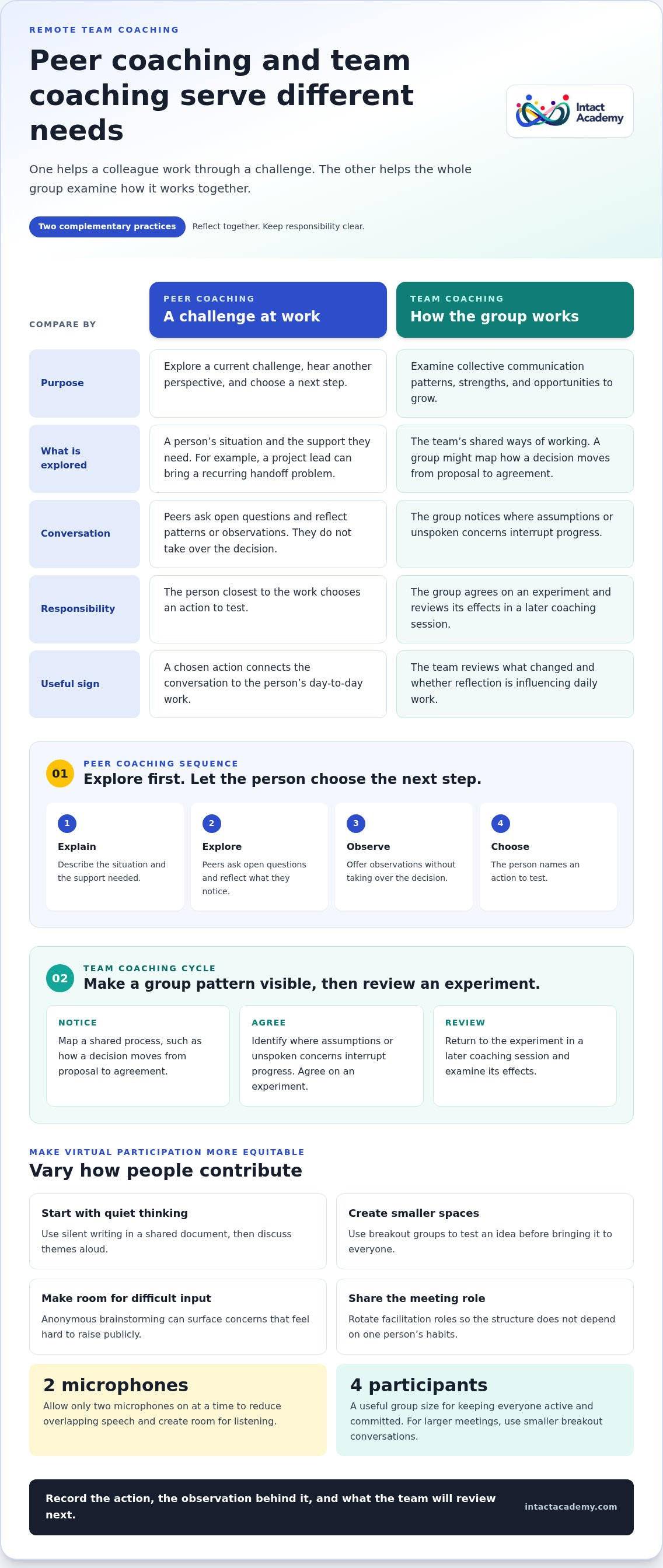
A coaching culture makes reflection part of how the team works, not an occasional event. Remote colleagues can use peer coaching to explore a current challenge, hear another perspective, and choose a next step. For example, a project lead might bring a recurring handoff problem to a peer group. The group first explores what each person observes, then considers possible solutions.
Give peer conversations a clear sequence. The person bringing a challenge explains the situation and what support they need. Peers ask open questions, reflect patterns they notice, and offer observations without taking over the decision. The person then names an action to test. This structure supports shared learning while keeping responsibility with the person closest to the work.
Leaders can reinforce the same approach by acting as coaches. Instead of immediately offering answers, a manager might ask, “What options have you considered?” or “Whose perspective is missing?” These prompts encourage more reflective decisions. Skill-building cohorts can also help distributed colleagues practise listening, giving feedback, and responding to disagreement through shared work scenarios.
Team coaching has a different purpose from peer coaching: it helps the group examine its collective communication patterns, strengths, and opportunities to grow. A team might map how a decision moves from proposal to agreement, then notice where assumptions or unspoken concerns interrupt progress. The group can agree on an experiment and review its effects in a later coaching session.
Keep learning visible. After a peer session or team coaching conversation, record the chosen action, the observation that prompted it, and what the team will review next. Look for clearer communication, stronger collaboration, and more direct discussion of emerging tensions. These signs show whether reflection is influencing daily work. Teams seeking to develop this practice can explore reflective team coaching practice as a way to deepen shared learning.
Equitable participation in virtual meetings
A virtual meeting link alone doesn’t guarantee equal access. Fast-moving discussions can favor people who speak quickly, while quieter colleagues or those joining across cultures may need more time. A facilitator can support psychological safety by inviting input without putting anyone on the spot. For example, ask each person to share an observation before the group settles on a decision.
Vary how people contribute. Begin with silent writing in a shared document, then invite participants to discuss themes aloud. Breakout groups give colleagues space to test an idea before sharing it with everyone. Anonymous brainstorming can surface concerns that feel difficult to raise publicly. Rotate facilitation roles, too, so the meeting structure doesn’t depend on one person’s habits.
Agree on practical norms together. Define how people request the floor, use chat, share documents, and signal disagreement. Set expectations for response times and for communication across time zones. Cultural awareness matters because norms around directness, feedback, tone, and conflict vary. Ask, “What helps you contribute when you disagree?” and include the answers in the team’s working agreements.
Structure affects who gets heard. One practice for a remote coaching session is to allow only two microphones on at a time. This can reduce overlapping speech and create room for listening. Four participants can be a useful group size for keeping everyone active and committed. For larger meetings, use smaller breakout conversations before bringing insights back to the full group.
After each meeting, assess the quality of participation, not just attendance. Notice who spoke, whose ideas shaped the decision, and whether people could disagree openly. Compare participation across meetings, then adjust facilitation if the same voices dominate. Clearer communication, stronger decisions, creativity, and open dialogue can all indicate progress. These observations help the team improve its process without assuming silence means agreement.
4. What are the best team coaching methods for remote teams?
Choose methods that fit the team’s challenge, time zones, and decision needs. Keep remote coaching sessions within 90 minutes, and plan 50 minutes of focused work. Use the remaining time for opening, transitions, and reflection. This structure gives the group room to think without turning a coaching session into an extended online meeting.
Make preparation part of the method. Email the agenda two or three days ahead, naming the purpose and any reflection participants should bring. For a workshop, divide the work into three phases of 20 minutes: explore the issue, identify patterns, then agree on experiments. Finish five minutes early so participants can capture one insight and one next step before leaving.
Keep the group small enough for meaningful exchange. Remote coaching groups should generally contain no more than 5-6 people. When ideas need time to mature, use asynchronous brainstorming in a shared document. Colleagues can contribute across time zones, then use the live session to examine themes. Make space for one-to-one conversations with every team member, especially when individual context may shape the group’s work.
Clarify how decisions will be made. State who makes the final decision, when feedback is needed, how alignment will be communicated, and what success means. These agreements can reduce bottlenecks without requiring everyone to attend every discussion. Digital reflection prompts, team pulse surveys, strength-based assessments, and relationship-mapping exercises can help identify where attention is needed.
Set expectations that are specific, transparent, and predictable. For example, explain whether a session aims to surface perspectives, resolve a tension, or commit to an action. During discussion, invite evidence and questions before conclusions. This helps leaders understand the team’s situation rather than decide from assumptions. To strengthen your facilitation practice, explore team coaching development.
Intact Academy: TA EMCC Senior Practitioner academy
Intact Academy’s TA EMCC Senior Practitioner academy supports professionals who want to deepen their coaching practice. For practitioners focused on remote team dynamics, the TA EMCC Senior Team Coach Academy develops team coaching capability. These learning paths may suit coaches and consultants who want to bring greater structure to group reflection, shared learning, and organizational change.
Consider this next step when your work calls for more than facilitation techniques alone. A coaching approach asks you to attend to relationships, patterns, and the conditions shaping team interaction. Intact Academy also offers Executive Coaching, Team Coaching, and the TA EMCC Senior Supervisor academy.
Contact Intact Academy to explore the learning or coaching path that best fits your work.
Turn shared insight into a lasting practice
Connection grows when a team learns from its own experience. Choose one pattern to explore, make space for honest reflection, and build the next conversation on what the team discovers. Over time, team coaching for remote teams can become part of how colleagues understand their relationships and shape their work together, rather than a separate activity.
If you’re ready to deepen your coaching practice, consider how your next step could align with the teams you support. Intact Academy offers the TA EMCC Senior Practitioner academy, TA EMCC Senior Team Coach Academy, and TA EMCC Senior Supervisor academy. Each offers a distinct path for professional development in coaching and supervision.
Explore the options or contact Intact Academy to discuss your learning direction. A thoughtful next step can help you bring greater intention to the work and support teams as they build more genuine connection.
Frequently Asked Questions
What is virtual team well-being coaching and why does it matter?
Virtual team well-being coaching is a guided online process for exploring how people experience work together. It helps a group notice pressures affecting trust, focus, or collaboration, then consider practical changes. For example, if project updates routinely arrive after decisions are made, the team can examine the communication pattern and its impact. This connects well-being with the conditions shaping everyday work.
What’s the biggest mistake organizations make with virtual team well-being?
A common mistake is treating well-being as an individual responsibility while overlooking team conditions. Advice about personal resilience won’t resolve recurring friction caused by unclear roles or conflicting priorities. If several colleagues describe the same obstacle, examine the shared work pattern rather than expecting each person to adapt alone. This helps leaders address a systemic issue instead of treating its effects separately.
What is team coaching for remote teams?
Team coaching for remote teams is a facilitated process in which colleagues examine how they work together and choose changes as a group. Unlike individual coaching, it focuses on the team’s relationships, shared goals, and collective patterns. For instance, a distributed product team might explore how design and engineering interpret a launch deadline differently, then agree on what it means before planning the next release.
What benefits does team coaching offer remote teams?
Team coaching can help remote colleagues build shared understanding, address misunderstandings, and learn from their collective experience. One practical benefit is making hidden assumptions discussable before they disrupt work. For example, a team preparing a client handover can clarify what “ready” means across functions. The group can coordinate with greater clarity and carry its learning into future projects.
How do you choose a remote team coach or coaching program?
Choose a coaching format that fits the team’s challenge, time zones, and decision needs. Look for clear expectations, focused agendas, reflection, and opportunities for peer or team coaching, with one-to-one conversations where individual context matters.
How can you measure the effectiveness and ROI of remote team coaching?
Assess engagement, balanced meeting participation, communication clarity, decision quality, creativity, and open dialogue that reflects trust. Compare these changes with the coaching investment; the page reports an average return of seven times the original investment.

Article by
Drs. Sari van Poelje
Sari van Poelje is an international master executive and team coach, supervisor and expert in agile business innovation. She has 40 years of experience. She is Managing Director of Intact Academy. The academy offers EMCC level 7 accredited training to coaches and consultants in 10 countries. She was also a director in multinationals such as Shell, EMI Music, KLM and ASML for 23 years.
Sari works with multinationals, family businesses and start-ups in a wide range of industries. She coaches leadership teams to create inspiring leadership, cooperative cultures and agile innovation processes.
She is an accredited EMCC Master Coach, Master Team Coach and Master Supervisor. She holds an MSc in systemic team coaching and an MSc in supervision. She is a Teaching and Supervising Transactional Analyst (TSTA-O) and a PCM coach trainer. She has published 34 articles and 5 books on leadership, coaching and organisational change.


