

Team diagnostic tools turn individual feedback into a shared picture of how a team works. Members answer questions about their experience, and the results reveal patterns in the team’s strengths, development opportunities, and effectiveness. The value lies not in a score alone, but in what the team can understand and do with the findings.
It’s reasonable to want more than a general sense that something is working, or not. A structured assessment can make less visible dynamics easier to discuss and give team members a common starting point for reflection. This article explains how assessments gather feedback, how findings can guide development, and what a report can show about team effectiveness. It also shows how to distinguish an individual-focused assessment from one designed to examine the team as a whole.
Key Takeaways
- Choose an assessment that examines team dynamics and shared outcomes, rather than treating individual profiles as a complete picture of team effectiveness.
- Use feedback to identify strengths and development opportunities, then translate the findings into focused actions the team can practise.
- Compare team, sponsor, and stakeholder perspectives to notice where experiences align and where expectations may differ.
- Read a team profile as a structured prompt for discussion, not a verdict; connect its indicators to the real work and relationships of the team.
Individual-focused versus team-focused assessment
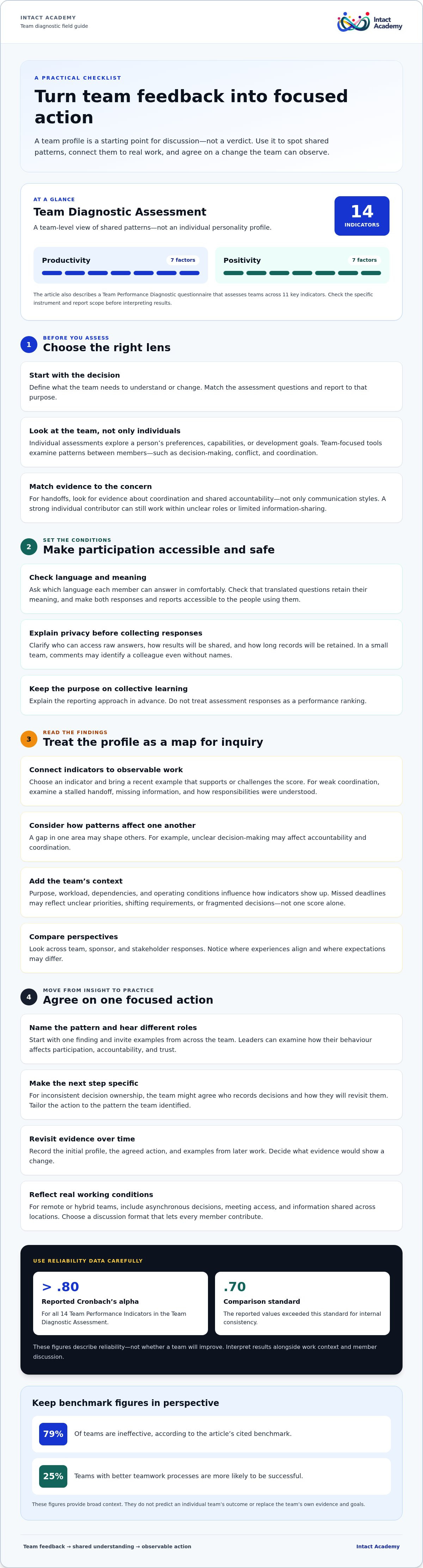
The best team diagnostic tools match the question an organization needs to answer. For example, the Team Diagnostic Assessment examines 14 indicators across seven productivity factors and seven positivity factors, creating a team-level view rather than an individual personality profile.
Individual assessments focus on a person’s preferences, capabilities, or development goals. Team-focused assessments examine patterns between members, such as how decisions are made, conflict is handled, and responsibilities are coordinated. A strong individual contributor may still face unclear roles or limited information-sharing within the group. The distinction matters: personal feedback can guide individual growth, while team feedback can reveal conditions that shape collective performance.
Choose a tool by defining the decision it should inform, then checking whether its questions and report address that decision. If the concern is handoffs, for instance, look for evidence about coordination and shared accountability, not just communication styles. Assessing a team as a dynamic system means examining interactions, expectations, and work practices together. Reports are most useful when they connect observed patterns to specific discussion points and actions, rather than presenting scores without context.
Language also shapes participation. Before using an assessment with a multilingual team, establish which language each member can answer in comfortably and whether translated questions retain their meaning. Consider both the language used for responses and the language of the report so findings remain accessible to the people expected to use them.
Address privacy before collecting responses. Clarify who can access raw answers, how results will be shared, and how long records will be retained. In a small team, comments may identify a colleague even without names. Explain the purpose and reporting approach in advance, and avoid treating assessment responses as a performance ranking. These steps help members respond thoughtfully and keep the focus on collective learning.
Team strengths and development opportunities
Team diagnostic tools differ in focus: some map relationships and communication, while others assess performance conditions and team climate. Choose according to the decision the team needs to make, such as improving handoffs or clarifying roles. Free access and trials depend on the provider’s model, so compare the feedback, reporting, and follow-up each option includes.
A useful assessment turns questionnaire responses into a clear account of team strengths and development opportunities. For example, a team might recognize open information-sharing as a strength, then identify inconsistent decision ownership as an area to develop. The report should connect each pattern to a practical next step, such as agreeing who records decisions and how the team revisits them.
Research and development matter because an instrument’s questions shape what a team can see. The Team Diagnostic Assessment’s internal consistency tests reported Cronbach’s alpha values above .80 for all 14 Team Performance Indicators, surpassing the .70 standard. These figures describe reliability, not whether a team will improve. Interpret results alongside work context and member discussion, rather than treating a measure as a complete explanation.
Team leaders can use feedback to examine how their behaviour affects participation, accountability, and trust. Start with one pattern from the report, then invite examples from different roles. If a leader sees that decisions are often reopened, the team can explore whether expectations, authority, or communication are unclear. A tailored action plan makes the insight observable in everyday work.
Remote and hybrid teams can use assessments when questions reflect their actual working conditions. Include examples about asynchronous decisions, meeting access, and information shared across locations. Then discuss findings in a format that lets every member contribute, not only those most vocal in live meetings. Leaders developing a more systemic response can explore support for organizational change.
Team profiles and effectiveness reporting
A team profile brings questionnaire results into a view of shared working patterns. The Team Performance Diagnostic questionnaire assesses teams across 11 key indicators. A report can show where indicators reinforce one another and where a gap in one area may shape others. For example, unclear decision-making may affect accountability and coordination. Read the profile as a map for inquiry, not a label for the team.
Effectiveness reporting is useful when it connects findings to observable work. Start with one indicator, then identify a recent example that supports or challenges the score. If a team reports weak coordination, examine a stalled handoff, what information was missing, and how responsibilities were understood. This makes abstract feedback concrete enough to discuss. The team can then choose an action and decide what evidence would show a change.
Reports need context, too. A team’s purpose, workload, dependencies, and operating conditions shape how indicators appear in practice. A profile should prompt questions about those conditions, not imply that one score explains performance. Missed deadlines, for instance, could reflect unclear priorities, shifting requirements, or fragmented decisions. Reviewing the surrounding work helps members distinguish a recurring team pattern from temporary pressure.
Benchmark figures can provide context, but they cannot diagnose a particular group. Seventy-nine percent of teams are ineffective. Teams with better teamwork processes are 25% more likely to be successful. These figures point to the relevance of team processes, not a prediction of an individual team’s outcome. Interpret them alongside the team’s own evidence and goals.
To monitor progress, record the initial profile, agreed action, and examples from later work. Revisit the same indicator after the team has put its action into practice. Compare patterns, not just scores: are decisions clearer, are handoffs smoother, or do members describe the same change? This creates a practical record of team effectiveness and helps the team refine its next step.
Team, sponsor, and stakeholder survey responses
Responses from team members, sponsors, and stakeholders offer different vantage points on the same work. Team members can describe daily coordination, while a sponsor may focus on priorities and delivery. A customer or partner may notice how reliably the team communicates across boundaries. For example, members might report timely decisions while a project sponsor experiences repeated delays. That difference points to a question to explore, not proof that one perspective is wrong.
Define the response groups before sending a survey. Ask team members about routines they experience directly, sponsors about outcomes and expectations, and stakeholders about the quality of collaboration. Keep questions tied to observable situations. “How clearly are decisions communicated?” invites more useful evidence than “Is this team effective?” A shared core question can help compare viewpoints, while role-specific prompts capture details each group can assess.
Interpret differences with care. If the team rates communication positively but a partner reports late updates, trace a recent handoff from decision to delivery. Identify who needed information, when it was needed, and where the message stalled. Then check whether the issue reflects a recurring process, a single event, or conflicting expectations. This turns contrasting responses into a practical discussion rather than a contest over whose account is correct.
Close the feedback loop by sharing themes, protecting individual responses, and naming an action owner. For example, the team could agree to send a concise status note after each milestone, while the sponsor clarifies which changes require escalation. Set a review point tied to that action, then ask the same groups whether updates became more timely and useful. If you facilitate these conversations, develop your systemic supervision practice to deepen reflection on group dynamics and professional relationships.
Intact Academy: TA EMCC Senior Practitioner academy
Intact Academy’s TA EMCC Senior Practitioner academy supports professionals who want to deepen their coaching practice. Team diagnostic findings can surface patterns, but turning them into meaningful development also calls for skilled reflection, dialogue, and attention to the wider system. This pathway may suit practitioners looking to strengthen how they work with feedback and change.
For coaches focused specifically on team development, the TA EMCC Senior Team Coach Academy offers a more directly relevant learning path. The TA EMCC Senior Supervisor academy may also interest practitioners seeking reflective support for their professional work. Each offers a distinct direction for developing practice, depending on the role and learning focus.
If you’re considering how to build your capacity to work with teams and assessment insights, visit intactacademy.com to explore the academy pathways.
Turn team insight into a deliberate next step
A team assessment can open a useful conversation, but its deeper value emerges when people keep learning from what they discover. Treat the findings as a starting point for reflection: notice how working relationships shape results, and choose development that supports change in the wider system. The right next step may be a focused conversation, continued team development, or deeper learning in your coaching practice.
For professionals seeking to build that practice, Intact Academy offers the TA EMCC Senior Practitioner academy, TA EMCC Senior Team Coach Academy, and TA EMCC Senior Supervisor academy. These pathways support different developmental interests, from practitioner growth to team coaching and supervision. If you’re considering how to support your team’s development, contact Intact Academy to discuss your team.
Use team diagnostic tools as an invitation to learn together, not as a final judgement. With curiosity and a clear next step, teams can turn feedback into more intentional ways of working.
Frequently Asked Questions
How does it work?
A team assessment gathers members’ responses to questions about their shared work. The process usually begins by defining the issue, such as recurring delays between departments. The team then answers relevant questions, reviews the resulting themes, and discusses what those patterns mean in practice. For instance, a team might examine how priorities are handed over before deciding what to change.
What are team diagnostic tools?
Team assessments are structured methods for examining how a group functions together. A questionnaire is one format; facilitated discussion or observation can also provide insight. Unlike an individual appraisal, a team diagnostic focuses on shared practices and relationships. A project group could use one to explore whether meeting decisions translate into clear responsibilities for the work that follows.
How do team assessment tools measure team effectiveness?
Team assessments examine factors connected to how a group works toward its purpose, then organize responses into patterns for discussion. Teams can compare perceptions with tangible evidence, such as whether a decision led to an agreed owner and completed work. Consider both the process and its consequences. A high score alone cannot show whether the team’s work meets the needs of those it serves.
How do you use a team diagnostic tool and interpret the results?
Begin with a specific aim, such as understanding why a new workflow feels difficult. Ask respondents to answer in relation to that shared context. When reviewing results, separate observed examples from assumptions about motives. If members describe different experiences, explore when each occurs before settling on an explanation. Then choose a practical experiment and notice what changes in daily work.
What are the prices of leading team diagnostic tools?
Pricing for leading team diagnostic tools varies widely based on features, team size, and provider. Many platforms charge a per-user subscription fee or a flat rate per assessment cycle, while comprehensive enterprise packages from organizations like Intact Academy often include custom facilitation, ongoing support, and advanced reporting features tailored to your specific development goals.

Article by
Drs. Sari van Poelje
Sari van Poelje is an international master executive and team coach, supervisor and expert in agile business innovation. She has 40 years of experience. She is Managing Director of Intact Academy. The academy offers EMCC level 7 accredited training to coaches and consultants in 10 countries. She was also a director in multinationals such as Shell, EMI Music, KLM and ASML for 23 years.
Sari works with multinationals, family businesses and start-ups in a wide range of industries. She coaches leadership teams to create inspiring leadership, cooperative cultures and agile innovation processes.
She is an accredited EMCC Master Coach, Master Team Coach and Master Supervisor. She holds an MSc in systemic team coaching and an MSc in supervision. She is a Teaching and Supervising Transactional Analyst (TSTA-O) and a PCM coach trainer. She has published 34 articles and 5 books on leadership, coaching and organisational change.


